Every crop a farmer grows draws on the same underlying asset: the soil. Fertilizers, sprays and good management all build on the foundation the soil provides, and where that foundation is degraded compacted, low in organic matter, or burdened with accumulated salts even generous feeding gives disappointing returns. Algreen Organohumos is a concentrated organic soil conditioner built to restore and improve that foundation, supplying humic and fulvic acids of plant origin along with organic matter and potassium. This guide explains what Organohumos is, how humic substances improve the soil, how and when to apply it, and why investing in soil health pays back across every crop that follows.
What is Algreen Organohumos?
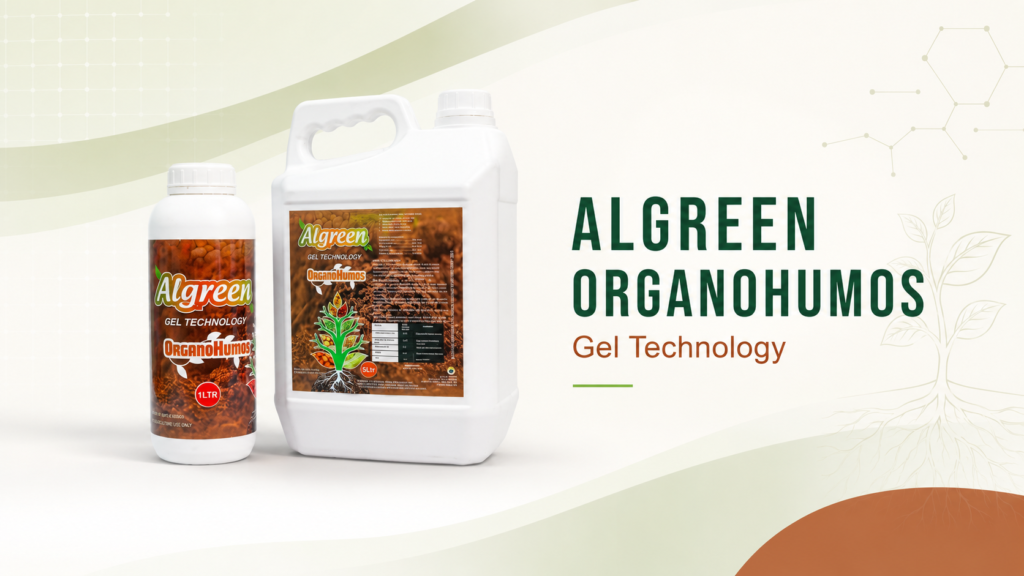
Algreen Organohumos is a highly concentrated organic-matter product supplying humic acid and fulvic acid from plant origin. Its analysis is Organic Matter 68.8% w/v, Total Humic Extract 26.7% w/v, Humic Acids 20.9% w/v, Fulvic Acids 5.8% w/v and Potassium Oxide (K2O) 4.5% w/v. Its stated purpose is to prevent the accumulation of salts and to improve the physical, chemical and biological properties of the soil. Unlike the foliar feeds in the range, Organohumos is fundamentally a soil product: its job is to improve the growing medium itself. It is available in 100 ml, 250 ml, 500 ml, 1 L, 5 L, 10 L and 20 L packs.
Quick facts
| Pack sizes | 100 ml, 250 ml, 500 ml, 1 L, 5 L, 10 L, 20 L |
| Standard rate | 6–12 litres per acre per season |
| Product type | Concentrated organic soil conditioner |
| Attribute | Detail |
| Main use | Improve soil structure and biology; prevent salt build-up |
| Composition | Organic Matter 68.8%, Total Humic Extract 26.7%, Humic Acids 20.9%, Fulvic Acids 5.8%, K2O 4.5% (w/v) |
| Best use | Season-long soil conditioning |
| Application method | Soil application |
What humic and fulvic acids are and how they work
Humic and fulvic acids are the stable, active fraction of well-decomposed organic matter the dark, fertile substances that give good soil its colour and much of its productivity. They are what remains after organic material has broken down fully, and they are remarkably active in the soil despite being stable.
Organohumos concentrates them from plant origin, so a relatively small application delivers the benefits of a large amount of well-rotted organic matter.
Humic acids are larger molecules that work mainly on soil structure and nutrient holding. They bind soil particles together into crumbs and aggregates, improving structure, aeration and water-holding, and they hold nutrients in a form the plant can access rather than letting them wash away.
Fulvic acids are smaller, more mobile molecules that work closely with the plant. They chelate minerals wrapping around nutrient ions and keeping them available and easy for the plant to take up and they can carry nutrients into the plant, improving nutrient uptake and use.
Together, the two fractions improve the soil on every front: physically through better structure, chemically through better nutrient holding and availability, and biologically by feeding and supporting the soil life that underpins fertility. The potassium in Organohumos adds a modest nutrient contribution alongside the conditioning effect.
The three ways Organohumos improves soil
The product’s stated benefit improving the physical, chemical and biological properties of the soil is worth unpacking, because these three dimensions cover everything that makes a soil productive.
| Property | How Organohumos helps |
| Physical | Binds particles into aggregates, improving structure, aeration, root penetration and water-holding |
| Chemical | Holds and releases nutrients, chelates minerals into available forms, buffers the soil, prevents salt build-up |
| Biological | Feeds and supports beneficial soil microbes and overall soil life |
The problem of salt accumulation
One specific benefit Organohumos offers is preventing the accumulation of salts, and this is a real and growing problem in intensively farmed and irrigated soils. Every time fertilizer is applied and every time irrigation water which always carries some dissolved salts is used, a little salt is left behind in the soil.
Over years of intensive cropping these salts build up, and a salty soil damages crops in two ways: it makes it physically harder for roots to take up water, mimicking drought even when the soil is moist, and at high levels it becomes directly toxic to roots.
The result is poor germination, stunted growth and declining yields that can be hard to diagnose. Humic substances help counter this by improving soil structure so that salts can be leached away more effectively, by buffering the soil, and by supporting the biological activity that helps maintain a healthy root zone. By preventing salt build-up, Organohumos protects the long-term productivity of the soil against one of the quieter threats to intensively managed land.
Signs your soil could benefit
| Sign | What it suggests |
| Hard, compacted, crusting soil | Poor structure needs conditioning |
| Poor water infiltration or waterlogging | Structural problems |
| Declining yields on long-cropped land | Depleted organic matter, possible salt build-up |
| White crust or patches on the surface | Salt accumulation |
| Poor response to fertilizer | Low organic matter and biological activity |
Key benefits of Algreen Organohumos
Better soil structure. Humic acids bind soil into aggregates, improving aeration, root penetration and water-holding.
Improved nutrient availability. Humic and fulvic acids hold nutrients and chelate minerals into forms the plant can readily use.
More active soil biology. Organic matter feeds and supports the beneficial microbes that drive fertility.
Prevents salt accumulation. It counters the salt build-up that degrades intensively farmed and irrigated soils.
Better use of other inputs. By improving the soil, it helps every fertilizer and every drop of water work more effectively.
Long-term productivity. It builds and maintains the soil health on which sustained yields depend.
How to use Algreen Organohumos
Organohumos is applied to the soil at a rate of 6–12 litres per acre per season, adjusted to the condition of the soil and the crop using the higher end for soils that are compacted, low in organic matter or affected by salt build-up. It can be applied through the irrigation system where one is used, or diluted and applied to the soil, so that it reaches the root zone where it does its work. Because it is a conditioner that acts on the soil over time rather than an instant crop treatment, it is best applied to build and maintain soil health across the season rather than as a quick fix.
Rate at a glance
| Soil condition | Suggested rate per acre per season |
| Maintenance on reasonable soil | 6–8 litres |
| Improving poorer or salt-affected soil | 8–12 litres |
Fitting soil conditioning into the programme
Because Organohumos works on the soil rather than directly on the crop’s stage-by-stage needs, it sits somewhat apart from the foliar feeds in a nutrition programme it is the foundation on which they build. A practical approach is to apply it as part of the season’s soil preparation and to maintain it through the season via irrigation, so that the soil is in good condition when the crop is establishing and stays that way as the crop grows.
The foliar feeds the starter, the growth feed, the flowering and fruiting products then address the crop’s changing needs above ground, while Organohumos keeps the root zone in the structural, chemical and biological health that lets the crop’s roots do their job. Seen this way, soil conditioning and foliar feeding are complementary halves of a complete programme: one builds and maintains the growing medium, the other feeds the crop growing in it.
Why investing in the soil pays back
It can be tempting to focus spending on inputs that give a visible, immediate crop response and to neglect the soil, whose condition changes slowly and quietly. But the soil is the asset on which every crop depends, and its condition sets a ceiling on what any amount of feeding can achieve.
A well-structured, biologically active soil rich in organic matter holds water better through dry spells, holds and releases nutrients more effectively, lets roots grow freely, and supports the soil life that makes nutrients available so every fertilizer application and every irrigation goes further.
A degraded soil does the opposite, wasting inputs and capping yields no matter how much is spent above ground. Investing in soil health through a product like Organohumos is therefore not a cost that competes with feeding the crop but one that increases the return on all the other inputs, and it does so cumulatively: improvements to soil structure, organic matter and biology built up over seasons compound into steadily better productivity.
For a farmer managing land for the long term, maintaining the soil is among the most fundamental and rewarding investments there is.
Humic substances and the wider soil ecosystem
It is worth appreciating that a soil is not merely a physical medium but a living ecosystem, teeming with bacteria, fungi and other organisms whose activity drives much of the soil’s fertility.
These organisms break down organic matter, release nutrients into forms plants can use, build soil structure through their activity, and form beneficial relationships with plant roots. Organic matter is their food and their habitat, so a soil rich in stable organic matter supports a larger, more active and more diverse soil community, while a soil depleted of organic matter starves it.
By supplying concentrated humic and fulvic substances, Organohumos feeds and supports this soil life, helping to restore the biological engine of fertility in soils that have been depleted by intensive cropping.
The benefits of a thriving soil biology are wide-ranging better nutrient cycling, improved structure, greater resilience and they reinforce the physical and chemical improvements the product brings. This biological dimension is often the least visible part of soil health, but it is among the most important, and it is one of the key reasons that building organic matter through a conditioner such as Organohumos has effects that reach well beyond what a straight fertilizer can achieve.
Tank mixing and compatibility
Organohumos is generally compatible with common products and humic substances often improve the performance of fertilizers applied with them, but do a jar test before combining it with an unfamiliar partner: mix the products in a jar of water in the intended proportions and check for curdling, clumping or separation before loading the tank. Add products one at a time with the agitator running, apply promptly, and keep mixtures simple.
Storage and safe handling
Store the product in its original sealed container in a cool, dry place out of direct sunlight and away from children, animals, food, seed and feed. Wear gloves and eye protection when handling and applying, and wash hands afterwards. Triple-rinse empty containers and dispose of them responsibly.
Troubleshooting and common mistakes
Expecting an instant crop response. Organohumos conditions the soil over time; think of it as a season-long and multi-season investment, not a quick fix.
Under-applying on poor soil. Use the higher end of the rate on compacted, depleted or salt-affected soils.
Neglecting crop feeding. Soil conditioning complements but does not replace feeding the crop; use it alongside the foliar range.
Ignoring the cause of salt build-up. Combine Organohumos with sensible irrigation and fertilizer practice to manage salts at the source.
Treating soil health as optional. The soil sets the ceiling on yield; maintaining it protects every other input.
Frequently asked questions
What is Organohumos used for? It conditions the soil with humic and fulvic acids, improving its physical, chemical and biological properties and preventing salt build-up.
How much do I apply? 6–12 litres per acre per season, depending on soil condition.
How is it applied? To the soil — through irrigation or diluted onto the soil — so it reaches the root zone.
Does it replace fertilizer? No — it improves the soil so that fertilizer works better; it complements crop feeding rather than replacing it.
When will I see results? It works over time; benefits to structure, biology and yield build through the season and across seasons.
Which soils benefit most? Compacted, depleted or salt-affected soils benefit most, though all soils gain from better organic matter and biology.
How humic substances improve fertilizer efficiency
One of the most practically valuable effects of humic and fulvic acids is the way they improve the efficiency of the fertilizers a farmer already uses. A significant portion of applied fertilizer can be lost before the crop ever uses it nitrogen can leach away or escape as gas, phosphorus can lock up into unavailable forms, and other nutrients can wash out of the root zone with rain or irrigation.
Humic substances reduce these losses in several ways. By improving soil structure and the soil’s capacity to hold nutrients, they keep applied nutrients in the root zone rather than letting them wash away. By chelating minerals, the fulvic fraction keeps nutrients in available forms and helps carry them into the plant.
And by supporting the soil biology that cycles nutrients, they help convert applied and native nutrients into forms the crop can use. The upshot is that a soil well supplied with humic substances gets more crop out of the same amount of fertilizer, because less is wasted and more reaches the plant. For a farmer, this means that investing in soil organic matter is partly self-financing: the improved efficiency of every subsequent fertilizer application helps offset the cost, while the crop benefits from more reliable nutrition. This efficiency effect is one of the clearest examples of how conditioning the soil pays back through better performance of the inputs applied to it.
Building soil health over the long term
Soil health is not built in a single season, and the most valuable results from a conditioner like Organohumos come from sustained, repeated use as part of ongoing soil management. Organic matter in the soil is constantly being consumed by soil organisms and, in warm climates especially, broken down quite rapidly, so it needs to be replenished regularly to maintain and build the soil’s reserves.
A single application improves the soil for a time; a consistent programme of applications, season after season, steadily raises the soil’s organic-matter content, structure and biological activity to a higher baseline that keeps paying dividends.
Combining Organohumos with other good soil practices returning crop residues rather than burning them, using organic manures where available, minimising unnecessary tillage that burns up organic matter, and rotating crops accelerates this improvement.
Over years, land managed this way becomes progressively easier to farm and more productive: it holds water better, needs less effort to work, responds better to fertilizer, and resists the degradation and salt build-up that afflict neglected soils.
Viewing Organohumos as one component of a long-term commitment to soil health, rather than a one-off input, is the way to unlock its full value and to leave the land in better condition than it was found.
Related Algreen products
Healthy soil makes every other input work better. These Algreen products feed the crop that healthy soil supports:
- Algreen Planta-P — phosphate starter feed with humic acid
- Algreen Supasense — balanced NPK crop nutrition
- Algreen Supa-K — potassium for fruit quality
- Algreen Hynitro 42 — nitrogen for vegetative growth
- Algreen Cytomone — hormones for rooting and vigour
This article is part of our complete guide: Algreen Foliar Fertilizers — The Complete Guide.
Pingback: Algreen Copagel-50 Liquid Copper - Solomon Agri
Pingback: Algreen Hynitro 42: Nitrogen 42% Foliar Fertilizer & How to Use It - Solomon Agri
Pingback: Algreen Majani Combi 2 Foliar Feed for Tea Growth & Taste - Solomon Agri
Pingback: Algreen Foliar Fertilizer: 10 Best Rates, Complete Guide - Solomon Agri