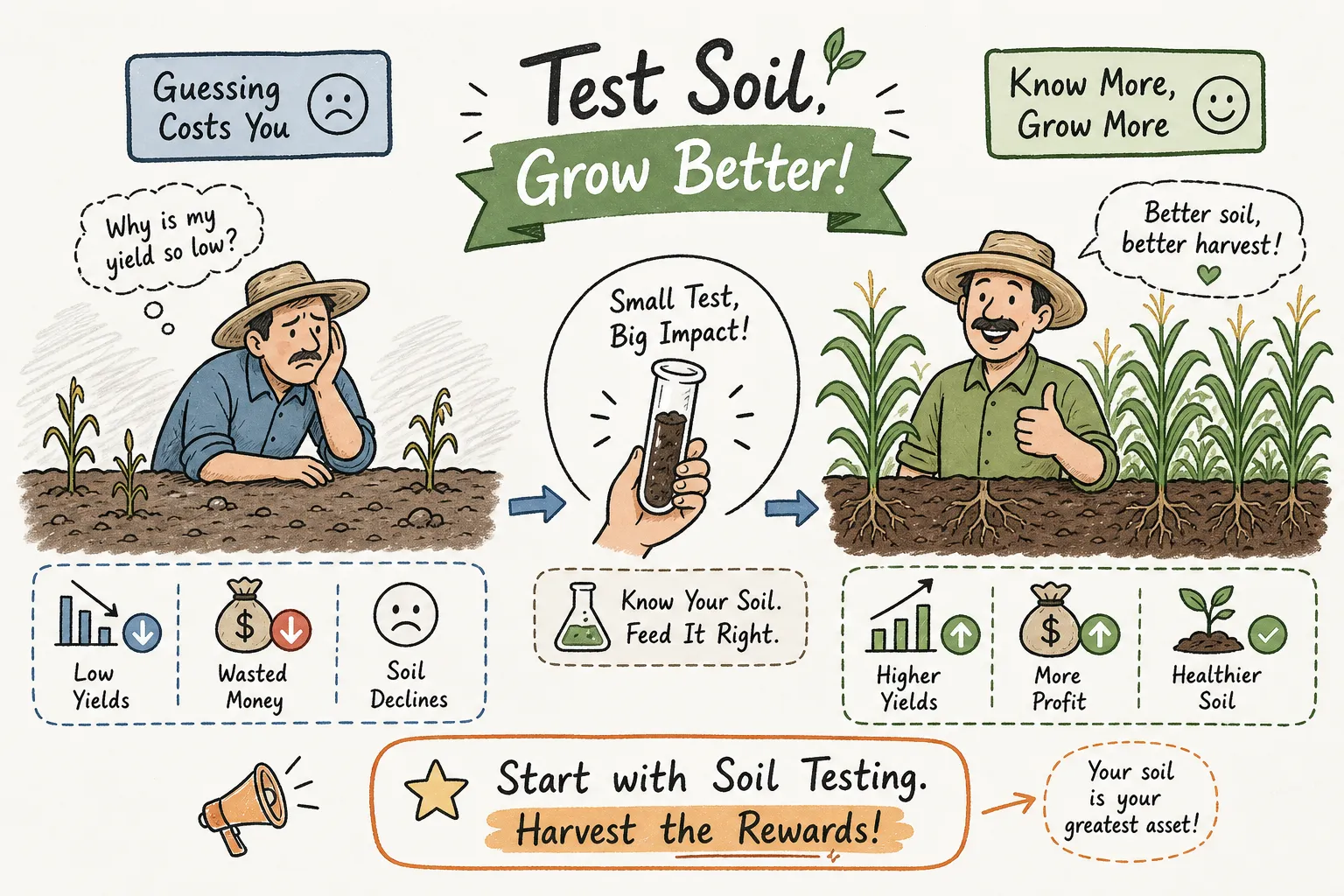
Soil Testing for Farmers is one of the most important steps in improving crop yields, reducing fertilizer waste, and making profitable farm decisions. Many growers apply fertilizer based on habit. or a neighbor’s recommendation rather than actual field data. A farmer buys two bags of DAP because that worked last year, broadcasts urea at the same rate as always, and then wonders why yields keep stalling. The problem isn’t the fertilizer. The problem is not knowing what the soil actually needs before reaching for an input.
Soil testing is the single most cost-effective decision a farmer can make before planting season. A basic soil fertility test typically costs less than a bag of fertilizer, check with your local extension office or search for a soil testing lab near me to compare pricing in your area, and it tells you whether that bag is even necessary, what it should contain, and how much to apply. Solomon Agri has made professional soil nutrient analysis accessible to smallholders and commercial growers across East Africa who want a clear, data-driven path to better yields.
This article walks you through the entire process: when to pull samples, how to collect them correctly, which tests to request, how to read a lab report, and how to turn those numbers into real fertilizer and lime decisions before the season starts.
What a soil test actually reveals about your land
pH and organic matter: the foundation of everything else
Why Every Farmer Needs a Soil Test. Soil pH is one of the primary controls on nutrient availability. Even when phosphorus is present in adequate amounts, a pH that is too low or too high can render it much less available to plant roots. Most crops perform best in the 6.0 to 7.5 range, with maize typically favoring 5.8 to 6.2 and soybeans performing well between 6.6 and 7.0. Vegetables generally hit their stride around 6.5. These two numbers alone justify testing before every new rotation.
Organic matter percentage tells you how much biological activity and natural nitrogen cycling your soil can support. Research from the University of Nebraska, Lincoln Extension shows that soils above 3% organic matter may release 60 to 70 lb of nitrogen per acre annually through natural decomposition, which directly reduces your fertilizer requirement. Soils below 1% organic matter contribute very little nitrogen on their own, meaning you’re carrying the full load through purchased inputs every single season.
N-P-K and the micronutrients most farmers overlook
Primary macronutrients, nitrogen, phosphorus, and potassium, are the obvious targets on any soil report. But yield problems that get blamed on “fertilizer failure” are often micronutrient deficiencies that no amount of NPK management can fix. Zinc, boron, and manganese directly affect fruit quality, pod fill, and marketable yield in cash crops and vegetables, and their deficiencies don’t show up visibly until significant yield loss has already occurred.
For vegetable growers and cash crop farmers targeting export quality, a test that stops at NPK leaves real money on the table. An expanded panel that adds calcium, magnesium, sulfur, zinc, boron, manganese, copper, and iron gives you the complete picture. Check local lab pricing for both options, the cost difference is often modest, while the difference in decision quality is significant.
CEC and what it says about your soil’s holding capacity
Cation exchange capacity (CEC) measures how well your soil holds onto nutrients rather than losing them to leaching. Sandy soils have low CEC, meaning nutrients move through quickly, split applications throughout the season are essential to avoid loss between fertilizations. Clay soils have high CEC and can hold nutrients longer between applications. A sandy field with low CEC, for example, benefits from applying nitrogen in two or three smaller doses rather than one heavy preplant application. Knowing your CEC directly changes how you time fertilizer applications and how aggressively you need to manage nitrogen in particular.
Soil testing for farmers: the right time to test and how often your farm needs it
Why late fall beats early spring for most farms
After harvest is the ideal window for soil sampling. Plant uptake has stopped, soil microbial activity has slowed, and the results give you enough lead time to act before spring planting. Lime needs at least six months to react in the soil, so fall sampling followed by immediate application means your pH correction is complete by the time you plant. Spring sampling done under urgency leaves no time to act on the results.
Consistency matters as much as timing. Sampling at the same time each year, under the same soil moisture conditions, is the only way to build a valid trend line and track whether your soil management program is actually working year over year.
How often to test based on your farming system
The right testing frequency depends on your system’s intensity. Standard row crops like corn-soybean rotations can be managed with soil health testing every three years. Intensive systems, sandy soils, or fields receiving heavy manure applications need annual testing because nutrient levels shift too quickly for a three-year window to capture. Problem fields showing variable yields or persistent pH issues should be tested annually until the issue is resolved and a clear trend is established.
How to pull a composite soil sample the right way
The 15, 20 core rule and what happens when you take fewer
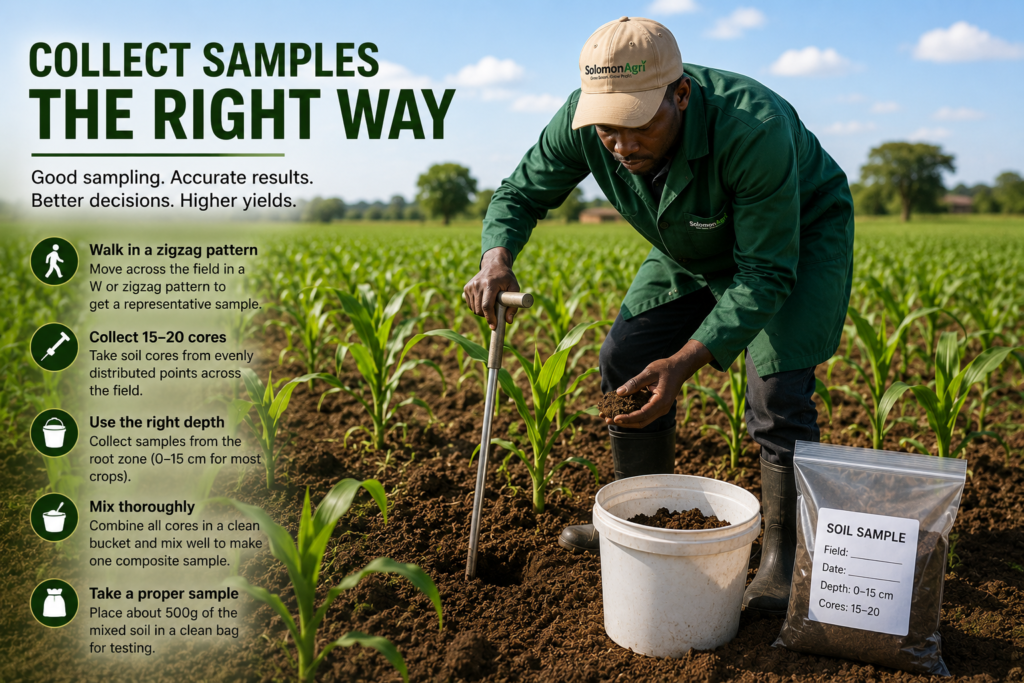
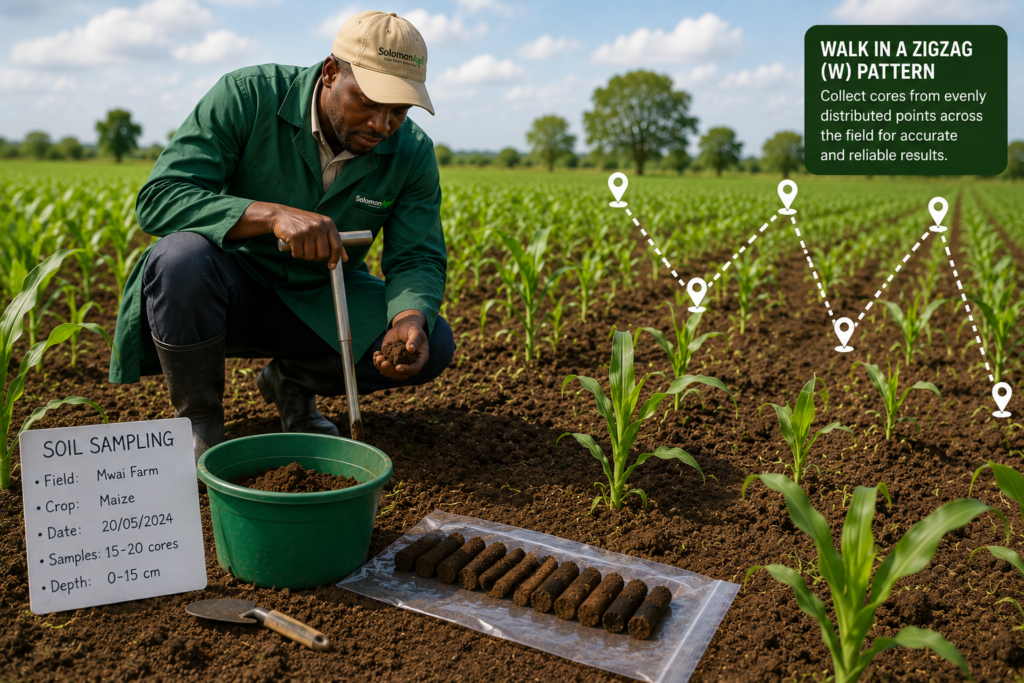
A composite soil sample is only as reliable as the number of cores it includes. Fewer than 10 cores introduces too much variability to trust the result. Following a sound soil sampling protocol, 15 to 20 cores per sample zone for most farm fields, gives you a result you can actually act on. Walk a W-pattern across the field and pull cores from evenly distributed points along that path. Convenience sampling near the field edge is one of the most common mistakes that leads to misleading results.
For smallholder plots under five acres, a single composite of 10 to 15 cores usually represents the field adequately when conditions are uniform. If one section of the field has visibly different soil color, texture, or drainage behavior, treat it as a separate sampling zone.
Depth, tools, and keeping samples clean
Standard sampling depth for most nutrient work is six inches. Going deeper or shallower shifts your reference point and makes year-over-year comparisons unreliable, so stick to six inches consistently. A soil probe gives cleaner, more uniform cores than a hand trowel, but either works if used carefully. One detail that trips up many farmers: use a clean plastic bucket for mixing your composite sample rather than a metal container, to avoid any risk of contamination that could skew micronutrient readings on the report.
Choosing the right test panel for your crop type
What the standard fertility package includes and when it’s enough
A basic soil analysis covers pH, phosphorus, potassium, and organic matter. For many field crops on soils without a known deficiency history, this gives you the minimum viable data to make a fertilizer decision. Standard packages, however, typically miss calcium, magnesium, sulfur, and CEC, all of which affect yield and input efficiency in ways that show up at harvest, not just on the lab report.
When to upgrade to an expanded micronutrient panel
Vegetable growers, cash crop farmers, and anyone growing export-quality produce need the expanded panel. Request pH, buffer pH if liming is likely, organic matter, phosphorus, potassium, calcium, magnesium, sulfur, CEC, EC, and micronutrients including zinc, boron, manganese, copper, and iron. That specific request covers everything a lab needs to generate precise, crop-specific recommendations rather than generic guidance.
Reading your lab report without getting lost in the numbers
What ppm, lb/acre, and percentage actually mean
Lab reports use several units that confuse farmers who don’t see them regularly. The most useful conversion to know: ppm multiplied by two gives lb/acre, and lb/acre divided by two gives ppm. Organic matter is reported as a percentage. Most labs classify results as Low, Medium, or High rather than publishing a single ideal number, because target values shift by crop, region, and extraction method.
Common target ranges and what they mean for your decisions
Most crops grow best in a pH range of 6.0 to 7.5. Zinc above 1.5 ppm by DTPA extraction is considered sufficient for most crops; below that level, supplementation pays. On organic matter, soils above 3% may allow you to reduce nitrogen inputs by 20 lb or more per acre; below 1%, plan on carrying the full nitrogen load through fertilizer. These are starting points for interpretation, not universal rules, local soil chemistry and crop-specific requirements adjust every one of these numbers in practice.
From results to fertilizer rates and lime decisions
The fertilizer rate calculation every farmer should know
The core formula is straightforward: divide the recommended nutrient amount by the nutrient fraction in the product. If the soil test calls for 60 lb of nitrogen per acre and you’re applying urea at 46-0-0, the calculation is 60 divided by 0.46, which gives you 130 lb of urea per acre. For phosphate, if the recommendation is 40 lb of P2O5 per acre and you’re using a 10-20-10 product, divide 40 by 0.20 to get 200 lb of product per acre. Running this calculation prevents both under-fertilization, which costs you yield, and over-fertilization, which wastes input money and contributes to environmental runoff. When applying, remember to factor in application timing and efficiency losses to get the most from these numbers.
How lime quality changes your application rate
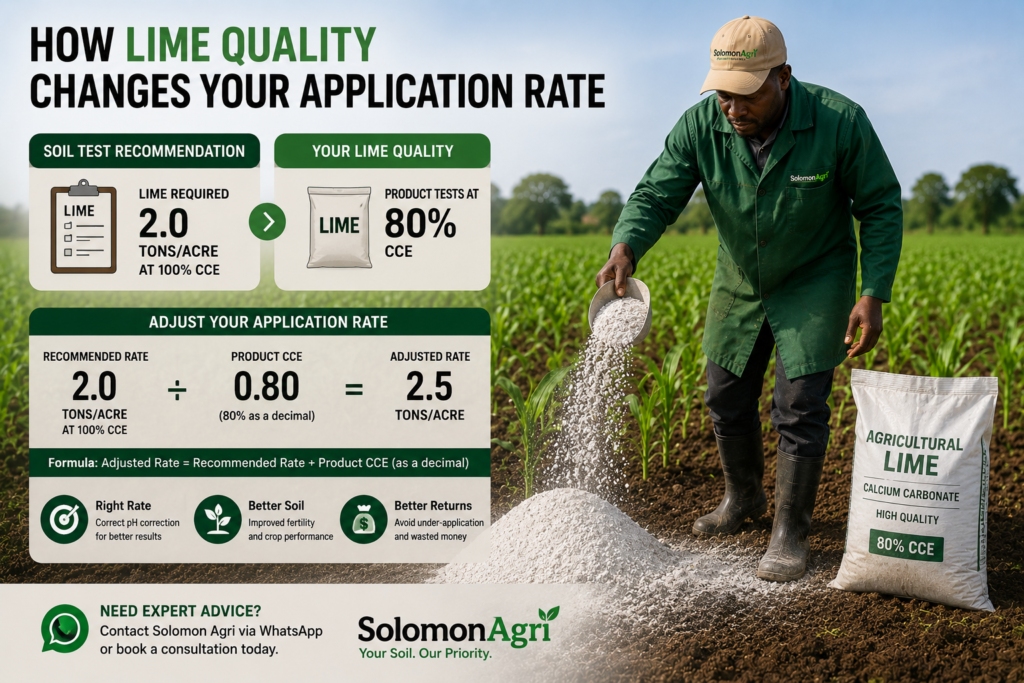
Lime is not all equal, and applying the wrong rate of a lower-quality product leaves your pH problem unsolved heading into the next season. If your soil test calls for two tons per acre of lime at 100% calcium carbonate equivalent (CCE) and your product tests at 80% CCE, you need to apply 2.5 tons to achieve the same neutralizing effect. The formula is straightforward: divide the recommended rate by the product’s CCE as a decimal. Two tons divided by 0.80 equals 2.5 tons per acre.
This is where professional advisory support pays off in real, measurable terms. Solomon Agri translates lab report numbers into specific, field-ready application plans, turning a soil report from a page of figures into a precise input plan for the season ahead. Contact Solomon Agri via WhatsApp or book a consultation directly to get started before your next planting window opens.
Start with a soil test and everything else gets easier
Soil health testing is not an advanced technique reserved for large commercial operations. It is the most practical decision a grower of any scale can make before the season starts. The steps are straightforward: test in late fall, follow a consistent soil sampling protocol of 15 to 20 cores per zone at six inches depth, request the right panel for your crop type, and use the results to calculate lime and fertilizer rates with real numbers instead of estimates.
Every acre you plant without a current soil test is an acre managed on assumption. Assumptions compound over seasons, driving up input costs and keeping yields stuck below what the land is actually capable of producing. The soil already has the answers. A soil fertility test is simply the most direct way to ask.
For farmers across East Africa ready to move from assumption to data, Soil analysis, agronomic interpretation, and customized farm planning are available to turn a lab report into a practical, season-ready management plan. Search for a soil testing lab near me to find local options, or reach out to Solomon Agri directly to get started.
FAQ 1
How often should farmers test their soil?
Most farmers should conduct soil testing every 2–3 years. Intensive vegetable production and sandy soils may require annual testing.
FAQ 2
What is the best time for soil testing?
The best time is after harvest and before the next planting season, allowing enough time for fertilizer and lime recommendations.
FAQ 3
How many soil samples should be collected?
Collect 15–20 cores from a uniform field area and combine them into one composite sample.
FAQ 4
Why is soil pH important?
Soil pH affects nutrient availability. Most crops perform best between pH 6.0 and 7.5.
FAQ 5
Can soil testing reduce fertilizer costs?
Yes. Soil testing identifies exactly which nutrients are needed, preventing unnecessary fertilizer purchases.
Pingback: Algreen Organohumos Humic & Fulvic Acid - Solomon Agri