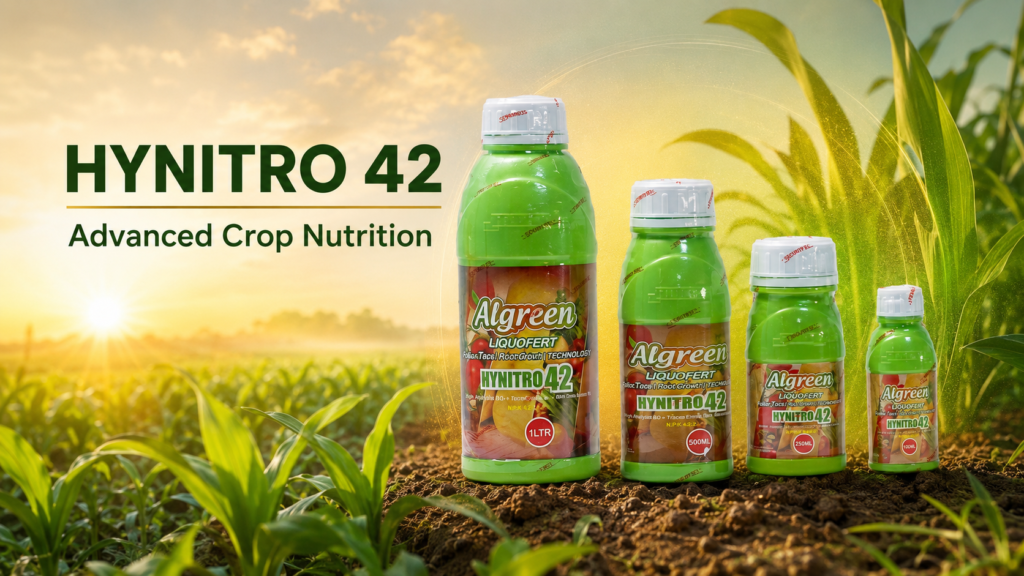
The size of a harvest is decided long before harvest day. A crop that builds a strong, leafy frame early in the season captures more sunlight, photosynthesises more, and has the capacity to carry a heavy yield later. Nitrogen is the nutrient that powers this vegetative growth, and Algreen Hynitro 42 is a concentrated nitrogen foliar fertilizer built to drive it, supplying 42% nitrogen together with humic acid, hormones, and trace elements. This guide explains what Hynitro 42 is, how nitrogen works in the plant, when and how to apply it, the crops it benefits most, and how to avoid the common pitfalls of nitrogen feeding.
What is Algreen Hynitro 42?
Algreen Hynitro 42 is a high-concentration nitrogen foliar fertilizer with an analysis of Nitrogen 42% plus 3% humic acid, stimulants and trace elements (TE). Its stated purpose is to deliver highly concentrated nitrogen with humic acid and hormones for increased size, height, tillering, branching and vigorous vegetative growth. It is a growth-stage product: the feed you use while the crop is building its structure. Hynitro 42 is available in 100 ml, 250 ml, 500 ml, 1 L, 5 L and 20 L packs.
Quick facts
| Attribute | Detail |
|---|---|
| Product type | Concentrated liquid nitrogen foliar fertilizer |
| Analysis | Nitrogen 42% + Humic Acid 3% + Stimulants + TE |
| Primary nutrient | Nitrogen (N) — 42% |
| Application method | Foliar spray |
| Standard rate | 40–50 ml per 20 litres of water |
| Pack sizes | 100 ml, 250 ml, 500 ml, 1 L, 5 L, 20 L |
| Main use | Vegetative growth, height, tillering, branching |
| Best stage | Vegetative growth phase |
Why nitrogen matters: the science in plain language
Nitrogen is the nutrient crops need in the largest quantity, and it is the master driver of vegetative growth. Its central role comes down to a few key functions.
Chlorophyll and photosynthesis. Nitrogen is a building block of chlorophyll, the green pigment that captures sunlight. A well-supplied crop has deep green leaves and an efficient photosynthetic factory; a nitrogen-short crop is pale and cannot capture energy effectively.
Protein and enzyme synthesis. Nitrogen is a component of every protein and enzyme in the plant. These proteins build new tissue and run the plant’s metabolism, so nitrogen supply sets the pace of growth.
Leaf and stem development. With ample nitrogen, the crop produces more and larger leaves, taller stems, and in cereals, more tillers, the side shoots that each carry a head of grain. In branching crops, it drives more branches, and therefore more potential fruiting sites.
Canopy and yield potential. All of this adds up to a larger canopy that intercepts more light and a bigger plant frame with more capacity to fill with yield. The role of humic acid in Hynitro 42 is to support this by improving nutrient uptake and root function, so the nitrogen is used efficiently.
Recognising nitrogen deficiency
Because nitrogen is mobile within the plant, deficiency shows first on the older, lower leaves, which the plant sacrifices to feed the growing tips.
| Symptom | What it looks like |
|---|---|
| General yellowing | Pale, uniformly yellow-green older leaves |
| Stunted growth | Slow, weak growth and a small plant frame |
| Thin canopy | Few, small leaves and limited ground cover |
| Poor tillering | Cereals producing few side shoots |
| Early leaf death | Lower leaves drying and dropping prematurely |
A foliar nitrogen feed such as Hynitro 42 corrects these symptoms quickly, greening the crop and restarting growth faster than a soil application would.
Key benefits of Algreen Hynitro 42
Vigorous vegetative growth. The high nitrogen concentration drives rapid, strong growth in leaves and stems.
Greater size and height. The crop builds a bigger, taller frame with more capacity to carry yield.
More tillering and branching. In cereals this means more grain-bearing shoots; in other crops, more fruiting sites.
Deeper green foliage. Healthy chlorophyll levels mean more efficient photosynthesis and a more productive canopy.
Fast correction of deficiency. Foliar delivery greens up a hungry crop quickly, restoring lost momentum.
Improved uptake through humic acid. The humic acid supports root activity and nutrient use, so the applied nitrogen works harder.
How to use Algreen Hynitro 42
The standard rate is 40–50 ml of Hynitro 42 per 20 litres of clean water, applied as a foliar spray. Apply during the vegetative growth stage, while the crop is actively building leaves, stems, and tillers, and repeat at your normal spray interval through that phase. Half-fill the tank, add the measured product, then top up with water while agitating for a uniform solution. Spray to cover the foliage evenly with a film that wets the leaf without running off, and apply in the early morning or late afternoon for the best uptake.
Dosage at a glance
| Water volume | Hynitro 42 (low rate) | Hynitro 42 (high rate) |
|---|---|---|
| 20 L (one knapsack) | 40 ml | 50 ml |
| 100 L | 200 ml | 250 ml |
| 200 L | 400 ml | 500 ml |
Crop-by-crop application guide
| Crop | When to apply | What it does |
|---|---|---|
| Maize | Early to mid vegetative stage | Vigorous growth, more tillers, taller plants |
| Wheat & barley | Tillering stage | More grain-bearing tillers, stronger canopy |
| Leafy vegetables (kale, spinach) | Through growth | Fast, lush leaf production |
| Tomatoes & capsicum | Vegetative stage before flowering | Strong plant frame to carry fruit |
| Tea & other leaf crops | Between harvests | Vigorous flush and leaf growth |
A simple seasonal nutrition calendar
Hynitro 42 leads during the first half of the crop’s life, then hands over to fruiting-stage products.
| Stage | Nutrition focus | Suggested Algreen product |
|---|---|---|
| Establishment | Roots and phosphorus | Planta-P |
| Vegetative growth | Nitrogen for size and tillering | Hynitro 42 |
| Flowering / fruit set | Micronutrients and calcium | Bonzin, Magical |
| Fruiting / grain filling | Potassium for quality | Supa-K |
Getting spray application right: water quality and technique
A foliar feed only works if it reaches and enters the leaf, so technique matters as much as the product. Use clean water of moderate pH, since very hard or silty water reduces effectiveness and clogs nozzles. Aim for a fine, even film over the leaf surface, wetting it without heavy run-off, and take care to reach the underside of the leaves where the stomata, the pores through which nutrients are absorbed, are most numerous.
A well-calibrated sprayer producing medium- to fine-sized droplets, moved at a steady pace, provides the most uniform coverage. Time applications for early morning or late afternoon, when the stomata are open, humidity is higher and the spray film lingers long enough for absorption. Avoid spraying in midday heat, in strong wind, or when rain is expected within a few hours, all of which waste product and reduce uptake.
How foliar nitrogen complements soil nutrition
Foliar nitrogen is a fast, efficient top-up rather than a total replacement for soil fertility. The crop takes up most of its nitrogen through the roots over the season, so a well-managed soil with adequate nitrogen is the foundation. Hynitro 42 comes into its own when demand spikes during rapid vegetative growth, when cold or dry soils slow root uptake, or when a quick green-up is needed to correct a visible shortfall. Applied on top of sound soil management, foliar nitrogen keeps growth moving through these periods so the crop never stalls, and the humic acid it carries improves the plant’s use of both applied and soil nutrients.
The danger of too much nitrogen at the wrong time
Nitrogen is powerful, and like all powerful tools, it can be misused. Applied in excess or too late in the season, nitrogen pushes the crop into continued leafy growth at the very time it should be switching its energy into flowering, fruiting or grain filling.
The result can be a tall, dark-green, lush crop that yields poorly all vine and no fruit because the plant has kept growing vegetatively instead of maturing. Excess nitrogen can also delay ripening, make the crop softer and more attractive to pests and diseases, and weaken stems so that a heavy crop lodges.
The discipline of nitrogen management is therefore about timing as much as quantity: feed generously during vegetative growth to build the frame, then ease off and switch to potassium and calcium as the crop moves into its reproductive stage. Used this way, Hynitro 42 builds the capacity for yield without tipping the crop into unproductive excess.
Understanding the label figures
The nitrogen figure on a fertilizer label tells you the percentage of nitrogen in the product, and at 42% Hynitro 42 is clearly a nitrogen-dominant, growth-stage feed. Nitrogen is expressed simply as N. The 3% humic acid is not a nutrient in the NPK sense but a soil-and-plant conditioner that improves uptake and root activity, while the trace elements and stimulants round out the formulation.
Reading these figures makes the product’s role obvious: a high nitrogen number signals a feed for the vegetative phase, when the crop is building leaves, stems and tillers, rather than for the fruiting phase, when potassium leads.
The economics of a strong start
Because the size of the canopy and the number of fruiting or grain-bearing sites are largely set during vegetative growth, this early stage has an outsized influence on final yield. A crop that starts strong has a higher ceiling for the rest of the season, while a crop that is checked by a nitrogen shortage early rarely catches up, no matter how well it is fed later. Investing in vigorous early growth is therefore one of the highest-return decisions a grower makes, and a foliar nitrogen feed is a practical way to ensure the crop never stalls during this critical window — especially in cool or wet conditions when soil nitrogen is slow to become available.
Tank mixing and compatibility
Hynitro 42 is generally compatible with common foliar products, but do a jar test before combining it with an unfamiliar partner: mix the products in a jar of water in the intended proportions and check for curdling, clumping or separation before loading the tank. Add products one at a time with the agitator running, spray tank mixes promptly, avoid strongly alkaline partners, and keep mixtures simple.
Storage and safe handling
Store Hynitro 42 in its original sealed container in a cool, dry place out of direct sunlight and away from children, animals, food, seed and feed. Wear gloves and eye protection when handling and spraying, and wash hands afterwards. Triple-rinse empty containers into the spray tank and dispose of them responsibly.
Troubleshooting and common mistakes
Feeding nitrogen too late. Late nitrogen delays maturity and pushes leafy growth over yield. Concentrate it in the vegetative stage.
Overdosing. Stay within 40–50 ml per 20 L to avoid scorch and excessive soft growth.
Ignoring the switch. Move to potassium and calcium as the crop flowers; do not keep pushing nitrogen.
Poor coverage. Calibrate the sprayer and cover the foliage evenly.
Spraying in the heat. Spray in the cooler hours for better uptake and less scorch.
Frequently asked questions
How do you use Algreen Hynitro 42? Mix 40–50 ml in 20 litres of water and spray on the foliage during the vegetative growth stage.
What is the application rate? 40–50 ml per 20 litres of water.
Which crops benefit most? Cereals needing tillering, leafy vegetables, and any crop needing a strong early vegetative frame.
Can I use it at fruiting? It is best used during vegetative growth; at fruiting, switch to a potassium feed to avoid excessive leafy growth.
Why does it contain humic acid? To improve nutrient uptake and root activity so the nitrogen is used more efficiently.
Can I mix it with other products? Generally yes, but do a jar test first with any unfamiliar partner.
The role of humic acid in Hynitro 42
One feature that sets Hynitro 42 apart from a plain nitrogen product is its 3% humic acid content. Humic acid is a stable fraction of natural organic matter, and it does several useful things when applied with a fertilizer. It improves the plant’s ability to take up and use nutrients, acting as a natural aid to absorption. It supports root development and root activity, which in turn helps the crop draw more water and nutrients from the soil.
And it has a buffering, conditioning effect that can improve how the plant copes with stress. In practical terms, the humic acid means that more of the applied nitrogen is actually used by the crop rather than lost, so the same amount of nitrogen delivers a better result. This pairing of a fast-acting nutrient with a natural uptake enhancer is part of what makes a concentrated foliar feed efficient.
Tillering and branching: building yield sites
For cereal growers, tillering deserves particular attention, because it is one of the main ways nitrogen turns into yield. A tiller is a side shoot that emerges from the base of a cereal plant, and each productive tiller can carry its own head of grain. A crop that tillers well effectively multiplies its yield potential from a single planted seed.
Nitrogen supply during the tillering stage strongly influences how many tillers form and survive, which is why a well-timed nitrogen feed at this point is so valuable in maize, wheat, and barley. In branching crops such as tomatoes, capsicum and many vegetables, the equivalent process is the production of side branches, each of which becomes a site for flowers and fruit.
In both cases, feeding nitrogen during the growth stage increases the number of productive sites the crop carries into flowering, and more sites mean a higher yield ceiling. This is the mechanism behind Hynitro 42’s stated benefits of increased tillering and branching.
Nitrogen, water and weather
Nitrogen management is closely tied to water and weather, and understanding this helps a grower use a foliar feed to best effect. In cool or waterlogged soils, the biological processes that release nitrogen and the root activity that takes it up both slow down, so a crop can look hungry even where soil nitrogen is present but simply unavailable.
A foliar feed sidesteps this by delivering nitrogen directly to the leaf, greening the crop while the soil and roots recover. In dry conditions, soil nitrogen becomes harder for roots to reach as the soil dries, and again a foliar application can bridge the gap. Because foliar feeding is fast and does not depend on soil moisture in the same way as a soil application, Hynitro 42 is a useful tool for keeping growth on track through the periods of difficult weather that would otherwise check a crop. As always, though, it works best alongside good water management, since a crop that is genuinely short of water cannot make full use of any nutrient.
Related Algreen products
Nitrogen drives early growth, but the crop’s needs change as the season progresses. These other Algreen products carry the crop through the later stages:
- Algreen Supa-K — potassium for the fruiting and grain-filling stage
- Algreen Supasense — balanced NPK maintenance feed
- Algreen Cytomone — hormones for deeper roots and faster growth
- Algreen Planta-P — phosphate starter feed for early roots
- Algreen Organohumos — soil conditioning to support nitrogen uptake
This article is part of our complete guide: Algreen Foliar Fertilizers — The Complete Guide.
Pingback: Algreen Planta-P: Slow-Release Phosphate Starter Fertilizer - Solomon Agri
Pingback: Algreen Majani Combi 2 Foliar Feed for Tea Growth & Taste - Solomon Agri
Pingback: Algreen Magical 1 Prevent Blossom End Rot - Solomon Agri
Pingback: Algreen Foliar Fertilizer: 10 Best Rates, Complete Guide - Solomon Agri
Pingback: Kenya Seed Company Maize Varieties: All 16 Compared by Zone and Yield Per Acre - Solomon Agri
Pingback: Algreen Gel Technology: Complete Guide to All 9 Products - Solomon Agri