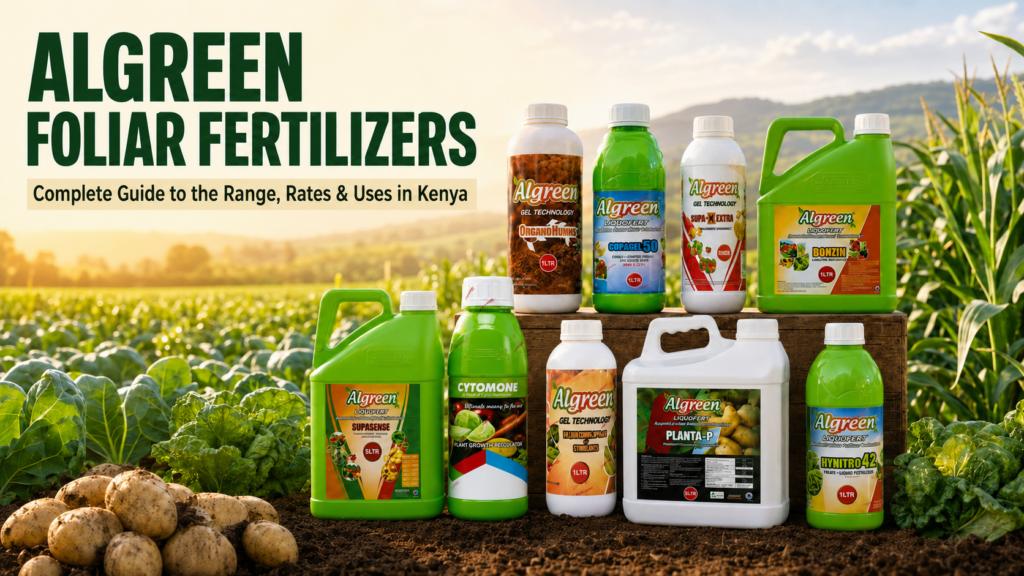
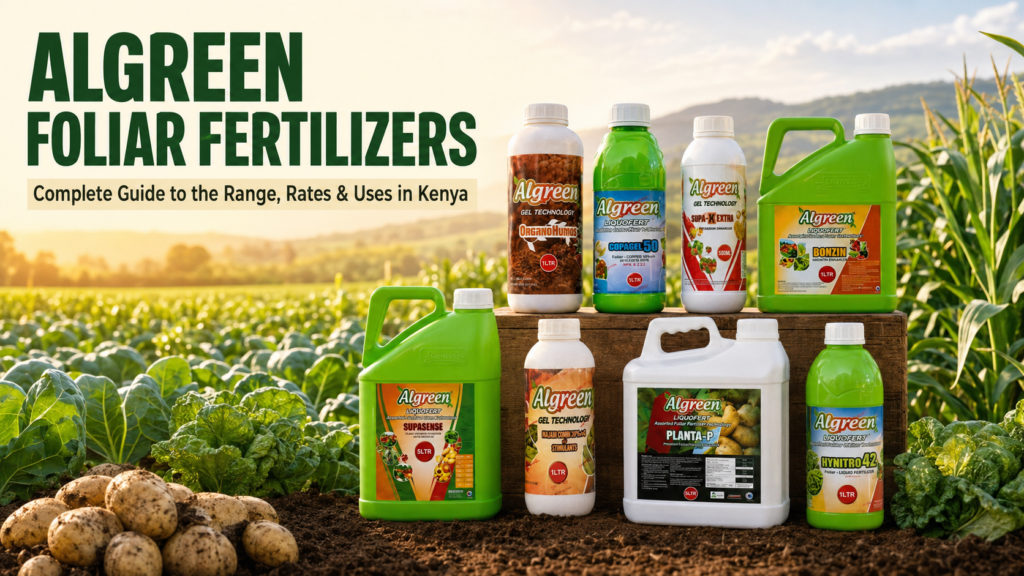
Algreen is a range of highly concentrated foliar fertilizers and crop stimulants used to boost growth, flowering, fruiting and yield, with each product built to target a specific need: nitrogen for vegetative growth, potassium for fruit filling, calcium to prevent blossom end rot, boron and zinc for flowering, and more.
Because they are absorbed directly through the leaf, Algreen feeds act fast, correcting shortages and supporting crops at the exact stages that decide the final harvest. This guide is the complete reference to the range: every product, what it does, how to mix it, which crops it suits, and how to use the whole system together.
Treat this as your hub. It gives the overview and the mixing rates at a glance, and each product links through to its own detailed guide for crop-by-crop timing, deficiency diagnosis, and fertigation use. Whether you are a smallholder with a knapsack or a commercial grower running injectors under greenhouse cover, the aim here is to help you match the right Algreen to the right need at the right moment.
Written by Solomon Muchori, Agronomist at Solomon Agri. Advisory services for farmers across East Africa. Last updated July 2026.
How foliar feeding works, in brief
Before the products, it helps to understand why feeding a crop through its leaves works at all. A plant absorbs a foliar spray through two routes: through the cuticle, the waxy outer skin of the leaf, and through the stomata, the tiny pores found mostly on the underside of the leaf. Dissolved nutrients diffuse through these pathways into the plant’s tissues, which is why a foliar feed reaches the crop far faster than a nutrient applied to the soil, where it must first be taken up by the roots and transported upward.
Speed is the headline advantage. Under good conditions, nutrients such as nitrogen, potassium, and magnesium are absorbed through the leaf within about 12 hours, and a visible response often follows within a few days. That makes foliar feeding the fastest way to correct a deficiency or support a crop through a demanding stage.
The limitation is quantity, since leaves can absorb only a fraction of a crop’s total demand, so foliar feeding supplements a sound soil fertility programme rather than replacing it. The Algreen range is designed around this reality: concentrated, targeted feeds for the moments when speed and precision matter most.
The Algreen range at a glance
The table below is your quick reference to the whole range, with the mixing rate for each product per 20-litre knapsack. Always shake concentrated products well before measuring, and confirm the rate on the actual product label, since formulations are occasionally updated.
| Product | Key nutrients | Best for | Rate per 20 L water |
|---|---|---|---|
| Algreen Supa-K | K 42% + trace elements + stimulant | Fruit size, sweetness, grain filling | 30 to 50 ml |
| Algreen Supasense | NPK 24:24:18 + TE + stimulant | Balanced feeding, heavy-yield crops | 20 to 30 ml |
| Algreen Hynitro 42 | Nitrogen 42% + humic acid + stimulants | Vegetative growth, height, tillering | 40 to 50 ml |
| Algreen Planta-P | NPK 15:45:5 + Fe + humic acid | Root development, starter feed | 50 to 60 ml |
| Algreen Magical | Ca 18%, N 8%, Mg 3%, B 1% | Blossom end rot, firm fruit | 20 to 50 ml |
| Algreen Bonzin | Zinc 10% + Boron 15% + stimulant | Flowering, prevents flower and fruit drop | 20 to 30 ml |
| Supa K Extra | Concentrated potassium blend | Growth, drought resistance, disease tolerance | 10 to 20 ml (crop-based) |
| Algreen Majani Combi | N 30% + S + stimulants | Tea production, leaf weight and taste | 60 to 80 ml |
| Cytomone | Auxins, cytokinins, gibberellins, tryptophan | Rooting, germination, flowering | 10 ml |
| Algreen Copagel-50 | Copper 50 g/L + stimulant | Bacterial spots and diseases, wheat and barley | 20 to 50 ml |
| Organohumos | Humic and fulvic acids, organic matter | Soil health, salt reduction | 6 to 12 L per acre |
The Algreen product range in detail
Each product below solves a particular problem. Read across the range to see how they fit together, then follow the link on any product to its full guide.
Algreen Supa-K
Algreen Supa-K is a high-potassium foliar feed (K 42%) with trace elements and hormones, made for all fruiting crops. Potassium is the quality nutrient. It does not build the plant’s structure the way nitrogen and phosphorus do.
Instead, it regulates the movement of sugars from the leaves into the fruit, controls water balance, and governs the processes that decide fruit size, colour, sweetness, firmness, and shelf life. This is why a crop can grow well on nitrogen and still disappoint at harvest if it ran short of potassium during fruiting.
Supa-K supplies that potassium at the fruiting and grain-filling stages when demand peaks, improving fruit size, colour, sweetness, storage life, and grain fill in cereals. It is best applied from the onset of flowering through fruit development. For the full crop-by-crop programme, see the dedicated Algreen Supa-K guide.
Algreen Supasense
Algreen Supasense is a balanced NPK 24:24:18 formula with trace elements and a growth stimulant, giving complete nutrition in a single feed. The balanced ratio makes it a dependable all-crop product during the main growth phase, supplying nitrogen for leaf and stem growth, phosphorus for roots and energy, and potassium for the transition toward fruiting, all at once. It is ideal for heavy-feeding, high-yield crops such as tomatoes, capsicum, potatoes, onions, and watermelon during their demanding stages.
Supasense is the backbone of a foliar programme, carrying the crop through vegetative growth and into early flowering before more targeted feeds take over for specific needs. The dedicated Algreen Supasense guide covers exact rates and timing for each crop, and its use in fertigation.
Algreen Hynitro 42
Algreen Hynitro 42 is a concentrated nitrogen feed (42%) with humic acid and hormones, the highest-nitrogen product in the range. Nitrogen is the engine of vegetative growth, a core building block of the amino acids, proteins, and chlorophyll a plant needs to grow. Hynitro 42 drives vigorous vegetative growth, greater height, stronger tillering, and better branching, and it corrects nitrogen deficiency quickly because the nutrient enters the leaf within hours.
It is best used during the vegetative stage, before flowering, and eased off as the crop moves into fruiting so that growth turns into yield rather than just more leaf. See the Algreen Hynitro 42 guide for the full programme and deficiency signs to watch for.
Algreen Planta-P
Algreen Planta-P is a high-phosphorus starter feed (NPK 15:45:5) with iron and humic acid, built on a slow-release polyphosphate. Phosphorus powers energy transfer through ATP and drives early root development, which makes it most valuable in the young stages of a crop when the root system is forming. Its high phosphorus content and slow-release form make it an ideal starter feed for strong early root growth and establishment.
Phosphorus is often locked up in Kenyan soils by the wrong pH, so feeding it through the leaf sidesteps that lock-up and gets the nutrient into the crop when the roots most need it. See the Algreen Planta-P guide for full details on rooting and establishment.
Algreen Magical
Algreen Magical is rich in calcium (18%), nitrogen (8%), and magnesium (3%) with trace boron (1%), formulated to prevent blossom end rot and fruit rots for firmer, better-storing fruit. Blossom end rot is not a disease but a calcium disorder, caused by a localised calcium shortage in the developing fruit. Because calcium moves poorly within the plant and travels with water, the disorder is closely tied to steady watering as well as calcium supply.
Magical delivers calcium at the fruiting stage to support the fruit cell walls whose breakdown causes the rot, and works best applied from fruit set alongside consistent irrigation. See the Algreen Magical guide for the full prevention programme, including the watering steps that matter as much as the spray.
Algreen Bonzin
Algreen Bonzin is a zinc (10%) and boron (15%) blend with a stimulant that boosts flower formation and prevents flower abortion and fruit drop. Boron is essential for flower formation, pollination, and fruit set, while zinc supports the enzyme and hormone systems behind healthy flowering. When either is short, a crop may flower heavily but drop many flowers before they set fruit.
Bonzin is timed to just before and during flowering, because boron is immobile in the plant and cannot be moved to the flowers later. See the Algreen Bonzin guide for crop-specific timing and the narrow safety margin boron requires.
Supa K Extra
Supa K Extra is a concentrated potassium fertilizer that speeds growth, strengthens roots, improves drought resistance, and supports flowering and fruit set. Beyond its role in fruit quality, potassium regulates the opening and closing of the stomata and manages the plant’s water balance, which is what underpins drought and stress tolerance. This makes a concentrated potassium feed valuable not only at fruiting but also as support through dry spells and stress.
Its rate is lower and crop-dependent (10 to 20 ml per 20 L), reflecting its concentration, so match it carefully to the crop and follow the label.
Algreen Majani Combi
Algreen Majani Combi is a tea-specific formulation (N 30% with sulphur and stimulants) that increases leaf growth, weight, and taste. Tea is a leaf-harvested crop, plucked repeatedly through the season, so it has a high and continuous nitrogen demand, and its nutrition is closely linked to the flavour chemistry of the leaf. Majani Combi is built around these needs, supporting vigorous flush, heavier plucking, and better-quality made tea.
It is applied through the growing and plucking season at 60 to 80 ml per 20 L. See the Algreen Majani Combi guide for the full tea programme.
Cytomone
Cytomone is a blend of plant hormones (auxins, cytokinins, gibberellins, and tryptophan) that promotes fast, deep rooting, uniform germination and flowering, larger fruit, and longer green life. Unlike the nutrient feeds, Cytomone supplies growth signals rather than nutrition, working with the plant’s own systems to direct how it grows and sets fruit. Auxins drive rooting and fruit set, cytokinins stimulate cell division and delay leaf ageing, and gibberellins support growth and fruit size.
Because hormones act in tiny amounts, Cytomone is used at a low rate (around 10 ml per 20 L) and precise dosing matters. See the Cytomone guide, and note how it pairs with Supasense in a complete programme.
Algreen Copagel-50
Algreen Copagel-50 is a soluble liquid copper (50 g per litre) with a stimulant that prevents bacterial spots and diseases, with particular value in wheat and barley. Copper works as a protectant, releasing copper ions that disrupt the enzymes and membranes of fungal spores and bacterial cells on the leaf surface before they can infect. This makes it a preventive tool, applied ahead of disease pressure rather than as a cure, and its gel form helps the copper cling to the leaf and resist wash-off.
Unlike the nutrient feeds, Copagel-50 is a foliar-applied protectant by design, since it must coat the leaf to protect it. See the Algreen Copagel-50 guide for disease targets and application timing.
Organohumos
Organohumos is a concentrated source of humic and fulvic acids and organic matter that improves soil structure, prevents salt build-up, and enhances soil biology. Humic acid improves soil structure and nutrient holding, while fulvic acid chelates nutrients and helps carry them into the plant, together improving root growth and the efficiency of every other input you apply. On the tired, continuously cropped soils common across Kenya, it is a long-term tool for rebuilding soil health.
Unlike the foliar feeds, Organohumos is applied to the soil or through fertigation at 6 to 12 litres per acre, reaching the root zone where it does its work. See the Organohumos guide for full details.
How to mix and apply Algreen foliar feeds
Getting the mixing and application right is what turns a good product into a good result. The steps below apply across the range.
- Shake the concentrate well. Many Algreen products are viscous gels or concentrates, so mix the container before measuring to get an even dose.
- Half-fill the tank first. Fill your knapsack roughly half with clean water, add the measured product, then top up and agitate. Products disperse far better in a larger volume of water.
- Mind your water. Aim for a slightly acidic to neutral spray water, around pH 5.5 to 7.0. Hard water high in bicarbonates reduces the availability of foliar nutrients.
- Cover both leaf surfaces. Because many stomata sit on the underside of the leaf, spray tops and undersides for the best uptake. Aim for even coverage to just before run-off, wetting the leaf well but not to dripping.
- Spray in the cool of the day. Apply in the early morning or late afternoon, when it is cooler, humidity is higher, and the stomata are open. Avoid the hot midday sun, which evaporates the spray before the plant can absorb it and can scorch the leaf.
- Leave a dry window. Check the forecast, since rain within about four hours of spraying can wash a significant part of the nutrients off before uptake. A sticker or spreader helps the solution cling on waxy leaves such as maize.
- Match the feed to the stage. Use nitrogen feeds during vegetative growth, boron and zinc at flowering, calcium at fruit set, and potassium during fruit fill, so the nutrient you apply is the one the crop needs at that moment.
Building a complete Algreen programme by growth stage
The real power of the range is using the products together, each at its stage. This table shows the pattern most fruiting crops follow. Adjust it to your crop and a soil test.
| Growth stage | Main need | Algreen product |
|---|---|---|
| Establishment and early roots | Phosphorus for rooting | Planta-P, with Cytomone for root stimulation |
| Vegetative growth | Nitrogen for leaf and stem | Hynitro 42 or Supasense |
| Pre-flowering | Boron and zinc for flower formation | Bonzin |
| Flowering and fruit set | Balanced nutrition and calcium | Supasense, Magical, Cytomone for fruit set |
| Fruit development and fill | Potassium for size and quality | Supa-K or Supa K Extra |
| Disease pressure | Copper protection | Copagel-50 (sprayed) |
| Throughout, at the roots | Soil health and uptake | Organohumos (soil or fertigation) |
This staged approach ensures each nutrient arrives when it delivers the most value, which is far more effective than applying a single product throughout the season.
How to choose the right Algreen for your situation
With eleven products, the range can feel like a lot to navigate. In practice, the choice comes down to answering one question: what does the crop need right now? Use this decision guide.
If the crop needs to grow bigger and greener, it needs nitrogen. Reach for Hynitro 42 for a strong vegetative push, or Supasense if you want balanced nutrition alongside the nitrogen. Signs the crop needs this include slow growth, pale or yellowing older leaves, and thin stems.
If you are establishing a young crop or transplant, it needs phosphorus for roots. Reach for Planta-P, ideally with Cytomone to stimulate rooting. This is the starter combination for the first weeks of a crop’s life.
If the crop is flowering or about to flower, it needs boron and zinc. Reach for Bonzin, timed just before and during flowering. Signs you need this include poor fruit set and flowers or young fruits dropping off.
If the crop is carrying and filling fruit, it needs potassium. Reach for Supa-K, or Supa K Extra where you also want drought and stress support. This is what delivers size, sweetness, colour, and shelf life.
If tomatoes or peppers are developing dark, sunken patches at the base of the fruit, that is blossom end rot, a calcium disorder. Reach for Magical, and fix any irregular watering at the same time.
If bacterial spots or disease are appearing, especially in wheat and barley, reach for Copagel-50 as a protective copper spray, applied before disease pressure builds.
If your soil is tired, hard, or salty, it needs conditioning. Reach for Organohumos, applied to the soil or through fertigation to rebuild structure and biology over time.
If you grow tea, use Majani Combi, the tea-specific feed, through the plucking season.
When more than one need overlaps, that is where a staged programme comes in, which is covered in the next section. And when you are unsure what the crop actually needs, a soil test and an agronomist’s eye are worth far more than guesswork.
Which Algreen for which crop: quick reference
This table gives a starting point for common Kenyan crops. It is a guide, not a rigid prescription, and should be adjusted to your soil test and growing conditions.
| Crop | Key Algreen products through the season |
|---|---|
| Maize | Planta-P at planting, Hynitro 42 for vegetative growth, Supa-K for grain fill |
| Tomatoes | Planta-P and Cytomone early, Supasense in growth, Bonzin at flowering, Magical at fruit set, Supa-K for fruit fill |
| Potatoes | Planta-P early, Supasense in growth, Supa-K at tuber fill |
| Onions | Supasense through leaf and bulb development, Supa-K toward bulbing |
| Capsicum and peppers | Supasense, Bonzin at flowering, Magical for fruit, Supa-K for quality |
| Watermelon and cucurbits | Supasense in vine growth, Bonzin at flowering, Supa-K for fruit size and sweetness |
| French beans and legumes | Planta-P early, Bonzin at flowering, Supa-K for pod fill |
| Wheat and barley | Hynitro 42 for tillering, Copagel-50 for disease, Supa-K for grain fill |
| Tea | Majani Combi through the plucking season |
| All crops, at the roots | Organohumos to build soil health |
Can Algreen be used in fertigation?
Yes. The Algreen liquid feeds can be injected into drip irrigation systems to deliver nutrition to the root zone through the water, a practice used on commercial horticulture and floriculture farms in Kenya, including greenhouse operations around Naivasha.
The nutrient feeds such as Supasense, Supa-K, Hynitro 42, and Planta-P suit fertigation well, and Organohumos is especially suited to it as a root-zone conditioner. Boron, zinc, and calcium feeds are often better timed as foliar sprays for precision, and the copper protectant Copagel-50 is foliar only, since it must coat the leaf to protect it.
When fertigating, flush the lines with plain water afterward to prevent residue clogging emitters, and keep calcium products separate from phosphate feeds to avoid precipitates that block the system. The dedicated fertigation guide covers this in full.
What Algreen foliar feeding cannot do
Being honest about the limits is what makes the rest of this guide trustworthy. Foliar feeding is a supplement to a sound soil fertility programme, not a replacement for it. Leaves cannot absorb the large quantities of nitrogen, phosphorus, and potassium a crop needs, so your base nutrition must come from soil-applied fertilizer or fertigation, with Algreen supplementing it at the critical stages.
Foliar feeding also cannot reverse a severe deficiency on its own, cannot work well when the crop is under severe drought stress, and cannot fix soil problems such as compaction, waterlogging, or a pH that is locking nutrients away. Where the crop keeps struggling despite feeding, the answer is a soil test and attention to the root environment, not more spraying. For a full discussion, see the guide on the disadvantages of foliar feeding.
Frequently asked questions
What is Algreen used for? Algreen foliar fertilizers feed crops through the leaves to correct deficiencies and boost growth, flowering, fruiting, and yield, with a specific product for each need. The range covers nitrogen for vegetative growth, potassium for fruit filling, calcium to prevent blossom end rot, boron and zinc for flowering, copper for disease, and humic and fulvic acids for soil health.
How do I apply Algreen foliar feed? Mix the recommended rate into 20 litres of water, shake concentrated products first, and spray evenly onto the foliage covering both leaf surfaces to just before run-off. Apply in the early morning or late afternoon, avoid the midday heat, and repeat at the crop’s spray interval.
Which Algreen is best for maize? Hynitro 42 for vegetative growth and Supa-K for grain filling are the common choices, with Supasense as a balanced feed through the season. Match the product to the growth stage rather than using one product throughout.
What is the best time to apply foliar fertilizer? Early morning before about 10 a.m. or late afternoon after 4 p.m., when it is cool, humidity is higher, and the leaf pores are open, which improves absorption and reduces evaporation. Avoid the hot midday sun, which dries the spray before the plant can absorb it and can scorch leaves. Some research even favours late-evening application, because residues stay liquid for longer overnight, extending the absorption window.
Which foliar has the highest nitrogen? Among the Algreen range, Hynitro 42 has the highest nitrogen content at 42 percent, combined with humic acid and hormones, which makes it the go-to feed for fast vegetative growth. Majani Combi carries 30 percent nitrogen but is formulated specifically for tea.
What are the disadvantages of foliar feeding? The main limitations are that leaves cannot absorb enough of the major nutrients to meet a crop’s full demand, that stronger sprays used to compensate risk burning the foliage, that results depend heavily on weather and timing, and that only about 15 to 20 percent of what is sprayed actually enters the leaf. Immobile nutrients such as calcium do not redistribute well within the plant. Foliar feeding is best as a targeted supplement, not a primary nutrition method.
How long does it take for foliar fertilizer to work? Nutrients such as nitrogen, potassium, and magnesium are absorbed through the leaf within about 12 hours under good conditions, and a visible response such as greener, stronger growth usually appears within 2 to 5 days. Other nutrients may take several days of wetting and rewetting to be absorbed fully. No fertilizer produces results within hours, so any claim of an overnight fix is a warning sign.
Can Algreen replace my soil fertilizer such as DAP and CAN? No. Foliar feeding supplies only a fraction of a crop’s total nutrient demand, so soil-applied fertilizer or fertigation must provide the base nutrition, with Algreen supplementing it at peak-demand stages.
Can I mix different Algreen products in one tank? Some combinations work, but run a jar test first in your own water and check for separation, gelling, or colour change before spraying. Keep calcium products such as Magical separate from phosphate feeds, and when unsure, apply separately.
Get a nutrition programme built for your farm
Choosing the right Algreen product is easier when it is matched to your crop, your soil, and your season. Solomon Agri provides soil testing, crop nutrition planning, and farm advisory services for farmers across East Africa. Book a consultation or reach an agronomist on WhatsApp for a foliar and soil programme tailored to your farm.
Note: product specifications are as provided by the manufacturer and may be updated over time. Always confirm current rates, timing, and directions on the actual Algreen product label before use, and seek local agronomic advice for your crop and conditions.