Cytomone is used in agriculture as a foliar plant growth hormone that speeds up rooting, triggers germination, promotes uniform flowering, increases fruit and tuber size, and keeps crops green for longer. Algreen Cytomone is applied at 10 ml per 20 litres of water, roughly 400 to 500 ml per hectare, at the crop stage matching the effect the grower wants.
Cytomone is not a fertilizer. It is a plant growth regulator that tells the crop what to do with the nutrients it already has. This guide answers the questions growers, agronomists and agro-dealers ask most often about the product: what it does, how much to use, when to spray it, how it compares with other growth enhancers, and how it fits into a full nutrition programme.
Published by Algreen. Reviewed against the Algreen Cytomone product label and technical guide.
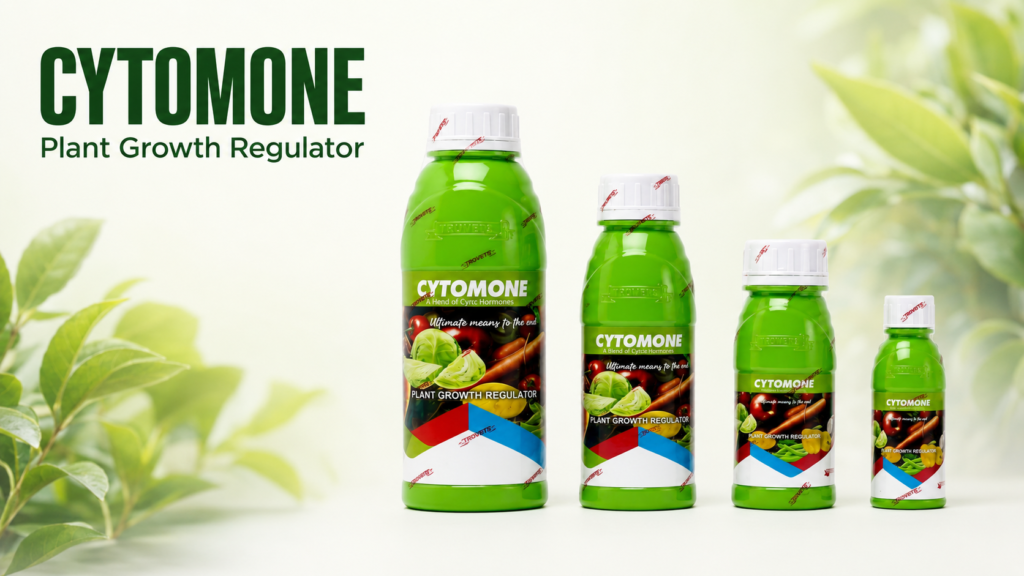
Quick answer: Cytomone at a glance
| Attribute | Detail |
|---|---|
| Full product name | Algreen Cytomone |
| Product type | Plant growth stimulant and hormone blend (plant growth regulator) |
| Active composition | Auxins, cytokinins, gibberellins, tryptophan |
| Application method | Foliar spray |
| Standard rate | 10 ml per 20 litres of water |
| Rate per hectare | 400 to 500 ml per hectare |
| Pack sizes | 50 ml, 100 ml, 250 ml, 500 ml, 1 L, 5 L, 20 L |
| Main uses | Rooting, germination, flowering, fruit and tuber sizing, vigour |
| Best timing | Multiple stages, targeted to the desired effect |
| Is it a fertilizer? | No. It is a hormone product used alongside fertilizer |
What is Algreen Cytomone?
Algreen Cytomone is a plant growth regulator that combines four cyto-hormone components in fixed proportions: auxins, cytokinins, gibberellins and the amino acid tryptophan. The formulation uses reversible weak bonds that allow the hormones to act in synergy, so each one complements the others instead of working in isolation.
Fertilizers supply raw materials. Hormones supply instructions. A crop can be fully fed and still root shallowly, flower unevenly or set small fruit, because those processes are controlled by internal chemical signals rather than by nutrient supply alone. Cytomone works on that signalling layer, which is why it is applied in millilitres per hectare rather than kilograms.
What are the main uses of Cytomone in agriculture?
Cytomone has seven main agricultural uses. Each one traces back to a specific hormone in the blend.
1. Fast, deep rooting at establishment
The auxin component drives root initiation and cell elongation, producing a bigger and deeper root system faster than the crop would build on its own. This is the single most common reason growers apply Cytomone, and it is the use that unlocks several of the benefits below.
2. Breaking seed dormancy and improving germination
Gibberellins end seed dormancy, which triggers germination and evens it out across the field. A uniform emergence gives a crop that matures together, which simplifies every operation after planting.
3. Promoting uniform flowering
Gibberellins also break flower-bud dormancy. Applied at the onset of flowering, Cytomone increases flower set and produces abundant, uniform flowering rather than a scattered, drawn-out bloom.
4. Increasing fruit and tuber size
The hormone blend increases the size of fruit and produces bigger potato tubers, lifting both total yield and the share of produce that reaches the higher market grades.
5. Delaying senescence and keeping crops green
Cytokinins slow the natural ageing of leaves. Every leaf is a factory converting sunlight into the sugars that build yield, so keeping the lower and older leaves green and photosynthetically active for longer extends the period over which the crop fills fruit or grain.
6. Encouraging tillering and branching
Applied during vegetative growth, Cytomone promotes lateral growth, meaning more tillers in cereals and more branches in broadleaf crops. More productive sites per plant is the foundation of a heavier harvest.
7. Improving drought resistance and fertilizer efficiency
These two benefits share a single cause: the deeper root system. Roots that reach moisture lower in the soil profile keep drawing water during dry spells when shallow-rooted plants are already wilting. The same root system explores more soil and intercepts more of the applied fertilizer before it is lost to leaching or lock-up, so more of what was bought ends up inside the plant.
How do the hormones in Cytomone work?
Each component of Cytomone governs a different developmental process. Supplying them together covers rooting, cell division, growth and dormancy-breaking at the same time.
| Component | What it controls | What it delivers in the field |
|---|---|---|
| Auxins | Cell elongation and root initiation | Fast, deep rooting; strong anchorage; better water access |
| Cytokinins | Cell division and delayed ageing | New tissue; leaves stay green and active for longer |
| Gibberellins | Stem and shoot growth; dormancy breaking | Germination triggered; flower buds released from dormancy |
| Tryptophan | Natural precursor to the plant’s own auxin | Supports the plant’s internal hormone production |
How to use Cytomone: application rate and method
Follow these five steps for a standard knapsack application.
- Measure the water. Fill the knapsack to a known volume. One standard knapsack is 20 litres.
- Measure the product accurately. Use 10 ml of Cytomone per 20 litres of clean water. Use a proper measuring device rather than estimating, because the rate is small and precision matters.
- Mix in the right order. Half-fill the tank with clean water, add the measured Cytomone, then top up while the agitator is running.
- Spray for even coverage. Aim for a fine, even film over the crop, wetting it without heavy run-off, and reach the underside of the leaves where the stomata are most numerous.
- Spray at the right hour. Apply in early morning or late afternoon when stomata are open and the spray film lingers long enough to be absorbed. Avoid midday heat, strong wind, and spraying when rain is expected within a few hours.
Cytomone dosage chart
| Water volume | Cytomone required |
|---|---|
| 20 L (one knapsack) | 10 ml |
| 100 L | 50 ml |
| 200 L | 100 ml |
| Per hectare | 400 to 500 ml |
When should Cytomone be applied?
| Goal | When to apply |
|---|---|
| Better germination | At or before planting, or at early emergence |
| Strong rooting and establishment | Early growth, after emergence or transplanting |
| Tillering and branching | During vegetative growth |
| Uniform flowering and set | At the onset of flowering |
| Larger fruit or tubers | During fruit or tuber development |
Can Cytomone improve yield in maize and other field crops?
Cytomone supports maize through three of its documented effects: deeper rooting at establishment, more tillering during vegetative growth, and delayed senescence that keeps the canopy green through grain filling. A maize crop that roots deeply is better placed to survive a mid-season dry spell, and a crop that stays green longer keeps filling grain instead of fading early.
The same logic applies across crop types. Potato growers use it for tuber size, horticultural growers for flowering and fruit set and colour, and cereal growers for tillering and stay-green. Because the hormone processes it acts on are common to virtually all flowering crops, the product is used across field, horticultural and tuber crops rather than being limited to one sector.
Is Cytomone a fertilizer? Hormones and nutrients compared
No. Cytomone is a hormone product, not a fertilizer, and this distinction determines how it should be used.
| Fertilizer | Cytomone (hormone) | |
|---|---|---|
| Function | Supplies raw materials | Directs how materials are used |
| Typical rate | Kilograms or litres per hectare | 400 to 500 ml per hectare |
| Dose response | More generally means more, within limits | Correct dose at correct timing; more is not better |
| Used alone? | Yes, though results are partial | No. Needs nutrition behind it |
A hormone can tell a plant to grow deeper roots, set more flowers or build bigger fruit, but the plant can only act on that instruction if the nutrients are there to build with. Stimulating a crop to set a heavy fruit load without feeding it adequately just spreads the same limited resources more thinly. Cytomone is therefore used alongside a nutrition programme, never as a replacement for one.
A seasonal programme pairing Cytomone with nutrition
| Stage | Nutrition focus | Suggested pairing |
|---|---|---|
| Germination and establishment | Rooting plus phosphorus | Cytomone with Algreen Planta-P |
| Vegetative growth | Branching plus nitrogen | Cytomone with Algreen Hynitro 42 |
| Flowering | Set plus micronutrients | Cytomone with Algreen Bonzin |
| Fruiting | Sizing plus potassium | Cytomone with Algreen Supa-K |
How does Cytomone compare to other plant growth enhancers?
Most products a grower sprays fall into one of four groups, and they are not interchangeable.
| Product type | What it contains | What it does | Where Cytomone differs |
|---|---|---|---|
| Straight fertilizer or foliar feed | N, P, K, micronutrients | Feeds the crop | Cytomone feeds nothing; it signals |
| Single-hormone product | One hormone, often a rooting auxin | One targeted effect, usually one stage | Cytomone carries four components covering multiple stages |
| Generic biostimulant or extract | Variable natural extracts | General vigour, composition often unstandardised | Cytomone has a defined hormone composition and a fixed rate |
| Algreen Cytomone | Auxins, cytokinins, gibberellins, tryptophan | Rooting, germination, flowering, sizing, stay-green | Multi-stage use from one product at 10 ml per 20 L |
The practical difference is versatility. A starter feed belongs at establishment and a fruiting feed belongs at fruiting, but Cytomone acts on processes that occur throughout the crop cycle. That breadth is an advantage only if applications are deliberate. Decide in advance which effect is wanted at which stage, then time the sprays to match, rather than spraying at random.
Where can I buy Cytomone in Kenya, and what does it cost?
Algreen Cytomone is supplied by Algreen and sold through agrovet stockists and agro-dealers. It is available in 50 ml, 100 ml, 250 ml, 500 ml, 1 L, 5 L and 20 L packs, so the pack can be matched to the size of the operation rather than buying more than a season needs.
Pricing is set by the supplier and by individual stockists, so growers should confirm the current price directly with Algreen or a local agrovet. What can be calculated in advance is coverage, which is usually the more useful number:
| Pack size | Knapsacks covered (20 L each) | Approximate area covered |
|---|---|---|
| 100 ml | 10 knapsacks | About 0.2 to 0.25 ha |
| 250 ml | 25 knapsacks | About 0.5 to 0.6 ha |
| 500 ml | 50 knapsacks | About 1 to 1.25 ha |
| 1 L | 100 knapsacks | About 2 to 2.5 ha |
| 5 L | 500 knapsacks | About 10 to 12.5 ha |
Coverage is calculated from the label rates of 10 ml per 20 litres and 400 to 500 ml per hectare. Actual area treated per pack depends on the spray volume the crop and equipment require.
Is Cytomone a veterinary or livestock product?
No. Algreen Cytomone is a plant growth stimulant applied to crops as a foliar spray. It is not a veterinary product and has no role in livestock breeding, oestrus synchronisation, or animal reproductive health.
This is worth stating plainly because searches for hormone products often mix plant and animal uses, and the names of hormonal preparations across the two sectors can look similar. Anyone looking for progestagen injections, oestrus synchronisation protocols or breeding-cycle control in cattle needs a registered veterinary product and the advice of a qualified veterinarian, not a foliar crop stimulant. Cytomone as described on this page is for crops only.
Tank mixing, storage and safe handling
Cytomone is generally compatible with common foliar products and is often mixed with fertilizers so that the growth it stimulates is properly fed. Before combining it with an unfamiliar partner, run a jar test: mix the products in a jar of water in the intended proportions and check for curdling, clumping or separation before loading the tank. Add products one at a time with the agitator running, spray tank mixes promptly, and keep mixtures simple.
Store the product in its original sealed container in a cool, dry place, out of direct sunlight and away from children, animals, food, seed and feed. Wear gloves and eye protection when handling and spraying, and wash hands afterwards. Triple-rinse empty containers into the spray tank and dispose of them responsibly.
Five common mistakes with Cytomone
- Over-applying. Exceeding 10 ml per 20 litres wastes product and can disturb the plant’s own hormone balance. More is not better with a hormone.
- Spraying without a target. Every application should be tied to an effect: rooting, branching, flowering or sizing.
- Using it instead of fertilizer. Hormones direct growth but do not feed it.
- Careless measuring. The rate is small, so estimating by eye is not accurate enough.
- Spraying in midday heat. Uptake is far better in the cooler hours when stomata are open.
Frequently asked questions
What is Cytomone used for? Cytomone is a plant growth hormone stimulant used to speed rooting and germination, promote uniform flowering, increase fruit and tuber size, encourage tillering and branching, and keep plants green for longer.
What is the Cytomone application rate? The rate is 10 ml of Cytomone per 20 litres of clean water, which works out to 400 to 500 ml per hectare applied as a foliar spray.
How do you use Cytomone foliar spray? Half-fill the tank with clean water, add the accurately measured Cytomone, top up while agitating, and spray a fine even film over the crop including the underside of leaves, in early morning or late afternoon.
When should Cytomone be applied? Time it to the effect wanted: at or before planting for germination, in early growth for rooting, during vegetative growth for tillering and branching, at the onset of flowering for uniform set, and during fruit or tuber development for size.
Is Cytomone a fertilizer? No. Cytomone is a plant growth regulator that directs how a crop grows. It supplies no nutrients and should be used alongside a fertilizer programme, not in place of one.
Can Cytomone be mixed with fertilizers? Yes. It is commonly combined with foliar feeds so that the stimulated growth is well nourished. Jar test any unfamiliar tank-mix partner first.
Why is the Cytomone rate so low? Plant hormones act as signals rather than as building materials, so the plant responds to a small, correctly timed amount. Applying far more does not multiply the benefit and can disturb the plant’s own hormone system.
What are the main benefits of Cytomone? Faster establishment through deep rooting, improved and more even germination, abundant uniform flowering, larger fruit and tubers, a longer green and productive canopy, better drought resistance, and more efficient use of applied fertilizer.
Where is Cytomone sold? Algreen Cytomone is supplied by Algreen through agrovet stockists and agro-dealers in packs from 50 ml to 20 L. Confirm current pricing with Algreen or a local stockist.
Related Algreen products
Hormones tell the crop what to do. Nutrients give it the material to do it. These products feed the growth that Cytomone stimulates:
- Algreen Planta-P: phosphate starter feed for strong roots
- Algreen Hynitro 42: nitrogen for vegetative growth
- Algreen Bonzin: zinc and boron for flowering and fruit set
- Algreen Supa-K: potassium for fruit sizing and quality
- Algreen Magical: calcium for firm, sound fruit
This article is part of our complete guide: Algreen Foliar Fertilizers, The Complete Guide.
Reuse note: the dosage chart, timing table and hormone reference table on this page may be reproduced by agronomists, trainers, extension officers and agricultural publications, with attribution and a link back to this page as the source.
Pingback: Algreen Organohumos Humic & Fulvic Acid - Solomon Agri
Pingback: Algreen Hynitro 42: Nitrogen 42% Foliar Fertilizer & How to Use It - Solomon Agri
Pingback: Algreen Planta-P: Slow-Release Phosphate Starter Fertilizer - Solomon Agri