Bacterial diseases are among the most difficult problems a grower faces, because once they take hold in a crop there is often no way to reverse the damage the emphasis has to be on prevention. Copper has been a cornerstone of that prevention for well over a century, and Algreen Copagel-50 makes it available in a convenient, soluble liquid form.
Supplying soluble copper at 50 grams per litre with a stimulant, it prevents bacterial spots and diseases and is described as a must-use in wheat and barley. This guide explains what Copagel-50 is, how copper protects a crop, when and how to apply it, and how to fit it into a preventive spray programme.
What is Algreen Copagel-50?
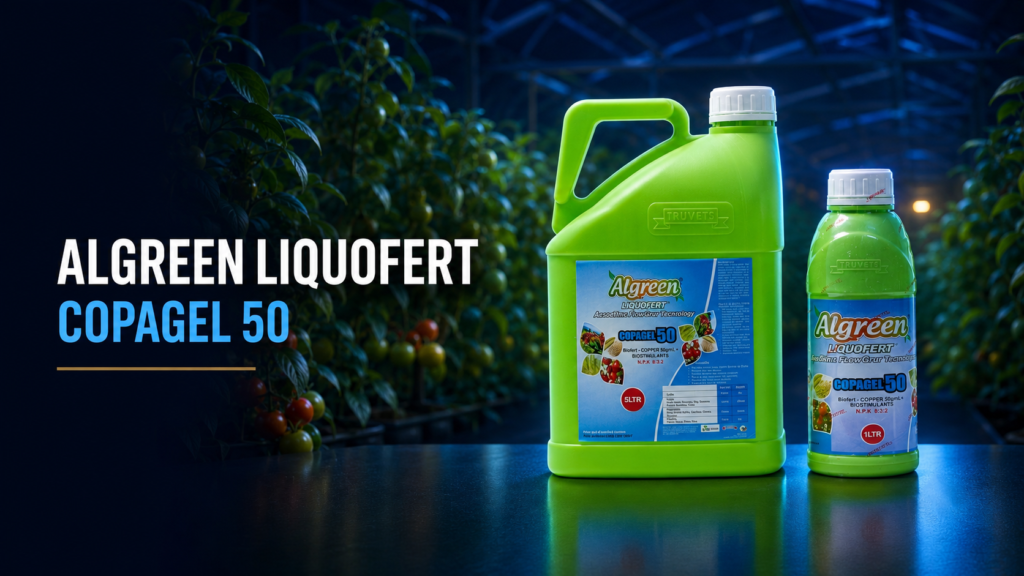
Algreen Copagel-50 contains soluble copper in liquid form at a concentration of 50 g/L, together with a stimulant. Its stated purpose is to prevent bacterial spots and diseases, and it is highlighted as a must-use in wheat and barley.
Unlike the other products in the range, which are primarily about feeding the crop, Copagel-50 is a protective product: its job is to keep bacterial and related diseases from establishing on the crop. It is available in 100 ml, 250 ml, 500 ml, 1 L, 5 L and 20 L packs.
Quick facts
| Attribute | Detail |
| Product type | Soluble liquid copper protectant |
| Composition | Copper 50 g/L + Stimulant |
| Application method | Foliar spray |
| Standard rate | 20–50 ml per 20 litres of water |
| Pack sizes | 100 ml, 250 ml, 500 ml, 1 L, 5 L, 20 L |
| Main use | Prevention of bacterial spots and diseases |
| Especially for | Wheat and barley |
How copper protects a crop: the science in plain language
Copper is unusual in playing two roles at once. It is a micronutrient the plant needs in small amounts for its own metabolism, and it is a long-established protective agent against certain diseases. As a protectant, copper works by releasing copper ions on the plant surface, which interfere with the enzymes and proteins that bacteria and some fungi depend on to live and multiply.
A pathogen landing on a copper-treated surface is disrupted before it can establish an infection. This is fundamentally a preventive, protective action: the copper forms a barrier on the plant that stops disease from taking hold, rather than curing an infection already inside the plant.
That distinction shapes how the product must be used applied before or at the very start of disease pressure, and maintained as a protective cover, rather than reached for after disease has spread.
The stimulant in the formulation supports the plant’s vigour, and the copper also contributes as a micronutrient to the plant’s own healthy function.
Why prevention is the only real option with bacterial disease
It is worth being clear about why the preventive emphasis matters so much. Bacterial diseases, once they have entered the plant’s tissue, cannot be eliminated by spraying there is no treatment that reaches inside the plant and removes them.
The visible spots, blights and rots they cause are permanent on the affected tissue. All a grower can do at that point is try to slow further spread and protect the parts of the crop not yet affected.
This is completely different from a nutrient deficiency, which can often be corrected once noticed. With bacterial disease, the decisive action is taken before the disease is visible: by keeping a protective copper cover on the crop during the periods when infection is likely warm, wet, humid weather that favours bacteria the grower prevents the pathogen from ever establishing.
Copagel-50 is designed for exactly this preventive role, which is why timing and consistent coverage matter more with a protectant than with a feed.
Recognising bacterial disease pressure
| Sign | What it suggests |
| Small water-soaked spots on leaves | Early bacterial spot infection |
| Angular spots limited by leaf veins | Bacterial leaf spot |
| Spots with yellow halos | Bacterial infection |
| Warm, wet, humid weather | Conditions that favour bacterial disease |
| History of disease in the field | High risk requiring preventive protection |
Where these signs or conditions appear, protective copper should already be on the crop — the aim is to be ahead of the disease, not behind it.
Key benefits of Algreen Copagel-50
Prevents bacterial spots and diseases. The protective copper cover stops bacterial pathogens from establishing on the crop.
Protects yield and quality. By keeping disease off the foliage and produce, it protects both the amount and the quality of the harvest.
Soluble, easy-to-use form. The soluble liquid mixes cleanly and spreads evenly for reliable coverage.
Valuable in wheat and barley. It is specifically recommended as a must-use in these cereals, where disease can significantly cut grain yield and quality.
Supplies copper as a micronutrient. Beyond protection, it contributes copper to the plant’s own nutrition.
Supports plant vigour. The added stimulant helps maintain a healthy, resilient crop.
How to use Algreen Copagel-50
The standard rate is 20–50 ml of Copagel-50 per 20 litres of clean water, applied as a foliar spray to give even, protective coverage of the foliage. Because it works preventively, apply it before disease pressure builds ahead of, or at the very start of, the warm, wet conditions that favour bacterial disease and maintain the protective cover as the crop grows and new, unprotected leaves emerge.
Half-fill the tank, add the measured product, top up while agitating, and spray to cover both the upper and lower leaf surfaces thoroughly, in the cooler hours of early morning or late afternoon.
Dosage at a glance
| Water volume | Copagel-50 (low rate) | Copagel-50 (high rate) |
| 20 L (one knapsack) | 20 ml | 50 ml |
| 100 L | 100 ml | 250 ml |
| 200 L | 200 ml | 500 ml |
Crop-by-crop application guide
| Crop | When to apply | What it does |
| Wheat & barley | Preventively, through the season | Protects against bacterial and related diseases; protects grain yield |
| Tomatoes | Before and during humid conditions | Guards against bacterial spot and speck |
| Capsicum & peppers | Preventively in warm, wet weather | Protects against bacterial spot |
| Beans | Preventively | Guards against bacterial blights |
| Fruit trees | As part of a protective programme | Protects against bacterial diseases |
Getting spray application right: water quality and technique
A protective spray only works where it lands, so coverage is everything. Use clean water of moderate pH, since very hard or silty water reduces effectiveness and clogs nozzles. Aim for a fine, even film that covers the whole leaf surface, top and underside, without heavy run-off the goal is a continuous protective layer.
A well-calibrated sprayer producing medium-to-fine droplets, moved at a steady pace, gives the most uniform coverage. Spray in early morning or late afternoon, and avoid strong wind or spraying when rain is expected within a few hours, which would wash the protectant off before it can act.
Maintaining protective cover as the crop grows
A key practical point with any protective spray is that it only protects the plant surface it actually covers, and it does not move into new growth. As a crop grows, it constantly produces new leaves and shoots that were not present at the last spray and therefore carry no protection.
Weather also erodes the protective cover over time rain washes some of it away, and the expansion of the leaf itself thins the deposit. For these reasons, protecting a crop against bacterial disease is not a one-off event but a matter of maintaining cover: reapplying at intervals so that new growth is protected and the cover stays effective, particularly through the warm, wet periods when disease pressure is highest.
The interval between sprays depends on how fast the crop is growing and how much rain falls, with faster growth and more rain calling for more frequent renewal. Thinking of Copagel-50 as a protective shield that must be kept in place, rather than a single treatment, is the mindset that gets reliable disease protection from it.
Copper as part of an integrated approach to disease
While copper is a valuable protective tool, it works best as one part of a broader, integrated approach to keeping a crop healthy, rather than as a standalone solution. Good field hygiene using clean, disease-free seed and planting material, removing and destroying infected debris, and rotating crops so that pathogens do not build up in the soil reduces the amount of disease pressure the crop faces in the first place.
Adequate spacing and good airflow help the canopy dry quickly after rain or dew, denying bacteria the prolonged leaf wetness they need to infect. Balanced nutrition keeps the crop vigorous and better able to withstand disease, which is where the rest of the Algreen range supports the picture.
Against this background, a protective copper spray such as Copagel-50 provides a chemical barrier that stops pathogens establishing on the crop surface. The combination clean material, good field management, sound nutrition and timely protective spraying is far more effective than relying on any single measure, and it is the approach that gives the most durable protection against bacterial disease.
Using copper responsibly
Copper is an effective and long-trusted protectant, but like any crop-protection input it should be used responsibly and according to the recommended rates. Applying it within the 20–50 ml range and only when it is needed preventively during periods of genuine disease risk makes the best use of the product and avoids unnecessary repeated copper application.
Following good spray practice, observing any recommended intervals before harvest, and keeping the protective cover targeted to the periods of real need all contribute to using copper sensibly. As part of an integrated programme, and applied with attention to rate and timing, Copagel-50 provides reliable protection against bacterial disease while being used no more heavily than the situation requires.
This measured, purposeful use is both more economical and more sustainable than blanket, routine spraying regardless of conditions.
Tank mixing and compatibility
Copper products can be sensitive in mixtures, so do a jar test before combining Copagel-50 with an unfamiliar partner: mix the products in a jar of water in the intended proportions and check for curdling, clumping or separation before loading the tank. Avoid strongly alkaline or acidic partners that could react with the copper, add products one at a time with the agitator running, spray promptly, and keep mixtures simple.
Storage and safe handling
Store the product in its original sealed container in a cool, dry place out of direct sunlight and away from children, animals, food, seed and feed. Wear gloves and eye protection when handling and spraying, and wash hands afterwards. Triple-rinse empty containers into the spray tank and dispose of them responsibly.
Troubleshooting and common mistakes
Spraying after disease appears. Copper is preventive; it cannot cure established infection. Apply before disease takes hold.
Letting cover lapse. New growth is unprotected and rain erodes the cover; renew the spray to maintain protection.
Poor coverage. Cover both leaf surfaces thoroughly; gaps in cover are gaps in protection.
Relying on copper alone. Combine it with field hygiene, spacing and sound nutrition for durable control.
Careless tank mixing. Copper can react in some mixtures; jar test unfamiliar partners.
Frequently asked questions
What is Copagel-50 used for? To prevent bacterial spots and diseases, particularly in wheat and barley.
What is the application rate? 20–50 ml per 20 litres of water.
Should I apply it before or after symptoms appear? Before copper is a preventive protectant and cannot cure established disease.
How often should I reapply? Often enough to keep new growth protected and maintain cover through disease-favourable weather.
Which crops is it best for? Wheat and barley especially, plus other crops threatened by bacterial spots and diseases.
Can I mix it with other products? Take care, as copper can react in some mixtures; jar test any unfamiliar partner first.
Why wheat and barley in particular
Copagel-50 is singled out as a must-use in wheat and barley, and it is worth understanding why these cereals warrant special mention. Wheat and barley are grown over large areas and produce their yield in the grain, which fills over a relatively short and critical period late in the season.
Diseases that attack the leaves and heads during this period strike directly at the plant’s ability to fill that grain: every patch of leaf lost to disease is a patch of the plant’s food-making surface taken out of action just when the grain most needs feeding, and disease on the head itself can damage the grain directly.
Because the yield of these crops depends so heavily on keeping the upper leaves and head healthy through grain filling, protecting them from disease has an outsized effect on the final harvest. The economics reinforce this: cereals are typically grown at scale on relatively thin margins per hectare, so protecting the yield and grain quality across a large area is important to the overall return.
A preventive copper protectant that keeps bacterial and related diseases off the crop through the vulnerable period is therefore a particularly valuable tool in these cereals, which is why it is highlighted for them specifically.
Weather, leaf wetness and timing
Timing a protective copper spray well depends on understanding the conditions that bacterial diseases need in order to spread. Bacteria multiply and infect most readily when the leaf surface stays wet for extended periods and temperatures are warm the combination found in humid weather, during rainy spells, and when heavy dew persists into the morning.
Long periods of leaf wetness give bacteria the time and moisture they need to enter the plant, while dry conditions slow them dramatically. This is why the risk of bacterial disease rises sharply in warm, wet weather and why protective cover is most important during those periods.
A grower watching the weather can use this to time applications well: ensuring the crop carries a protective copper cover going into a forecast wet, warm spell, and renewing it as needed while such conditions persist, concentrates the protection where and when it is genuinely needed.
Applying copper preventively ahead of high-risk weather, rather than reacting after a wet period has already allowed infection, is the single most important principle of timing, and it is what turns a copper protectant from a routine expense into a targeted, effective defence.
Copper as a dual-purpose input
One feature that makes a copper product like Copagel-50 attractive is that it does two jobs from a single application. Its primary purpose is protection against bacterial disease, but copper is also a genuine plant micronutrient, needed in small amounts for the plant’s own enzymes and metabolic processes.
A crop short of copper can show poor growth and, in cereals, problems with grain formation, so ensuring an adequate copper supply supports healthy function in its own right. When Copagel-50 is applied for disease protection, the crop therefore also receives copper as a nutrient, addressing any mild copper shortage at the same time.
This dual action protectant and micronutrient in one means the product contributes to the crop’s health on two fronts, which adds to its value in a programme. It is a useful reminder that the line between crop protection and crop nutrition is not always sharp: some inputs, copper among them, sit on both sides of it, defending the crop against disease while also feeding it.
Used thoughtfully as part of an integrated approach, Copagel-50 delivers protection and a nutritional contribution together, helping keep the crop both disease-free and healthy through to harvest.
Related Algreen products
Disease protection works best alongside good nutrition. These Algreen products keep the crop healthy and well fed:
- Algreen Hynitro 42 — nitrogen for vigorous cereal growth
- Algreen Supa-K — potassium for grain filling and disease tolerance
- Algreen Organohumos — soil health for a resilient crop
- Algreen Supasense — balanced NPK nutrition
- Algreen Supa K Extra — potassium that helps crops retard disease
This article is part of our complete guide: Algreen Foliar Fertilizers — The Complete Guide.
Pingback: Algreen Gel Technology: 9 Products, 4 Claims - Solomon Agri