The most expensive mistake Kenyan maize farmers make has nothing to do with fertilizer prices or rainfall. It happens before the first seed touches the soil — in the moment you choose between the best maize seed varieties in Kenya and whatever happens to be on the shelf in front of you.
A farmer in Kitui plants H614D because it is what the agrovet stocks and what the neighbour planted. It is a highland variety needing 160 to 210 days of reliable rain. The short rains end in 90. The crop dies at grain fill, and the season is lost to a decision made in five minutes at a counter.
This guide covers 28 maize varieties officially sold in Kenya across four seed companies, matched to altitude, rainfall and season length — with yield per acre for each, taken from the companies’ own published tables rather than from what circulates at the agrovet.
Quick answer: which maize variety should I plant?
| Your altitude | Season | Plant this |
|---|---|---|
| 1,500–2,800m | Long rains, reliable | H6213 (54 bags/acre) or H9401 (50) |
| 1,400–1,900m | Long rains, high input | DK777 or DKC90-89 (up to 10 t/ha) |
| 1,000–1,800m | Transitional | H624 or H520 |
| 900–1,600m | Unreliable rain | DK8031 or DKC80-33 |
| 900–1,500m | Short rains | H513, H516 or H517 |
| 0–1,200m | Coastal | PH1 or PH4 |
| 900–1,700m | Arid / semi-arid | DH01–DH08 or SC Sungura 301 |
Everything below explains why, and what each variety actually yields.
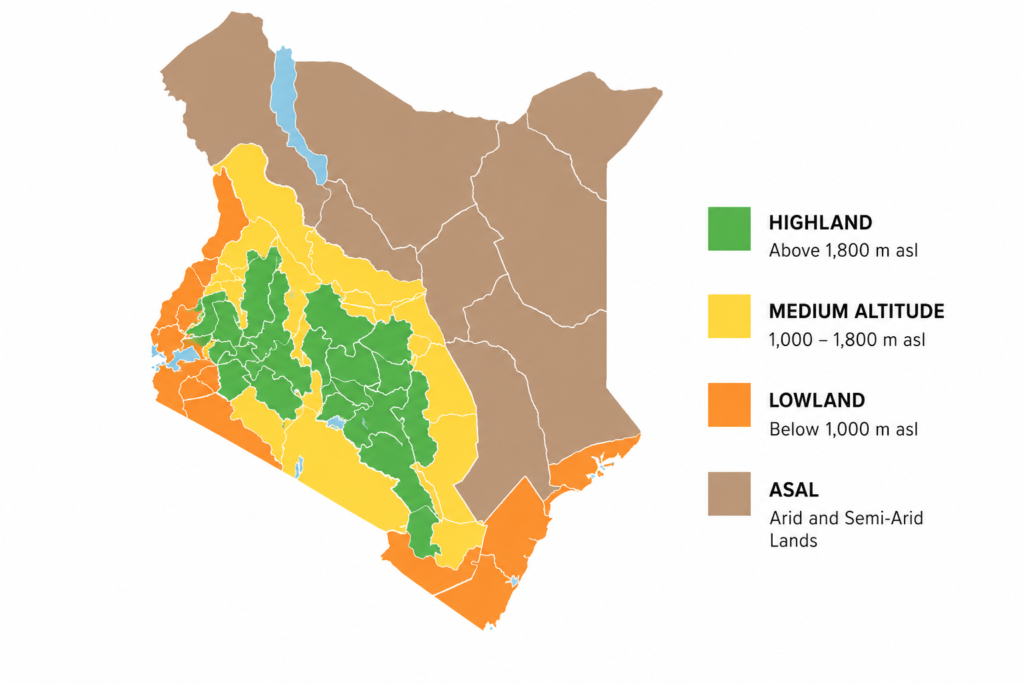
The three questions that decide your variety
Variety choice is not about brand loyalty or yield numbers on a bag. Three things decide it, in this order.
1. How high is your farm? Altitude governs temperature, and temperature governs how fast maize develops. A highland variety planted low matures too fast and yields poorly; a lowland variety planted high sits in the cold and never finishes. Every variety in this guide carries an official altitude band. Stay inside it.
2. How many days of reliable rain do you get? This is the question that ruins more crops than any other. A variety needing 160–210 days planted into a 90-day short-rains window will not finish grain fill, regardless of how much fertilizer you apply. Match maturity period to your actual rainfall window, not your hoped-for one.
3. What is available and genuine near you? The best-matched variety you cannot buy is worth less than the second-best one you can — but only if the seed is certified. See how to verify your seed below.
The best maize seed varieties in Kenya by region
| County / zone | Altitude | Best-matched varieties |
|---|---|---|
| Trans Nzoia, Uasin Gishu | 1,800–2,100m | H6213, H9401, H629, DK777 |
| Nakuru highlands, Nyandarua | 1,800–2,400m | H6213, H628, H629, DK777 |
| Kericho, Nandi, Bomet | 1,700–2,100m | H6213, H9401, SC Tembo 73 |
| Kisii, Nyamira (upper) | 1,500–1,800m | H6213, H628, SC Tembo 73 |
| Bungoma, Kakamega | 1,200–1,600m | PHB3253, DKC80-33, H624 |
| Siaya, Homa Bay, Migori | 1,100–1,500m | PHB3253, H516, SC Punda Milia 555 |
| Meru, Embu (lower) | 900–1,400m | H513, H517, DK8031 |
| Machakos, Kitui | 900–1,400m | H513, DH04, SC Duma 419 |
| Laikipia, Baringo, W. Pokot | 1,200–1,600m | DK8031, DKC80-33, DH08 |
| Garissa, Tharaka Nithi, ASAL | 900–1,700m | DH01, DH02, SC Sungura 301 |
| Kwale, Kilifi, coastal strip | 0–1,200m | PH1, PH4 |
| Mwea, Ahero, Bunyala (irrigated) | 1,100–1,200m | H517 (officially recommended for irrigation) |
Kenya Seed Company varieties
Kenya Seed Company lists 16 varieties across 5 zone categories. Most farmer content covers three or four of them. The gains usually sit in the ones nobody mentions.
Highland varieties (1,500–2,800m, 150–210 days)
| Variety | Maturity | Yield per acre | Standout trait |
|---|---|---|---|
| H6213 | 160–210 days | 54 bags | Highest yield in the entire range |
| H9401 | 160–190 days | 50 bags | Broadest disease resistance; silage |
| H629 | 160–210 days | 48 bags | Lodging resistant; best storage |
| H628 | 150–210 days | 46 bags | Heavy flint grain; blight/GLS |
| H614D | 160–210 days | 38 bags | Most widely available |
A correction worth making plainly: H6213 is often described as a medium-altitude alternative to H614D. It is not. Kenya Seed Company classifies it as a Highland variety, 1,500–2,800m, 160–210 days — the same band as H614D — with a 54 bags per acre ceiling against H614D’s 38. In the correct zone, H6213 is the stronger default. Planted at medium altitude expecting a shorter season, it fails the same way H614D does.
Transitional zone (1,000–1,800m, 120–150 days)
| Variety | Yield per acre | Standout trait |
|---|---|---|
| H624 | 36 bags | Higher ceiling of the two |
| H520 | 34 bags | Explicit GLS and MSV tolerance |
Both are double-cobbing — they need sustained feeding through fill or the plant aborts the second cob.
Medium maturity (900–1,500m, 110–150 days)
| Variety | Maturity | Yield per acre | Standout trait |
|---|---|---|---|
| H517 | 120–150 days | 32 bags | Officially ideal for irrigation |
| H516 | 120–150 days | 30 bags | Blight, rust, lodging resistant |
| H513 | 110–130 days | 26 bags | Shortest season in category |
Lowland / Pwani hybrids (0–1,200m)
| Variety | Maturity | Yield per acre |
|---|---|---|
| PH4 | 100–120 days | 26 bags |
| PH1 | 75–100 days | 20 bags |
Dryland varieties (900–1,700m)
| Variety | Maturity | Yield per acre | Standout trait |
|---|---|---|---|
| DH08 | 100–120 days | 26 bags | Newest release; ear rot tolerant |
| DH04 | 75–100 days | 24 bags | Widest altitude range |
| DH02 | 70–100 days | 18 bags | MSV tolerant |
| DH01 | 70 days | 15 bags | Fastest maturing; stay-green |
Full breakdown: Kenya Seed Company maize varieties — all 16 compared
Bayer DEKALB (DK) varieties
Bayer Kenya markets four registered DEKALB cultivars. They split cleanly into two altitude pairs.
| Variety | Maturity | Altitude | Yield per acre |
|---|---|---|---|
| DK777 | 4–5 months | 1,400–1,900m | Up to 10 t/ha ≈ 45 bags |
| DKC90-89 | 4–4.5 months | 1,400–1,900m | Up to 10 t/ha ≈ 45 bags |
| DKC80-33 | 3.5–4 months | 900–1,600m | Up to 7 t/ha ≈ 31 bags |
| DK8031 | 3.5–4 months | 900–1,600m | Up to 7 t/ha ≈ 31 bags |
Bayer publishes DEKALB yields in tonnes per hectare while Kenyan agrovets quote bags per acre. They are the same figure: 1 t/ha is about 4.5 bags of 90kg per acre. A datasheet saying 10 t/ha and a dealer saying 45 bags are not disagreeing.
The highland pair: DK777 is marketed on MLN tolerance and uniform cob placement for machine harvest. DKC90-89 adds double-cobbing potential and flint grain valued for poundability. Same band, same ceiling — choose on disease history and market.
The early, drought-tolerant pair: DK8031 is the established default. DKC80-33 is specifically bred for wide adaptability across environments and also carries double-cobbing potential.
None of the four suits lowland irrigation schemes — all are bred for 900m and above. For Mwea, Ahero or Bunyala, use H517.
Full breakdown: Bayer DEKALB maize varieties in Kenya
Seed Co Kenya varieties
Important correction. Earlier versions of this guide listed “SC403” and “SC627” as Seed Co Kenya varieties. Checking Seed Co Kenya’s own current product listing, neither name appears in their Kenya lineup or zone recommendations. Those codes appear to belong to another market or an outdated naming convention. If you were planning around either, the information below replaces it.
Seed Co Kenya’s actual range uses Swahili animal names, and the company organises recommendations by rainfall zone rather than altitude:
| Variety | Maturity | Yield per acre | Best fit |
|---|---|---|---|
| SC Tembo 73 | Medium-highland | 53–58 bags | Highest yield; GLS tolerant |
| SC Tembo 727 | Medium-highland | Comparable | Same zones, non-GLS farms |
| SC Punda Milia 555 | 105–120 days | 38–43 bags | Double cobber |
| SC Duma 419 | Very early | 32–38 bags | Best very-early yield |
| SC Duma 43 | Very early | 30–35 bags | Excellent for silage |
| SC Simba 61 | Medium rainfall | — | Zones 3–4 specifically |
| SC Sungura 301 | 72–85 days | 25–30 bags | Recommended in every zone |
Seed Co’s rainfall zones: Zone 1 (below 250mm), Zone 2 (250–800mm), Zone 3 (800–1,200mm), Zone 4 (1,500–1,800mm), Zone 5 (1,800–2,000mm). SC Sungura 301 is the only variety Seed Co recommends across all five — the strongest pure risk-management choice in their range.
Full breakdown: Seed Co Kenya maize varieties
Pioneer varieties
PHB3253 (Pioneer Hi-Bred) — 110–120 days, 1,000–1,600m, 700–1,000mm rainfall, 25–35 bags per acre.
Its reputation is regional and well earned: across Bungoma and Kakamega it consistently outperforms H614D. That is adaptation, not brand strength — Western Kenya’s medium-altitude, high-rainfall conditions suit PHB3253’s maturity better than H614D’s highland genetics, even where H614D is technically within its altitude range.
Full guide: PHB3253 maize variety in Kenya
Other seed companies
The four companies above are the ones whose complete official lineups we have verified directly. Others operate in Kenya — the Agricultural Development Corporation (ADC), which describes itself as the country’s largest seed maize grower and releases KALRO-developed hybrids in the KH series, and Freshco among them. We are building verified guides for these rather than repeating figures we cannot source. If you are considering a KH- or Tsavo-series variety, ask the stockist for the company’s own printed specification sheet before buying.
Highest yield per acre: the honest comparison
| Rank | Variety | Yield per acre | Condition |
|---|---|---|---|
| 1 | SC Tembo 73 | 53–58 bags | Zones 4–5, reliable high rainfall |
| 2 | H6213 | 54 bags | 1,500–2,800m, 160–210 days |
| 3 | H9401 | 50 bags | 1,500–2,800m, mixed disease risk |
| 4 | H629 | 48 bags | 1,500–2,800m, exposed sites |
| 5 | H628 | 46 bags | 1,500–2,800m, blight/GLS zones |
| 6 | DK777 / DKC90-89 | ~45 bags | 1,400–1,900m, full input programme |
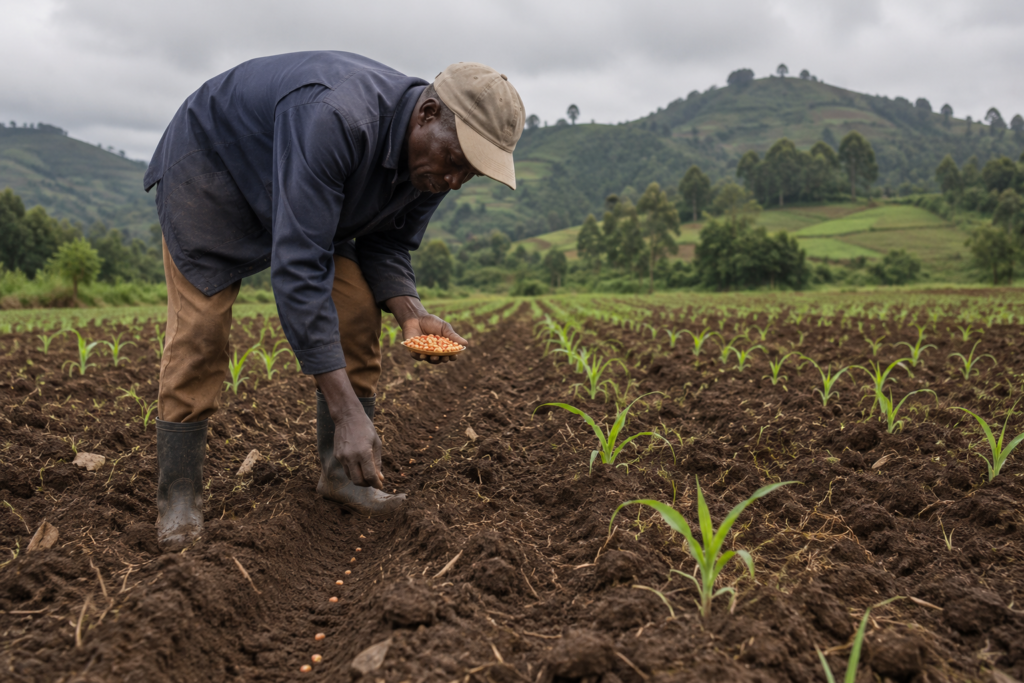
maturity and yield per acre — matched to your county and rainfall.
Read that table with the “condition” column, not without it. Every one of these numbers is a ceiling under good management in the correct zone — not an average, and not a promise. DK777 planted at 1,200m yields less than H513 planted at 1,200m, at more than double the seed cost.
Best maize varieties for the short rains
If your rainfall window is short or unreliable, maturity period matters more than yield ceiling. A 26-bag variety that finishes beats a 54-bag variety that dies at grain fill.
| Variety | Maturity | Yield per acre |
|---|---|---|
| SC Sungura 301 | 72–85 days | 25–30 bags |
| DH01 | 70 days | 15 bags |
| DH04 | 75–100 days | 24 bags |
| SC Duma 419 | Very early | 32–38 bags |
| H513 | 110–130 days | 26 bags |
| DK8031 | 3.5–4 months | ~31 bags |
For Eastern Kenya’s short rains specifically — Machakos, Kitui, lower Meru and Embu — H513 remains the standard choice at 110–130 days. Where the window is shorter still, SC Sungura 301 at 72–85 days is the most reliable finisher in the country.
Seed prices in Kenya, 2026
Indicative retail for a 10kg bag, which plants roughly one acre. Confirm locally — prices move with season and county.
| Variety | Price (KES per 10kg) |
|---|---|
| H513 | 2,800–3,200 |
| H6213 | 3,000–3,600 |
| H614D | 3,200–3,800 |
| PHB3253 | 4,000–4,800 |
| DK8031 | 4,200–5,000 |
| DK777 | 4,500–5,500 |
One 10kg bag plants roughly one acre at the recommended spacing — 75cm between rows, 25cm between plants, one seed per hole.
Seed is the cheapest input decision with the largest consequence. The difference between the most and least expensive variety here is under KES 2,700 an acre far less than the yield gap between a well-matched variety and a mismatched one. How to verify your seed is genuine
Counterfeit and recycled seed is the second most expensive mistake after variety mismatch. Recycled hybrid seed typically yields 30–50% less than fresh certified seed.
Do this at the counter, before you pay. Packs of 10kg and under carry a KEPHIS scratch-off sticker. Scratch it, text the concealed code to 1393 — free, any network — and a reply comes back with the seed type, species, variety, class and testing date. Check those match the packet in your hand. No reply means the seed is not genuine.
About 85% of Kenyan farmers know this check exists. Only around 35% use it.
- Scratch and text 1393. Thirty seconds, no airtime, before the money leaves your hand.
- Read the variety line in the reply. A common fraud is genuine labels moved onto bags of grain — the message arrives, but it describes a different variety.
- Buy sealed. Never accept seed decanted from a larger bag into an unmarked packet. On bags above 10kg, check the tag is attached to the seal, not loose.
- Keep the receipt, packet and label until after harvest. Compensation claims fail on missing evidence far more often than on merit.
- Never plant saved hybrid seed. Second-generation hybrid seed loses vigour and uniformity — genetics, not storage. Yield typically drops 30–50%.
Report suspect seed to KEPHIS on +254 709 891 000 or via kephis.go.ke.
Full detail, including what to do if you have already planted: How to identify fake seeds in Kenya
Planting calendar by region
| Region | Long rains | Short rains |
|---|---|---|
| Rift Valley highlands | Mar–Apr | Not typically double-cropped |
| Western Kenya | Mar–Apr | Aug–Sep |
| Central highlands | Mar–Apr | Oct–Nov |
| Eastern (Machakos, Kitui) | Mar–Apr | Oct–Nov |
| Coastal | Apr–May | Oct–Nov |
Plant with the first reliable rains, not the first shower — the first shower is usually a false start. Wait for two to three consecutive days of rain that wet the soil to at least 15cm depth before planting. Replanting after a false start costs a full seed bag and two weeks of season.
Feeding your variety
Yield ceilings assume nutrition scaled to match them. A 54-bag variety fed like a 30-bag variety yields like a 30-bag variety, at a higher seed cost.
| Variety tier | Programme |
|---|---|
| Long-season highland (H6213, H9401, H629, H628, DK777, Tembo 73) | Planta-P at planting → split nitrogen with Hynitro 42 → Supa-K through grain fill |
| Double-cobbing (DKC90-89, DKC80-33, H520, H624, Punda Milia 555) | As above, but sustained Supasense through fill — underfeeding means the second cob aborts |
| Drought-tolerant / dryland (DK8031, DH series, Sungura, Duma) | Cytomone at establishment for root depth, plus Organohumos on low-organic-matter soils |
| Short-season (H513, H516, PH1) | Timing over volume — prompt early nutrition, since there is no time to correct a slow start |
Frequently asked questions
Which maize variety has the highest yield per acre in Kenya? SC Tembo 73 (53–58 bags/acre) and H6213 (54 bags/acre) top the published tables, with DK777 and DKC90-89 at roughly 45 bags/acre. All are conditional on the correct altitude band, reliable rainfall through the full season, and a complete fertilizer programme.
What is the best maize variety for the short rains in Kenya? For Eastern Kenya’s short rains, H513 (110–130 days, 26 bags/acre) is the standard choice. Where the window is shorter, SC Sungura 301 (72–85 days) or Kenya Seed’s DH01 (70 days) finish faster.
Are SC403 and SC627 still available in Kenya? Neither appears in Seed Co Kenya’s current official lineup or zone recommendations. Their present range is SC Sungura 301, SC Duma 43, SC Duma 419, SC Punda Milia 555, SC Simba 61, SC Tembo 73 and SC Tembo 727.
Is H614D still the best Kenya Seed Company variety? Not by official yield data. Within the highland category, H6213 (54 bags/acre), H9401 (50), H629 (48) and H628 (46) all out-yield H614D (38). H614D’s advantage is familiarity and availability, not yield.
Is H6213 a highland or medium-altitude variety? Highland, per Kenya Seed Company’s own classification — 1,500–2,800m and 160–210 days, the same band as H614D. It is widely and wrongly described as a medium-altitude alternative.
How many maize varieties does Kenya Seed Company sell? 16, across five categories: Highland, Transitional Zone, Medium Maturity, Lowland (Pwani), and Dryland.
How many DEKALB varieties are registered in Kenya? Four: DK777, DKC90-89, DKC80-33 and DK8031.
Which maize variety works under irrigation at Mwea or Ahero? H517, which Kenya Seed Company explicitly marks as ideal for irrigation. These schemes sit at 1,100–1,200m, below the altitude floor of every highland variety including H614D and DK777.
How do I convert tonnes per hectare to bags per acre? Multiply by roughly 4.5. One tonne per hectare is about 4.5 bags of 90kg per acre, so a variety listed at 10 t/ha is around 45 bags per acre.
Can I plant H614D below 1,500 metres? You can, but it usually fails. H614D needs 160–210 days of reliable rain; below its altitude floor the rains typically end before grain fill completes. Use H513, H516, DK8031 or DKC80-33 instead.
The right seed for your farm
Variety choice is an agronomic decision, not a brand one. The three questions that matter — your altitude, your reliable rainfall window, and whether you can buy certified seed locally — will point you to two or three candidates. Choose between those on disease history and market.
Everything after that decision, from fertilizer to spray timing, is working within a ceiling the seed already set.
The farmers consistently hitting 40 bags an acre in Kenya are rarely using more fertilizer than their neighbours. They are usually planting a variety that matches their farm.
If you want a recommendation for your specific conditions, get in touch through the Solomon Agri consultation service — we build crop plans around your county, altitude, rainfall pattern and available inputs.
Pingback: H513 Maize Variety in Kenya: Yield, Maturity & Growing Areas - Solomon Agri
Tembo 73 variety did very well during the long rains this year 2026 in kakamega and bungoma Counties.