Best Maize Seed Varieties in Kenya 2026: Which Variety Works in Your Region?
Introduction — Stop Planting the Wrong Maize Seed
The most expensive mistake Kenyan maize farmers make has nothing to do with fertilizer prices or rainfall. It happens before the first seed touches the soil.
Most Kenyan farmers choose their maize variety based on what their neighbor planted, what the agrovet had in stock, or what someone recommended at a baraza. The result is predictable — a farmer in Nyeri plants a lowland variety and wonders why yields disappoint. A farmer in Bungoma plants an early maturing variety suited for dry areas and leaves 15 bags per acre of potential yield on the table.

Maize variety selection is the single highest leverage decision in your entire farming season. Get it right and everything else — fertilizer, irrigation, pest control — works at maximum efficiency. Get it wrong and no amount of inputs will save your harvest.
This guide matches every major commercial maize variety available in Kenya in 2026 to the specific regions, altitudes, and conditions where it performs best. By the end you will know exactly which seed to plant on your specific farm.
Understanding Maize Variety Classification in Kenya
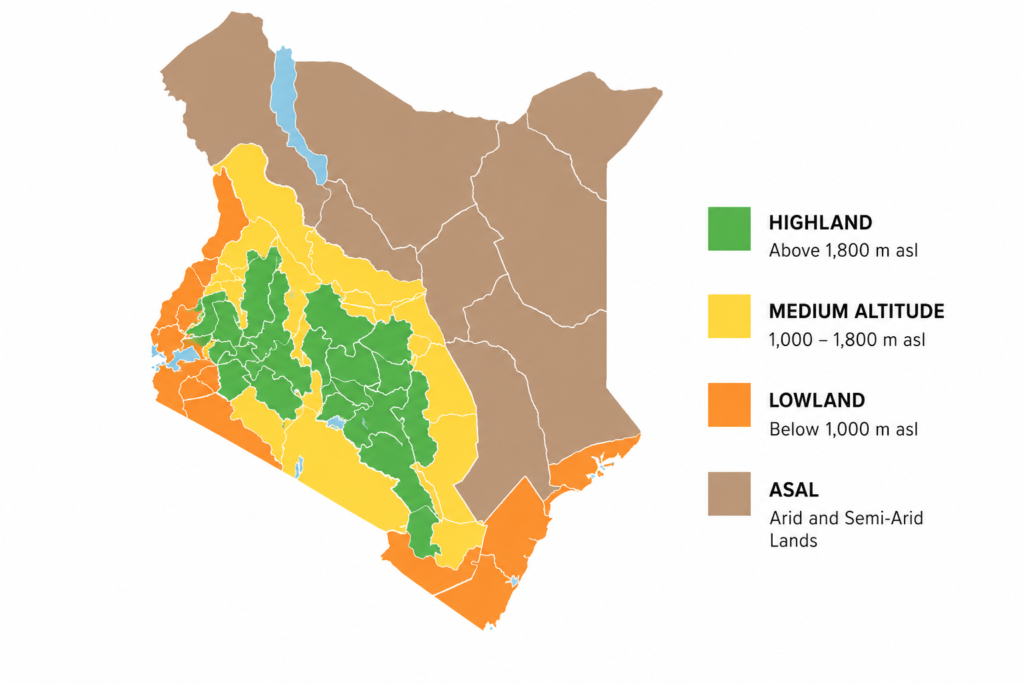
Before comparing varieties you need to understand how Kenyan maize seeds are classified. Every certified variety has three key characteristics that determine where it should be planted.
Maturity Period
- Early maturing — 75 to 90 days to harvest. Suited for short rains, ASAL regions, and areas with unreliable rainfall.
- Medium maturing — 90 to 120 days. Suited for medium altitude zones with reliable single long rains.
- Late maturing — 120 to 140 days. Suited for high altitude highland areas with long reliable rains.
Altitude Suitability
- Lowland varieties — 0 to 1200 metres above sea level
- Medium altitude varieties — 1200 to 1800 metres above sea level
- Highland varieties — 1800 to 2400 metres above sea level
Seed Company
Kenya’s certified maize seed market is supplied by several companies including Kenya Seed Company, Monsanto Kenya (now Bayer), Seedco Kenya, Pioneer Hi-Bred, Dryland Seed, and Evogene. Each company has varieties suited to different agroecological zones.
Certified seed from registered companies is always preferable to recycled or uncertified seed. Recycled seed loses hybrid vigour and typically yields 30 to 50 percent less than fresh certified seed.
Kenya Seed Company Varieties — Full Regional Guide
Kenya Seed Company is the oldest and most widely distributed seed company in Kenya. Their varieties are familiar to most farmers but familiarity does not mean suitability for your specific zone.
H614D — The Most Misplanted Variety in Kenya
H614D is Kenya’s most popular maize variety by volume sold. It is also the most misplanted.
What H614D actually is:
- Maturity: 130 to 140 days
- Altitude: 1500 to 2100 metres above sea level
- Rainfall requirement: 800 to 1200mm well distributed
- Expected yield under good management: 30 to 40 bags per acre
- Grain type: White, large, preferred by millers
Where H614D performs well:
- Nakuru highlands
- Nyandarua
- Trans Nzoia
- Uasin Gishu
- Parts of Meru highlands above 1600m
- Nyeri above 1700m
Where H614D fails and why:
H614D is a late maturing highland variety. Planting it in medium or low altitude areas means it faces moisture stress during grain filling because the rains end before the crop matures. This is why farmers in Kitui, Makueni, Kisii lowlands, and coastal areas consistently get poor yields from H614D — they are planting a highland variety in the wrong environment.
The bottom line on H614D: If your farm is below 1500 metres do not plant H614D regardless of what your neighbor says.
H6213 — The Underrated Workhorse
H6213 is consistently underrated by Kenyan farmers who chase the more famous H614D. In the right zone it outperforms H614D significantly.
What H6213 actually is:
- Maturity: 120 to 130 days
- Altitude: 1200 to 1800 metres above sea level
- Rainfall requirement: 700 to 1100mm
- Expected yield under good management: 28 to 38 bags per acre
- Grain type: White, medium size
Where H6213 performs well:
- Kisii highlands
- Nyamira
- Kakamega
- Vihiga
- Bungoma medium altitude areas
- Bomet
- Kericho medium zones
- Migori highlands

Can you plant H6213 in Bungoma?
Yes. H6213 is well suited to Bungoma’s medium altitude zones between 1300 and 1700 metres. It matures before the long rains end and yields consistently in this region. Many Bungoma farmers who switched from H614D to H6213 report 20 to 25 percent yield improvement simply from correct variety selection.
Can you plant H6213 in Kisii?
Yes. Kisii’s bimodal rainfall and medium altitude make H6213 an excellent choice. It performs particularly well in Kisii and Nyamira counties where altitude ranges from 1400 to 1800 metres.
H513 — The Short Rains Specialist
What H513 actually is:
- Maturity: 90 to 100 days
- Altitude: 900 to 1500 metres above sea level
- Rainfall requirement: 500 to 800mm
- Expected yield: 18 to 25 bags per acre
- Best use: Short rains season, areas with unreliable rainfall
Where H513 performs well:
- Machakos short rains
- Kitui short rains
- Meru lower zones
- Embu lower zones
- Eastern Kenya generally for short rains season
This variety is specifically designed for situations where you cannot guarantee a full long rains season. If you are farming in an area that gets one reliable short rain season H513 consistently outperforms longer season varieties that do not have time to mature.
Bayer Kenya Varieties — DK Series Regional Guide
Monsanto Kenya rebranded to Bayer following a global acquisition. Their DK series remains among the highest yielding commercial varieties available in Kenya when planted in the correct zone.
DK777 — Kenya’s Highest Potential Yield Variety
DK777 consistently achieves the highest yield potential of any variety commercially available in Kenya. Under optimal conditions and proper management it yields 40 to 55 bags per acre. However it is also the most demanding variety in terms of inputs and management.
What DK777 actually is:
- Maturity: 130 to 140 days
- Altitude: 1600 to 2400 metres above sea level
- Rainfall requirement: 900 to 1400mm well distributed
- Expected yield under good management: 40 to 55 bags per acre
- Input requirement: High — requires adequate phosphorus at planting and split nitrogen applications
- Drought tolerance: Low — extremely sensitive to moisture stress during tasselling
Can you plant DK777 in Nyeri?
Yes — but only in Nyeri areas above 1700 metres with reliable rainfall. Nyeri’s highland zones around Tetu, Mathira, and Kieni East are well suited to DK777. However Nyeri farmers in lower zones below 1600 metres should use H6213 or DK8031 instead.
Can you plant DK777 in Nakuru?
Yes. Nakuru’s highland zones above 1800 metres including Rongai, Bahati, and Subukia are excellent DK777 territory. This is one of the highest performing areas for DK777 in Kenya.
Can you plant DK777 on irrigation in Mwea or Ahero?
This is a common and costly mistake. DK777 is a highland variety. Mwea and Ahero irrigation schemes are lowland environments at 1100 to 1200 metres altitude. DK777 will perform poorly in these environments regardless of irrigation because altitude and temperature affect the crop’s development independent of water supply. Use SC403 or DH04 for lowland irrigation schemes instead.

Can you plant DK777 in Ukunda or coastal areas?
No. Coastal Kenya is at sea level with high humidity and temperatures that are completely outside DK777’s optimal range. Planting DK777 at the coast will result in poor germination, excessive disease pressure, and failed grain set.
DK8031 — The Drought Tolerant Alternative
What DK8031 actually is:
- Maturity: 100 to 115 days
- Altitude: 900 to 1600 metres above sea level
- Rainfall requirement: 500 to 900mm
- Expected yield: 22 to 32 bags per acre
- Drought tolerance: High — maintains yield under moderate moisture stress
- Best use: Medium altitude areas with unreliable or below average rainfall
Where DK8031 performs well:
- Rift Valley medium altitude zones
- Baringo
- Elgeyo Marakwet lower zones
- West Pokot lower zones
- Laikipia medium zones
- Parts of Eastern Kenya with medium altitude
DK8031 is the correct choice for farmers who want a Bayer variety but farm in areas where rainfall is unreliable. It sacrifices some yield potential compared to DK777 but maintains that yield consistently even in stress years.
Seedco Kenya Varieties — SC Series Regional Guide
Seedco Kenya has built a strong reputation particularly in Eastern and Central Kenya with varieties that perform well in medium altitude zones.
SC403 — The Reliable Medium Altitude Performer
What SC403 actually is:
- Maturity: 100 to 110 days
- Altitude: 900 to 1500 metres above sea level
- Rainfall requirement: 600 to 1000mm
- Expected yield: 20 to 30 bags per acre
- Drought tolerance: Medium
- Grain type: White, medium size, good posho quality
Where SC403 performs well:
- Embu
- Meru lower zones
- Tharaka Nithi
- Machakos higher zones
- Kitui higher zones
- Laikipia
- Lowland irrigation schemes
Can you plant SC403 in Kirinyaga including Mwea irrigation scheme?
Yes. SC403 is one of the best performing varieties for Mwea and other lowland irrigation schemes. Its medium maturity period fits well within irrigation scheduling and it performs consistently at Mwea’s altitude of around 1100 metres. Many commercial irrigated maize farmers in Mwea use SC403 as their primary variety.
SC627 — The Highland Seedco Option
What SC627 actually is:
- Maturity: 120 to 135 days
- Altitude: 1500 to 2100 metres above sea level
- Rainfall requirement: 800 to 1200mm
- Expected yield: 28 to 40 bags per acre
Where SC627 performs well:
- Trans Nzoia
- Uasin Gishu
- Nyandarua
- Nakuru highlands
- Elgeyo Marakwet highlands
SC627 competes directly with H614D in highland zones and many farmers who have trialed both report comparable yields with SC627 showing slightly better tolerance to grey leaf spot disease which is common in highland areas.
Pioneer Varieties — P Series
Pioneer Hi-Bred offers varieties particularly suited to Western Kenya and medium altitude zones.
PHB3253 — Western Kenya Specialist
- Maturity: 110 to 120 days
- Altitude: 1000 to 1600 metres
- Rainfall: 700 to 1000mm
- Expected yield: 25 to 35 bags per acre
- Strong performance in: Bungoma, Kakamega, Siaya, Homabay, Migori
PHB3253 has built a particularly strong reputation among commercial maize farmers in Bungoma and Kakamega counties where it consistently outperforms H614D due to better adaptation to the specific growing conditions of Western Kenya’s medium altitude zones.
Regional Variety Recommendation Guide
Use this table to find the right variety for your specific county or region.
| Region | County Examples | Altitude | Recommended Varieties |
| Central Highlands | Nyeri above 1700m, Nyandarua, Murang’a highlands | 1700-2200m | DK777, H614D, SC627 |
| Central Medium | Nyeri below 1700m, Kirinyaga highlands, Murang’a medium | 1400-1700m | H6213, DK8031, SC403 |
| Rift Valley Highlands | Nakuru highlands, Trans Nzoia, Uasin Gishu | 1800-2200m | DK777, H614D, SC627 |
| Rift Valley Medium | Baringo, Laikipia, Elgeyo Marakwet medium | 1200-1800m | DK8031, H6213, SC403 |
| Western Kenya | Bungoma, Kakamega, Vihiga | 1300-1700m | H6213, PHB3253, H6210 |
| Nyanza | Kisii, Nyamira, Homabay highlands | 1400-1800m | H6213, SC403, PHB3253 |
| Eastern Medium | Embu, Meru medium, Tharaka Nithi | 1200-1600m | SC403, H6213, DK8031 |
| Eastern Lowland | Machakos, Kitui, Makueni | 800-1400m | H513, DK8031, SC403 |
| Irrigation Schemes | Mwea, Ahero, Bunyala | 900-1200m | SC403, DH04, H513 |
| ASAL Regions | Kajiado, Garissa, Marsabit | Variable | Drought tolerant only — WEMA varieties, H513 |
| Coastal | Kilifi, Kwale, Taita Taveta lowlands | 0-600m | Local varieties, short season varieties only |
Seed Prices in Kenya 2026
Current certified seed prices from major suppliers. Prices vary by agrovet and region.
| Variety | Company | Pack Size | Approximate Price KES |
| H614D | Kenya Seed | 10kg | 3,200 – 3,800 |
| H6213 | Kenya Seed | 10kg | 3,000 – 3,600 |
| H513 | Kenya Seed | 10kg | 2,800 – 3,200 |
| DK777 | Bayer | 10kg | 4,500 – 5,500 |
| DK8031 | Bayer | 10kg | 4,200 – 5,000 |
| SC403 | Seedco | 10kg | 3,500 – 4,200 |
| SC627 | Seedco | 10kg | 3,800 – 4,500 |
| PHB3253 | Pioneer | 10kg | 4,000 – 4,800 |
One 10kg bag plants approximately one acre at the recommended spacing of 75cm between rows and 25cm between plants with one seed per hole.
Always buy certified seed from registered agrovets. Counterfeit seed is a significant problem in Kenya — KEPHIS maintains a register of certified seed varieties and licensed seed dealers you can verify before purchasing.
How to Verify Your Seed Is Genuine
Counterfeit maize seed is one of the most damaging problems facing Kenyan farmers. The Kenya Plant Health Inspectorate Service (KEPHIS) estimates that fake seed causes losses of hundreds of millions of shillings annually.
Check these before buying:
1. KEPHIS certification tag
Every genuine certified seed bag must have a KEPHIS certification tag attached. Check the tag has a unique serial number and matches the variety name on the bag.
2. Sealed packaging
Genuine seed bags are factory sealed. Any bag that appears repackaged or has a broken seal is suspect.
3. Registered dealer
Buy only from agrovets registered with the Kenya Agro-chemical and Food Company or KEPHIS registered dealers. Roadside sellers and open air markets are high risk sources.
4. Purchase receipt
Always get a receipt. If the seller refuses to give one that is a warning sign.
If you suspect you have purchased fake seed report it to KEPHIS on their hotline or through the Ministry of Agriculture portal.
Planting Calendar by Region
Timing your planting to match your variety’s maturity period with your reliable rainfall window is as important as variety selection.
| Region | Long Rains Planting | Short Rains Planting | Recommended Variety Maturity |
| Central Highlands | March – April | October | 120-140 days |
| Western Kenya | March – April | August – September | 110-130 days |
| Rift Valley | March | September – October | 120-140 days highlands |
| Eastern Medium | March – April | October – November | 100-120 days |
| Eastern Lowland | March – April | October – November | 90-100 days |
| Coastal | April – May | November | Short season varieties only |
Plant at the onset of reliable rains not at the first shower. The first shower is often a false start. Wait for two to three consecutive days of rain that wets the soil to at least 15cm depth before planting.
Frequently Asked Questions
Can I plant DK777 in Nyeri?
Yes but only in Nyeri areas above 1700 metres with reliable long rains. Zones like Mathira, Tetu, and upper Kieni are suitable. For Nyeri areas below 1700 metres use H6213 or DK8031 which are better adapted to slightly lower altitudes.
Can I plant H624D in Bungoma?
H614D can be planted in Bungoma’s higher altitude zones above 1600 metres. However in medium altitude Bungoma areas between 1300 and 1500 metres H6213 or PHB3253 will consistently outperform H614D because they are better matched to the growing conditions.
Can I plant DK777 on an irrigation scheme?
No. DK777 is a highland variety optimized for altitudes above 1600 metres. Most Kenyan irrigation schemes including Mwea, Ahero, and Bunyala are below 1300 metres. Planting DK777 under irrigation in lowland schemes will give poor results regardless of water supply. Use SC403 or H513 for lowland irrigation.
Which maize variety is best for Kisii?
H6213 and PHB3253 are the top performers in Kisii County’s medium highland zones between 1400 and 1800 metres. Both varieties are well matched to Kisii’s bimodal rainfall pattern and altitude range.
Which maize variety is best for Ukambani — Machakos and Kitui?
Eastern Kenya’s Ukambani region requires early to medium maturing drought tolerant varieties. H513, DK8031, and SC403 are the best options depending on your specific altitude. Avoid late maturing highland varieties like H614D and DK777 in this region.
Can I recycle maize seed from last season’s harvest?
You can but you should not if you planted a hybrid variety. Hybrid varieties like H614D, DK777, and SC403 do not breed true in the second generation. Recycled hybrid seed typically yields 30 to 50 percent less than fresh certified seed. Open pollinated varieties like Katumani can be recycled but certified fresh seed always outperforms recycled seed.
What is the best maize seed for short rains in Kenya?
H513, DK8031, and WEMA drought tolerant varieties are best suited for short rains planting. They mature within 90 to 110 days which fits within the shorter moisture window of Kenya’s short rains season.
How much does certified maize seed cost in Kenya in 2026?
Certified maize seed costs between KES 2,800 and KES 5,500 per 10kg bag depending on variety and company. One 10kg bag plants one acre. Kenya Seed Company varieties are generally the most affordable at KES 2,800 to 3,800. Bayer DK series varieties are the most expensive at KES 4,500 to 5,500 but offer higher yield potential in suitable zones.
Which maize variety gives the highest yield in Kenya?
DK777 has the highest documented yield potential in Kenya at 40 to 55 bags per acre under optimal highland conditions. However yield potential is only achieved in the correct zone above 1600 metres with adequate rainfall and proper fertilization. In the wrong zone DK777 will underperform varieties costing half as much.
Is there a maize variety that works everywhere in Kenya?
No. Any seed company or agrovet telling you one variety works everywhere in Kenya is misleading you. Kenya’s diverse agro-ecological zones require different varieties matched to altitude, rainfall, and temperature. The correct variety for your farm depends on your specific location.
Conclusion — The Right Seed for Your Farm
Maize variety selection is not about brand loyalty or what your neighbor planted. It is an agronomic decision based on your altitude, rainfall reliability, season length, and target market.
The farmers consistently achieving 30 to 40 bags per acre in Kenya are not necessarily using more fertilizer or better irrigation than their neighbors. In many cases they are simply planting the right variety for their specific conditions.
Use the regional guide in this article to identify the correct variety for your farm. Verify your seed is KEPHIS certified before purchase. And plant at the right time matched to your rainfall window.
If you need specific advice for your farm’s conditions contact us through the Solomon Agri consultation service — we provide personalized crop planning recommendations based on your county, altitude, and available inputs.Best Maize Seed Varieties in Kenya 2026: Which Variety Works in Your Region?
Meta Description: Discover the best maize seed varieties in Kenya for 2026 by region. Compare H624D, H6213, DK777, SC403, and more — with planting zones, yield data, and expert recommendations for every county.
Focus Keyword: best maize seed varieties in Kenya
Internal links needed: Link to your maize farming cost article, irrigation scheduling article, soil fertility article once published.
Introduction — Stop Planting the Wrong Maize Seed
The most expensive mistake Kenyan maize farmers make has nothing to do with fertilizer prices or rainfall. It happens before the first seed touches the soil.
Most Kenyan farmers choose their maize variety based on what their neighbor planted, what the agrovet had in stock, or what someone recommended at a baraza. The result is predictable — a farmer in Nyeri plants a lowland variety and wonders why yields disappoint. A farmer in Bungoma plants an early maturing variety suited for dry areas and leaves 15 bags per acre of potential yield on the table.

Maize variety selection is the single highest leverage decision in your entire farming season. Get it right and everything else — fertilizer, irrigation, pest control — works at maximum efficiency. Get it wrong and no amount of inputs will save your harvest.
This guide matches every major commercial maize variety available in Kenya in 2026 to the specific regions, altitudes, and conditions where it performs best. By the end you will know exactly which seed to plant on your specific farm.
Understanding Maize Variety Classification in Kenya
Before comparing varieties you need to understand how Kenyan maize seeds are classified. Every certified variety has three key characteristics that determine where it should be planted.
Maturity Period
- Early maturing — 75 to 90 days to harvest. Suited for short rains, ASAL regions, and areas with unreliable rainfall.
- Medium maturing — 90 to 120 days. Suited for medium altitude zones with reliable single long rains.
- Late maturing — 120 to 140 days. Suited for high altitude highland areas with long reliable rains.
Altitude Suitability
- Lowland varieties — 0 to 1200 metres above sea level
- Medium altitude varieties — 1200 to 1800 metres above sea level
- Highland varieties — 1800 to 2400 metres above sea level
Seed Company
Kenya’s certified maize seed market is supplied by several companies including Kenya Seed Company, Monsanto Kenya (now Bayer), Seedco Kenya, Pioneer Hi-Bred, Dryland Seed, and Evogene. Each company has varieties suited to different agroecological zones.
Certified seed from registered companies is always preferable to recycled or uncertified seed. Recycled seed loses hybrid vigour and typically yields 30 to 50 percent less than fresh certified seed.
Kenya Seed Company Varieties — Full Regional Guide
Kenya Seed Company is the oldest and most widely distributed seed company in Kenya. Their varieties are familiar to most farmers but familiarity does not mean suitability for your specific zone.
H614D — The Most Misplanted Variety in Kenya
H614D is Kenya’s most popular maize variety by volume sold. It is also the most misplanted.
What H614D actually is:
- Maturity: 130 to 140 days
- Altitude: 1500 to 2100 metres above sea level
- Rainfall requirement: 800 to 1200mm well distributed
- Expected yield under good management: 30 to 40 bags per acre
- Grain type: White, large, preferred by millers
Where H614D performs well:
- Nakuru highlands
- Nyandarua
- Trans Nzoia
- Uasin Gishu
- Parts of Meru highlands above 1600m
- Nyeri above 1700m
Where H614D fails and why:
H614D is a late maturing highland variety. Planting it in medium or low altitude areas means it faces moisture stress during grain filling because the rains end before the crop matures. This is why farmers in Kitui, Makueni, Kisii lowlands, and coastal areas consistently get poor yields from H614D — they are planting a highland variety in the wrong environment.
The bottom line on H614D: If your farm is below 1500 metres do not plant H614D regardless of what your neighbor says.
H6213 — The Underrated Workhorse
H6213 is consistently underrated by Kenyan farmers who chase the more famous H614D. In the right zone it outperforms H614D significantly.
What H6213 actually is:
- Maturity: 120 to 130 days
- Altitude: 1200 to 1800 metres above sea level
- Rainfall requirement: 700 to 1100mm
- Expected yield under good management: 28 to 38 bags per acre
- Grain type: White, medium size
Where H6213 performs well:
- Kisii highlands
- Nyamira
- Kakamega
- Vihiga
- Bungoma medium altitude areas
- Bomet
- Kericho medium zones
- Migori highlands

Can you plant H6213 in Bungoma?
Yes. H6213 is well suited to Bungoma’s medium altitude zones between 1300 and 1700 metres. It matures before the long rains end and yields consistently in this region. Many Bungoma farmers who switched from H614D to H6213 report 20 to 25 percent yield improvement simply from correct variety selection.
Can you plant H6213 in Kisii?
Yes. Kisii’s bimodal rainfall and medium altitude make H6213 an excellent choice. It performs particularly well in Kisii and Nyamira counties where altitude ranges from 1400 to 1800 metres.
H513 — The Short Rains Specialist
What H513 actually is:
- Maturity: 90 to 100 days
- Altitude: 900 to 1500 metres above sea level
- Rainfall requirement: 500 to 800mm
- Expected yield: 18 to 25 bags per acre
- Best use: Short rains season, areas with unreliable rainfall
Where H513 performs well:
- Machakos short rains
- Kitui short rains
- Meru lower zones
- Embu lower zones
- Eastern Kenya generally for short rains season
This variety is specifically designed for situations where you cannot guarantee a full long rains season. If you are farming in an area that gets one reliable short rain season H513 consistently outperforms longer season varieties that do not have time to mature.
Bayer Kenya Varieties — DK Series Regional Guide
Monsanto Kenya rebranded to Bayer following a global acquisition. Their DK series remains among the highest yielding commercial varieties available in Kenya when planted in the correct zone.
DK777 — Kenya’s Highest Potential Yield Variety
DK777 consistently achieves the highest yield potential of any variety commercially available in Kenya. Under optimal conditions and proper management it yields 40 to 55 bags per acre. However it is also the most demanding variety in terms of inputs and management.
What DK777 actually is:
- Maturity: 130 to 140 days
- Altitude: 1600 to 2400 metres above sea level
- Rainfall requirement: 900 to 1400mm well distributed
- Expected yield under good management: 40 to 55 bags per acre
- Input requirement: High — requires adequate phosphorus at planting and split nitrogen applications
- Drought tolerance: Low — extremely sensitive to moisture stress during tasselling
Can you plant DK777 in Nyeri?
Yes — but only in Nyeri areas above 1700 metres with reliable rainfall. Nyeri’s highland zones around Tetu, Mathira, and Kieni East are well suited to DK777. However Nyeri farmers in lower zones below 1600 metres should use H6213 or DK8031 instead.
Can you plant DK777 in Nakuru?
Yes. Nakuru’s highland zones above 1800 metres including Rongai, Bahati, and Subukia are excellent DK777 territory. This is one of the highest performing areas for DK777 in Kenya.
Can you plant DK777 on irrigation in Mwea or Ahero?
This is a common and costly mistake. DK777 is a highland variety. Mwea and Ahero irrigation schemes are lowland environments at 1100 to 1200 metres altitude. DK777 will perform poorly in these environments regardless of irrigation because altitude and temperature affect the crop’s development independent of water supply. Use SC403 or DH04 for lowland irrigation schemes instead.

Can you plant DK777 in Ukunda or coastal areas?
No. Coastal Kenya is at sea level with high humidity and temperatures that are completely outside DK777’s optimal range. Planting DK777 at the coast will result in poor germination, excessive disease pressure, and failed grain set.
DK8031 — The Drought Tolerant Alternative
What DK8031 actually is:
- Maturity: 100 to 115 days
- Altitude: 900 to 1600 metres above sea level
- Rainfall requirement: 500 to 900mm
- Expected yield: 22 to 32 bags per acre
- Drought tolerance: High — maintains yield under moderate moisture stress
- Best use: Medium altitude areas with unreliable or below average rainfall
Where DK8031 performs well:
- Rift Valley medium altitude zones
- Baringo
- Elgeyo Marakwet lower zones
- West Pokot lower zones
- Laikipia medium zones
- Parts of Eastern Kenya with medium altitude
DK8031 is the correct choice for farmers who want a Bayer variety but farm in areas where rainfall is unreliable. It sacrifices some yield potential compared to DK777 but maintains that yield consistently even in stress years.
Seedco Kenya Varieties — SC Series Regional Guide
Seedco Kenya has built a strong reputation particularly in Eastern and Central Kenya with varieties that perform well in medium altitude zones.
SC403 — The Reliable Medium Altitude Performer
What SC403 actually is:
- Maturity: 100 to 110 days
- Altitude: 900 to 1500 metres above sea level
- Rainfall requirement: 600 to 1000mm
- Expected yield: 20 to 30 bags per acre
- Drought tolerance: Medium
- Grain type: White, medium size, good posho quality
Where SC403 performs well:
- Embu
- Meru lower zones
- Tharaka Nithi
- Machakos higher zones
- Kitui higher zones
- Laikipia
- Lowland irrigation schemes
Can you plant SC403 in Kirinyaga including Mwea irrigation scheme?
Yes. SC403 is one of the best performing varieties for Mwea and other lowland irrigation schemes. Its medium maturity period fits well within irrigation scheduling and it performs consistently at Mwea’s altitude of around 1100 metres. Many commercial irrigated maize farmers in Mwea use SC403 as their primary variety.
SC627 — The Highland Seedco Option
What SC627 actually is:
- Maturity: 120 to 135 days
- Altitude: 1500 to 2100 metres above sea level
- Rainfall requirement: 800 to 1200mm
- Expected yield: 28 to 40 bags per acre
Where SC627 performs well:
- Trans Nzoia
- Uasin Gishu
- Nyandarua
- Nakuru highlands
- Elgeyo Marakwet highlands
SC627 competes directly with H614D in highland zones and many farmers who have trialed both report comparable yields with SC627 showing slightly better tolerance to grey leaf spot disease which is common in highland areas.
Pioneer Varieties — P Series
Pioneer Hi-Bred offers varieties particularly suited to Western Kenya and medium altitude zones.
PHB3253 — Western Kenya Specialist
- Maturity: 110 to 120 days
- Altitude: 1000 to 1600 metres
- Rainfall: 700 to 1000mm
- Expected yield: 25 to 35 bags per acre
- Strong performance in: Bungoma, Kakamega, Siaya, Homabay, Migori
PHB3253 has built a particularly strong reputation among commercial maize farmers in Bungoma and Kakamega counties where it consistently outperforms H614D due to better adaptation to the specific growing conditions of Western Kenya’s medium altitude zones.
Regional Variety Recommendation Guide
Use this table to find the right variety for your specific county or region.
| Region | County Examples | Altitude | Recommended Varieties |
| Central Highlands | Nyeri above 1700m, Nyandarua, Murang’a highlands | 1700-2200m | DK777, H614D, SC627 |
| Central Medium | Nyeri below 1700m, Kirinyaga highlands, Murang’a medium | 1400-1700m | H6213, DK8031, SC403 |
| Rift Valley Highlands | Nakuru highlands, Trans Nzoia, Uasin Gishu | 1800-2200m | DK777, H614D, SC627 |
| Rift Valley Medium | Baringo, Laikipia, Elgeyo Marakwet medium | 1200-1800m | DK8031, H6213, SC403 |
| Western Kenya | Bungoma, Kakamega, Vihiga | 1300-1700m | H6213, PHB3253, H6210 |
| Nyanza | Kisii, Nyamira, Homabay highlands | 1400-1800m | H6213, SC403, PHB3253 |
| Eastern Medium | Embu, Meru medium, Tharaka Nithi | 1200-1600m | SC403, H6213, DK8031 |
| Eastern Lowland | Machakos, Kitui, Makueni | 800-1400m | H513, DK8031, SC403 |
| Irrigation Schemes | Mwea, Ahero, Bunyala | 900-1200m | SC403, DH04, H513 |
| ASAL Regions | Kajiado, Garissa, Marsabit | Variable | Drought tolerant only — WEMA varieties, H513 |
| Coastal | Kilifi, Kwale, Taita Taveta lowlands | 0-600m | Local varieties, short season varieties only |
Seed Prices in Kenya 2026
Current certified seed prices from major suppliers. Prices vary by agrovet and region.
| Variety | Company | Pack Size | Approximate Price KES |
| H614D | Kenya Seed | 10kg | 3,200 – 3,800 |
| H6213 | Kenya Seed | 10kg | 3,000 – 3,600 |
| H513 | Kenya Seed | 10kg | 2,800 – 3,200 |
| DK777 | Bayer | 10kg | 4,500 – 5,500 |
| DK8031 | Bayer | 10kg | 4,200 – 5,000 |
| SC403 | Seedco | 10kg | 3,500 – 4,200 |
| SC627 | Seedco | 10kg | 3,800 – 4,500 |
| PHB3253 | Pioneer | 10kg | 4,000 – 4,800 |
One 10kg bag plants approximately one acre at the recommended spacing of 75cm between rows and 25cm between plants with one seed per hole.
Always buy certified seed from registered agrovets. Counterfeit seed is a significant problem in Kenya — KEPHIS maintains a register of certified seed varieties and licensed seed dealers you can verify before purchasing.
How to Verify Your Seed Is Genuine
Counterfeit maize seed is one of the most damaging problems facing Kenyan farmers. The Kenya Plant Health Inspectorate Service (KEPHIS) estimates that fake seed causes losses of hundreds of millions of shillings annually.
Check these before buying:
1. KEPHIS certification tag
Every genuine certified seed bag must have a KEPHIS certification tag attached. Check the tag has a unique serial number and matches the variety name on the bag.
2. Sealed packaging
Genuine seed bags are factory sealed. Any bag that appears repackaged or has a broken seal is suspect.
3. Registered dealer
Buy only from agrovets registered with the Kenya Agro-chemical and Food Company or KEPHIS registered dealers. Roadside sellers and open air markets are high risk sources.
4. Purchase receipt
Always get a receipt. If the seller refuses to give one that is a warning sign.
If you suspect you have purchased fake seed report it to KEPHIS on their hotline or through the Ministry of Agriculture portal.
Planting Calendar by Region
Timing your planting to match your variety’s maturity period with your reliable rainfall window is as important as variety selection.
| Region | Long Rains Planting | Short Rains Planting | Recommended Variety Maturity |
| Central Highlands | March – April | October | 120-140 days |
| Western Kenya | March – April | August – September | 110-130 days |
| Rift Valley | March | September – October | 120-140 days highlands |
| Eastern Medium | March – April | October – November | 100-120 days |
| Eastern Lowland | March – April | October – November | 90-100 days |
| Coastal | April – May | November | Short season varieties only |
Plant at the onset of reliable rains not at the first shower. The first shower is often a false start. Wait for two to three consecutive days of rain that wets the soil to at least 15cm depth before planting.
Frequently Asked Questions
Can I plant DK777 in Nyeri?
Yes but only in Nyeri areas above 1700 metres with reliable long rains. Zones like Mathira, Tetu, and upper Kieni are suitable. For Nyeri areas below 1700 metres use H6213 or DK8031 which are better adapted to slightly lower altitudes.
Can I plant H624D in Bungoma?
H614D can be planted in Bungoma’s higher altitude zones above 1600 metres. However in medium altitude Bungoma areas between 1300 and 1500 metres H6213 or PHB3253 will consistently outperform H614D because they are better matched to the growing conditions.
Can I plant DK777 on an irrigation scheme?
No. DK777 is a highland variety optimized for altitudes above 1600 metres. Most Kenyan irrigation schemes including Mwea, Ahero, and Bunyala are below 1300 metres. Planting DK777 under irrigation in lowland schemes will give poor results regardless of water supply. Use SC403 or H513 for lowland irrigation.
Which maize variety is best for Kisii?
H6213 and PHB3253 are the top performers in Kisii County’s medium highland zones between 1400 and 1800 metres. Both varieties are well matched to Kisii’s bimodal rainfall pattern and altitude range.
Which maize variety is best for Ukambani — Machakos and Kitui?
Eastern Kenya’s Ukambani region requires early to medium maturing drought tolerant varieties. H513, DK8031, and SC403 are the best options depending on your specific altitude. Avoid late maturing highland varieties like H614D and DK777 in this region.
Can I recycle maize seed from last season’s harvest?
You can but you should not if you planted a hybrid variety. Hybrid varieties like H614D, DK777, and SC403 do not breed true in the second generation. Recycled hybrid seed typically yields 30 to 50 percent less than fresh certified seed. Open pollinated varieties like Katumani can be recycled but certified fresh seed always outperforms recycled seed.
What is the best maize seed for short rains in Kenya?
H513, DK8031, and WEMA drought tolerant varieties are best suited for short rains planting. They mature within 90 to 110 days which fits within the shorter moisture window of Kenya’s short rains season.
How much does certified maize seed cost in Kenya in 2026?
Certified maize seed costs between KES 2,800 and KES 5,500 per 10kg bag depending on variety and company. One 10kg bag plants one acre. Kenya Seed Company varieties are generally the most affordable at KES 2,800 to 3,800. Bayer DK series varieties are the most expensive at KES 4,500 to 5,500 but offer higher yield potential in suitable zones.
Which maize variety gives the highest yield in Kenya?
DK777 has the highest documented yield potential in Kenya at 40 to 55 bags per acre under optimal highland conditions. However yield potential is only achieved in the correct zone above 1600 metres with adequate rainfall and proper fertilization. In the wrong zone DK777 will underperform varieties costing half as much.
Is there a maize variety that works everywhere in Kenya?
No. Any seed company or agrovet telling you one variety works everywhere in Kenya is misleading you. Kenya’s diverse agro-ecological zones require different varieties matched to altitude, rainfall, and temperature. The correct variety for your farm depends on your specific location.
Conclusion — The Right Seed for Your Farm
Maize variety selection is not about brand loyalty or what your neighbor planted. It is an agronomic decision based on your altitude, rainfall reliability, season length, and target market.
The farmers consistently achieving 30 to 40 bags per acre in Kenya are not necessarily using more fertilizer or better irrigation than their neighbors. In many cases they are simply planting the right variety for their specific conditions.
Use the regional guide in this article to identify the correct variety for your farm. Verify your seed is KEPHIS certified before purchase. And plant at the right time matched to your rainfall window.
If you need specific advice for your farm’s conditions contact us through the Solomon Agri consultation service — we provide personalized crop planning recommendations based on your county, altitude, and available inputs.