If there is one nutrient that quietly decides whether a fruiting crop makes money or disappoints at harvest, it is potassium. It governs the size, colour, sweetness, and shelf life of the produce, and it is drawn down heavily exactly when the crop is under the most pressure, during flowering, fruit swelling, and grain filling.
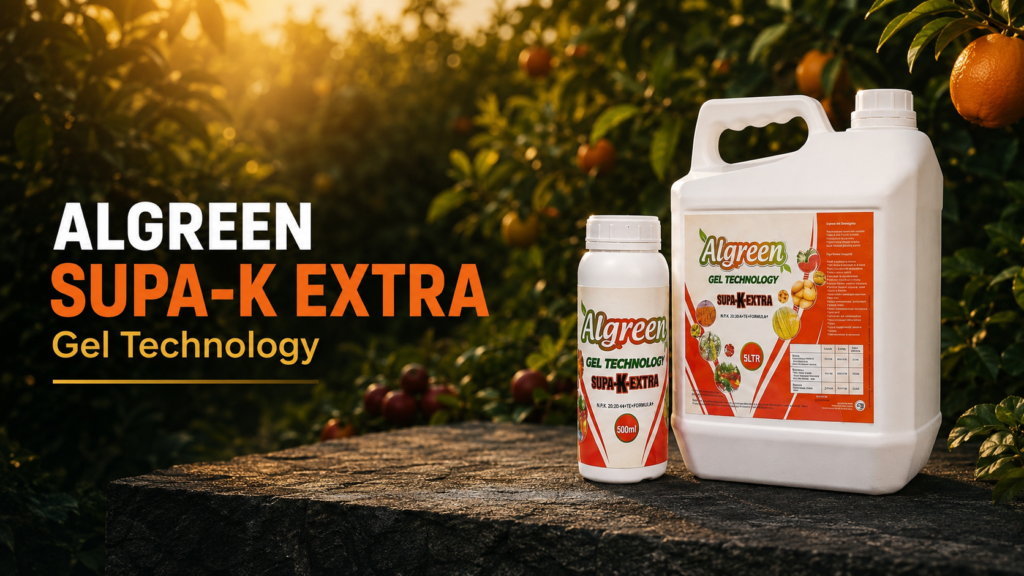
Algreen Supa-K is a highly concentrated liquid potassium foliar fertilizer, analysed at NPK 6:0:42 with trace elements and a natural stimulant, formulated to deliver that potassium straight to the crop through the leaves precisely when demand is at its peak.
This guide explains what Supa-K is, how potassium works in the plant, when and how to apply it, which crops respond best, and how to get the most from every bottle. It is written for Kenyan farmers, from smallholders with a single knapsack to commercial growers running fertigation under greenhouse cover, and the potassium science is sourced so you can trust the reasoning behind the advice.
Written by Solomon Muchori, Agronomist at Solomon Agri. Advisory services for farmers across East Africa. Last updated July 2026.
What is Algreen Supa-K?
Algreen Supa-K is a foliar-applied potassium fertilizer built around a very high potassium concentration. Its analysis is NPK 6:0:42, meaning it supplies 6 percent nitrogen, no phosphorus, and 42 percent potassium, reinforced with trace elements and a natural stimulant that supports uptake and plant vigour.
It is sold in a range of pack sizes, from 100 ml, 250 ml, and 500 ml up to 1 litre, 5 litres, and 20 litres, so smallholders and large commercial growers alike can match the container to their acreage.
The product is designed for all fruiting crops. Its purpose is to produce big fruits with good colour, sweetness, shelf life, and storability in crops such as tomatoes, watermelons, potatoes, and other fruits, and to support fuller, more even grain filling in cereals.
In other words, Supa-K is a quality-and-finish product. It is what you reach for once the crop has been established and grown, when the job now is to convert that growth into a heavy, high-value, marketable harvest.
Quick facts
| Attribute | Detail |
|---|---|
| Product type | Concentrated liquid potassium foliar fertilizer |
| Analysis | NPK 6:0:42 plus trace elements and stimulant |
| Primary nutrient | Potassium (K), 42 percent |
| Application method | Foliar spray, also suitable for fertigation |
| Standard rate | 30 to 50 ml per 20 litres of water |
| Pack sizes | 100 ml, 250 ml, 500 ml, 1 L, 5 L, 20 L |
| Main use | Fruit size, colour, sweetness, storability, grain filling |
| Best stage | Flowering through fruiting and grain filling |
Why potassium matters: the science in plain language
Potassium is one of the three primary macronutrients, alongside nitrogen and phosphorus, but unlike them it does not become part of the plant’s structural tissue. Instead, it acts as a regulator and an activator, and plants require it in large amounts, especially fruiting crops.
Understanding its main jobs makes clear why a dedicated potassium feed like Supa-K is so valuable at the fruiting stage.
Water regulation. Potassium controls the opening and closing of the stomata, the tiny pores on the leaf through which the plant loses water and takes in carbon dioxide.
When potassium is adequate, the plant manages its water use efficiently, stays turgid, and resists wilting during hot or dry spells. When potassium is short, the plant loses water carelessly and suffers stress far sooner. This role in stomatal regulation and water balance is a large part of why good potassium nutrition improves drought tolerance .
Sugar and starch transport. The leaves manufacture sugars through photosynthesis, but those sugars have to be moved to the fruits, tubers, and grains where they are stored. Potassium is the nutrient that drives this translocation of sugars from the leaves into the developing fruit .
Research on citrus has shown that good potassium nutrition increases sugar accumulation in the fruit by strengthening this flow of carbon from the leaves . A potassium-rich crop moves more of its manufactured energy into the harvestable parts, which is precisely why potassium is linked to bigger, sweeter fruit and heavier grain.
Enzyme activation. Potassium activates dozens of enzymes that run the plant’s metabolism, and it is essential to protein synthesis and to the general efficiency of the plant’s internal chemistry. A crop short of potassium runs its metabolism inefficiently even when other nutrients are present.
Quality and resilience. Adequate potassium builds firmer tissue and stronger cell walls, which translates into produce that stores longer, transports better, and resists bruising. It also strengthens stems against lodging and helps the plant tolerate disease and environmental stress. During storage, potassium-deficient produce breaks down faster because sugars and acids degrade more quickly when potassium is short, which is why potassium is so closely tied to shelf life .
Recognising potassium deficiency
Because potassium is mobile within the plant, deficiency symptoms usually appear on the older, lower leaves first, as the plant moves its limited potassium to the growing tips and developing fruit . Knowing the signs helps you decide when a corrective foliar feed is needed.
| Symptom | What it looks like |
|---|---|
| Leaf-edge scorch | Yellowing and browning that starts at the margins and tips of older leaves |
| Interveinal yellowing | Yellow patches between the veins on lower leaves while the veins stay green |
| Weak stems | Plants that lodge or fall over easily |
| Poor fruit quality | Small, pale, unevenly ripened fruit with low sugar content |
| Uneven grain fill | Cereals with light, poorly filled grain |
| Increased wilting | Crops that wilt quickly under mild heat or water stress |
One important point: potassium deficiency can occur even when a soil test shows adequate potassium, particularly in high-demand fruit crops during heavy fruiting, because the crop’s demand outpaces what the roots can supply from the soil.
This is exactly the gap a foliar feed is designed to close. Foliar potassium, such as Supa-K, is the fastest way to respond to these symptoms, because it delivers potassium directly to the leaf tissue, where it is absorbed within hours, rather than waiting for roots to take it up from the soil.
Key benefits of Algreen Supa-K
Bigger, better-quality fruit. The high potassium concentration drives fruit expansion and the accumulation of sugars, giving larger fruit with deeper, more even colour and higher sweetness, the qualities buyers pay a premium for.
Improved shelf life and storability. Firmer tissue and stronger cell walls mean produce that lasts longer after harvest and survives handling and transport to distant markets with less loss.
Proper grain filling. In cereals such as maize and wheat, potassium supports the movement of assimilates into the grain, producing heavier, better-formed grain and improving both yield and quality.
Drought and stress tolerance. By regulating water use through the stomata, potassium helps the crop hold up through hot, dry periods that would otherwise cause wilting and yield loss.
Fast correction of deficiency. As a foliar feed, Supa-K bypasses the slow soil-and-root route and supplies potassium directly when the crop’s demand suddenly spikes at fruiting.
Added trace elements and stimulant. The trace elements cover minor nutrient gaps, while the natural stimulant supports uptake and overall vigour, so the potassium is used efficiently.
How to use Algreen Supa-K
The standard rate is 30 to 50 ml of Supa-K per 20 litres of clean water, applied as a foliar spray. Begin at the onset of flowering and continue through fruit set and fruit development, repeating at your normal spray interval so the crop has a steady supply of potassium through the whole quality-building phase. For cereals, target the period from flowering into grain filling.
Fill the tank with about half the required water, add the measured Supa-K, then top up with the remaining water while agitating so the solution is uniform. Spray to cover the foliage thoroughly, aiming for even coverage of the leaf surface rather than a heavy stream in one place.
Spray in the early morning or late afternoon, when temperatures are lower and the stomata are open, since this is when leaf uptake is most efficient. Avoid spraying in the heat of the day, in strong wind, or when rain is expected within a few hours.
Dosage at a glance
| Water volume | Supa-K (low rate) | Supa-K (high rate) |
|---|---|---|
| 20 L (one knapsack) | 30 ml | 50 ml |
| 100 L | 150 ml | 250 ml |
| 200 L | 300 ml | 500 ml |
Use the lower end of the range for routine maintenance and the higher end where deficiency symptoms are visible or the crop is carrying a heavy fruit load.
Crop-by-crop application guide
| Crop | When to apply | What it does |
|---|---|---|
| Tomatoes | From first fruit set, repeating through harvest | Larger, firmer, sweeter fruit with better colour and shelf life |
| Watermelon and melons | From fruit set through swelling | Bigger fruit, higher sugar content, better storability |
| Potatoes | During tuber bulking | Larger tubers with better quality and storage |
| Capsicum and other fruits | From flowering through fruit development | Improved size, colour, and firmness |
| Maize and wheat | From flowering into grain filling | Heavier, better-filled grain |
| French beans and peas | From pod set | Better pod fill and quality |
A simple seasonal nutrition calendar
Supa-K is a finishing product, so it fits into the second half of a crop’s life. A typical foliar programme for a fruiting crop might run like this:
| Stage | Nutrition focus | Suggested Algreen product |
|---|---|---|
| Establishment | Roots and phosphorus | Planta-P |
| Vegetative growth | Nitrogen and leaf development | Hynitro 42 |
| Flowering and fruit set | Micronutrients and calcium | Bonzin, Magical |
| Fruiting and grain filling | Potassium for quality and finish | Supa-K |
This staged approach ensures each nutrient is supplied when the crop actually needs it, rather than applying everything at once.
Can Supa-K be used in fertigation?
Yes. Supa-K is a liquid formulation, and liquid potassium feeds are well suited to injection through drip irrigation, which is standard practice on commercial fruit and vegetable farms, including greenhouse operations in Kenya. Applied through the system, it supplies potassium to the root zone across the fruiting period, while foliar sprays remain useful for a fast, targeted top-up at peak demand.
When fertigating, flush the lines with plain water afterward to prevent residue building up in the emitters, and keep potassium feeds separate from any calcium product in the injection to avoid precipitates. For the full picture, see our guide to using Algreen in irrigation and fertigation.
Getting spray application right: water quality and technique
Foliar feeding only works if the nutrient actually reaches and enters the leaf, so the mechanics of spraying matter as much as the product itself.
The first factor is water quality. Very hard water, high in calcium and magnesium, or water with a high pH, can reduce the effectiveness of some foliar sprays and encourage residues that clog nozzles. Where possible, use clean water of moderate pH, ideally slightly acidic to neutral, and where water is very hard, a small volume of a compatible buffering agent can help. Always use clean water free of silt, which otherwise settles in the tank and blocks filters.
The second factor is coverage and droplet size. The aim of a foliar spray is a fine, even film over the leaf surface rather than large droplets that run off and are wasted on the ground. A well-calibrated sprayer producing medium-to-fine droplets, moved at a steady pace, gives the most uniform coverage. Spray to the point where the leaf is wetted but not dripping.
Because many stomata sit on the underside of the leaf, take the time to move the lance so the spray penetrates the canopy and reaches the leaf undersides, where uptake is highest.
The third factor is timing within the day. Leaf uptake is greatest when the stomata are open and the leaf surface stays moist long enough for absorption to occur. Early morning and late afternoon meet both conditions, since temperatures are lower, humidity is higher, and the spray film lingers rather than flashing off in minutes .
Midday spraying in bright sun and heat dries the droplets too quickly and can scorch the foliage. Avoid spraying when rain is likely within a few hours, as it will wash the product off before the crop has absorbed it.
How foliar potassium complements soil nutrition
It is worth being clear about what a foliar product like Supa-K is designed to do and what it is not. Foliar feeding is a fast, efficient top-up that meets short, intense spikes in demand and corrects deficiencies quickly. It is not a total replacement for sound soil fertility.
A crop takes up the bulk of its potassium through the roots over the season, and a well-managed soil with adequate potassium reserves is the foundation. Leaves can absorb only a limited quantity of a nutrient at a time, so a spray cannot supply a crop’s entire potassium demand.
Supa-K comes into its own during the fruiting and grain-filling stages, when the crop’s potassium demand rises faster than the roots can supply it from the soil, and when the difference between an adequate and an abundant potassium supply shows up directly in fruit quality.
Used this way, as a targeted top-up on top of good soil management, foliar potassium gives the best return. It ensures that all the investment already made in land preparation, seed, base fertilizer, and crop protection is converted into the heaviest, highest-quality harvest the crop is capable of, rather than being lost to a late-season potassium shortfall.
The economic case for a quality-finishing feed
Most of the cost of growing a crop is committed early. Land preparation, seed, base fertilizer, labour, and crop protection are all spent before the crop reaches the fruiting stage. By the time the crop is setting fruit, the farmer has already paid for almost everything. A relatively small additional investment in a quality-finishing feed at this point works on the part of the crop that carries the value, the harvestable produce itself.
Larger, firmer, sweeter, better-coloured fruit that stores and travels well commands a higher price and suffers fewer post-harvest losses. In markets where produce is graded, moving a larger share of the harvest into the top grade can lift the average price substantially. This is the logic behind treating potassium at fruiting not as an optional extra but as the step that protects and realises the value of everything spent earlier in the season.
Understanding the NPK figures on the label
The three numbers in an NPK analysis always refer, in order, to nitrogen (N), phosphorus (expressed as P2O5), and potassium (expressed as K2O), given as a percentage of the product. Supa-K’s 6:0:42 therefore tells you at a glance that it is overwhelmingly a potassium product, with a little nitrogen and no phosphorus.
The very high potassium figure is what marks it out as a specialist fruiting-stage feed rather than a general balanced fertilizer. Reading these numbers is the quickest way to match a product to the crop’s stage: a high middle number signals a starter or rooting product, a high first number signals a growth or vegetative product, and a high last number, as here, signals a fruiting and finishing product.
Tank mixing, storage, and safe handling
Supa-K is generally compatible with common foliar products, but as with any mixture, a small jar test is wise before combining it with a new partner. Mix the intended products in a jar of water in the correct proportions and check that no curdling, clumping, or separation occurs before loading the main tank.
Add products to the tank one at a time with the agitator running, and spray tank mixes promptly rather than leaving them to stand. Avoid mixing with strongly alkaline products, and never combine more products than necessary in a single pass. For the full method, see our guide on mixing foliar fertilizer with insecticides and fungicides.
Store Supa-K in its original sealed container in a cool, dry place away from direct sunlight and out of the reach of children, animals, and food. Keep it separate from seed and feed. When handling and spraying, wear appropriate protective equipment, gloves and eye protection at minimum, and wash your hands after use. Triple-rinse empty containers into the spray tank and dispose of them responsibly rather than reusing them.
Troubleshooting and common mistakes
Overdosing. More is not better. Exceeding the 30 to 50 ml rate risks leaf scorch and wastes product, so stay within the recommended range.
Applying too late. Potassium builds fruit quality over the whole fruiting period, so a single late spray achieves little. Start at fruit set and maintain the programme.
Poor coverage. Uneven spraying leaves parts of the crop unfed. Calibrate the sprayer and aim for uniform coverage of the foliage.
Relying on potassium alone. Supa-K finishes the crop, but it cannot compensate for weak roots or poor early nitrogen. Use it as part of a staged programme.
Spraying in the heat. Midday spraying reduces uptake and increases the risk of scorch. Stick to early morning or late afternoon.
Frequently asked questions
What is Algreen Supa-K used for? It supplies concentrated potassium through the leaves to improve fruit size, colour, sweetness, and storability, and to support proper grain filling in cereals. It is a fruiting-stage finishing feed for all fruiting crops.
What is the application rate for Supa-K? 30 to 50 ml per 20 litres of water, sprayed to cover the foliage evenly. Use the lower end for routine maintenance and the higher end where deficiency is visible or the fruit load is heavy.
When should I apply Supa-K? From the onset of flowering through fruit development, and in cereals into grain filling, which is the period of highest potassium demand. Applying it earlier, during pure leaf growth, makes poorer use of it.
Which crops benefit most? All fruiting crops, especially tomatoes, watermelons, potatoes, capsicum, and other fruits, plus cereals such as maize and wheat for grain filling.
Can I use Supa-K together with other feeds? Yes, it is generally compatible, but do a jar test first when combining it with an unfamiliar product, and keep it away from strongly alkaline products and calcium feeds.
Will Supa-K help in dry conditions? Yes. Potassium improves the crop’s water-use efficiency by regulating the stomata, which reduces wilting under heat and drought stress.
Can potassium deficiency happen even if my soil test shows enough potassium? Yes. In heavy-fruiting crops the demand can outpace what the roots supply from the soil, so deficiency appears at fruiting even on soils that test adequate. This is exactly when a foliar top-up helps most.
Does Supa-K replace my soil fertilizer? No. The crop takes up most of its potassium through the roots over the season, so soil fertility is the foundation. Supa-K is a targeted top-up for the fruiting stage, not a replacement for base nutrition.
Related Algreen products
Potassium works best as part of a complete nutrition programme. These other products in the Algreen range complement Supa-K at different stages of the crop:
- Algreen Hynitro 42, high nitrogen for the earlier vegetative growth stage
- Algreen Supasense, balanced NPK feeding across all stages
- Algreen Magical, calcium to keep fruit firm and free of blossom end rot
- Algreen Bonzin, zinc and boron to improve flowering and fruit set
- Algreen Planta-P, phosphate starter feed for strong early roots
This article is part of our complete guide: Algreen Foliar Fertilizers, The Complete Guide.
Get a potassium and nutrition programme for your farm
Timing potassium correctly, on the crop and soil you actually have, is what turns it into fruit quality and income. Solomon Agri provides soil testing, crop nutrition planning, and farm advisory services for farmers across East Africa. Book a consultation or reach an agronomist on WhatsApp for a programme tailored to your farm.
Note: product specifications are as provided by the manufacturer and may be updated over time. The agronomic sources above describe the general science of potassium nutrition and foliar feeding. Always confirm current rates, timing, and directions on the actual Algreen Supa-K label before use, and seek local agronomic advice for your crop and soil.
Pingback: Algreen Bonzin for Better Flowering - Solomon Agri
Pingback: Algreen Hynitro 42: Nitrogen 42% Foliar Fertilizer & How to Use It - Solomon Agri
Pingback: Algreen Magical 1 Prevent Blossom End Rot - Solomon Agri
Pingback: Algreen Foliar Fertilizers: The Complete Guide to the Range, Rates and Uses in Kenya - Solomon Agri
Pingback: Kenya Seed Company Maize Varieties: All 16 Compared by Zone and Yield Per Acre - Solomon Agri