The way a crop begins its life shapes everything that follows. A strong, well-branched root system laid down in the first weeks lets a plant anchor firmly, reach water and nutrients, and grow away vigorously; a weak start leaves the crop struggling to catch up all season.
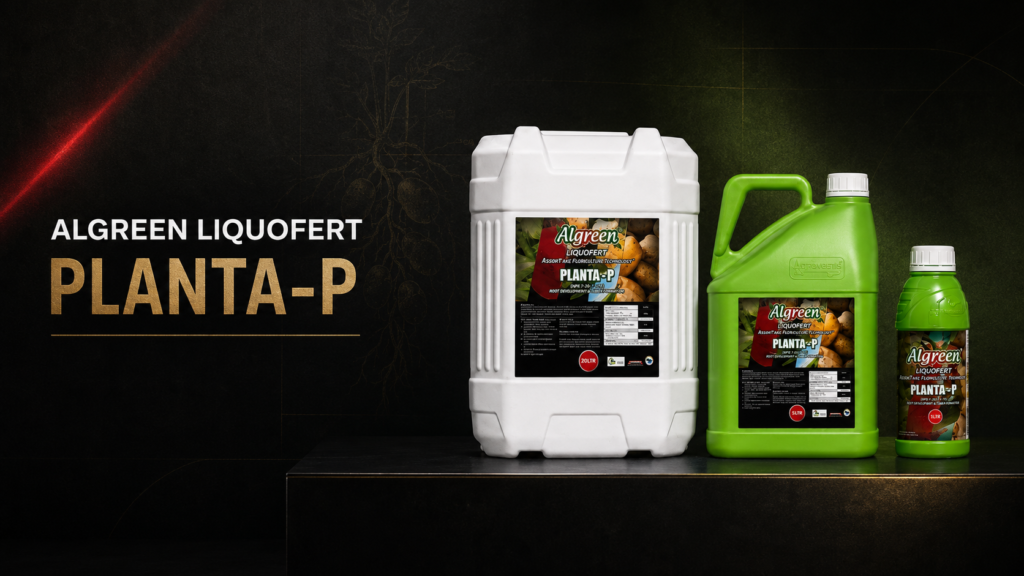
Phosphorus is the nutrient of this early establishment, and Algreen Planta-P is a specialised liquid polyphosphate fertilizer built to supply it efficiently. With an analysis of NPK 15:45:5 plus iron, humic acid, stimulants, and trace elements, and a slow-release polymer structure, Planta-P is designed as the ideal starter feed and a corrective for phosphate deficiency.
This guide explains what it is, how phosphorus works, when and how to apply it, and how to build a strong crop from the ground up.
What is Algreen Planta-P?
Algreen Planta-P is a unique liquid polyphosphate slow-release fertilizer with special polymer chains between the phosphate molecules. Its analysis is NPK 15:45:5 with 1% iron (Fe), 2% humic acid, stimulants, and trace elements (TE).
The high middle figure, 45% phosphorus marks it out as a phosphorus-dominant product. Its stated role is the correction and prevention of phosphate deficiencies, and it is the ideal starter fertilizer where high levels of plant-available phosphorus are required for growth and root production, which is particularly important in early growth stages for cell division and multiplication. Planta-P is available in 100 ml, 250 ml, 500 ml, 1 L, 5 L, 10 L and 20 L packs.
Quick facts
| Attribute | Detail |
|---|---|
| Product type | Liquid polyphosphate slow-release fertilizer |
| Analysis | NPK 15:45:5 + Fe 1% + Humic Acid 2% + Stimulants + TE |
| Primary nutrient | Phosphorus (P) 45% |
| Application method | Foliar spray |
| Standard rate | 50–60 ml per 20 litres of water |
| Pack sizes | 100 ml, 250 ml, 500 ml, 1 L, 5 L, 10 L, 20 L |
| Main use | Starter feed; root development; phosphate-deficiency correction |
| Best stage | Early growth and establishment |
Why phosphorus matters: the science in plain language
Phosphorus is one of the three primary macronutrients, and it has a distinctive set of roles centred on energy and establishment.
Energy transfer. Phosphorus is at the heart of the molecules that store and release energy inside the plant. Every process that requires energy growth, nutrient uptake, and the building of new tissue depends on this phosphorus-based energy currency. A crop short of phosphorus is, in effect, low on usable energy.
Root development. Phosphorus strongly promotes the growth of roots, especially the fine feeder roots that take up water and nutrients. Because roots explore the soil early in the crop’s life, an adequate phosphorus supply at the start builds the root system on which the whole season depends.
Cell division and early growth. Phosphorus is essential for cell division and multiplication, the processes by which a young plant grows. This is why phosphorus demand, relative to the size of the plant, is highest early on.
Flowering and seed formation. Later in the season phosphorus contributes to flowering, seed set and maturity, rounding out its role from establishment through to reproduction. The iron in Planta-P supports chlorophyll formation, and the humic acid improves overall nutrient uptake.
The problem of phosphate lock-up
Phosphorus behaves differently from other nutrients in the soil. Applied as ordinary phosphate, much of it reacts quickly with calcium, iron or aluminium in the soil and becomes fixed chemically locked into forms the plant cannot use.
This is why a soil test can show adequate total phosphorus while the crop still shows deficiency: most of that phosphorus is unavailable. Planta-P addresses this in two ways. As a foliar feed it delivers phosphorus directly to the leaf, bypassing the soil entirely.
And its polyphosphate structure, with polymer chains linking the phosphate molecules, releases phosphorus gradually and resists the rapid lock-up that afflicts ordinary phosphate, keeping more of it available to the plant.
Recognising phosphorus deficiency
| Symptom | What it looks like |
|---|---|
| Purpling | Reddish-purple tints on leaves and stems, often on older leaves |
| Stunted growth | Small, slow-growing plants |
| Poor root system | Sparse, weak roots and unstable plants |
| Delayed maturity | Slow flowering and late ripening |
| Dull dark-green leaves | Abnormally dark foliage before purpling appears |
Because early phosphorus is so hard to recover later, catching these symptoms and responding quickly with a foliar feed such as Planta-P is important.
Key benefits of Algreen Planta-P
Strong early roots. The high phosphorus content builds an extensive root system that anchors the plant and mines water and nutrients efficiently.
Ideal starter feed. It supplies the concentrated phosphorus a young crop needs for cell division and rapid establishment.
Corrects phosphate deficiency. Foliar delivery and the polyphosphate structure make phosphorus available even where soil phosphorus is locked up.
Slow, sustained release. The polymer chains release phosphorus gradually, extending availability rather than delivering it all at once.
Added iron and humic acid. Iron supports green, healthy foliage, while humic acid improves uptake of the whole package.
Better establishment, better season. A crop that establishes well has a higher yield ceiling for the rest of its life.
How to use Algreen Planta-P
The standard rate is 50–60 ml of Planta-P per 20 litres of clean water, applied as a foliar spray. It is most valuable during the early growth and establishment stages, when root production and cell division are at their peak, and wherever plant symptoms or a soil test indicate phosphorus is limiting. Half-fill the tank, add the measured product, then top up with water while agitating for a uniform solution. Spray to cover the foliage evenly, and apply in the cooler hours of early morning or late afternoon for the best uptake.
Dosage at a glance
| Water volume | Planta-P (low rate) | Planta-P (high rate) |
|---|---|---|
| 20 L (one knapsack) | 50 ml | 60 ml |
| 100 L | 250 ml | 300 ml |
| 200 L | 500 ml | 600 ml |
Crop-by-crop application guide
| Crop | When to apply | What it does |
|---|---|---|
| Transplanted vegetables | Soon after transplanting | Rapid root establishment and reduced transplant shock |
| Maize & cereals | Early growth stage | Strong roots and vigorous early development |
| Tomatoes & capsicum | Early growth, before flowering | Good root frame to support later fruiting |
| Legumes | Early growth | Root and nodule development for nitrogen fixation |
| Potatoes | Early growth | Root system to support tuber production |
A simple seasonal nutrition calendar
Planta-P leads at the very start, laying the foundation for the products that follow.
| Stage | Nutrition focus | Suggested Algreen product |
|---|---|---|
| Establishment | Roots and phosphorus | Planta-P |
| Vegetative growth | Nitrogen for size and tillering | Hynitro 42 |
| Flowering / fruit set | Micronutrients and calcium | Bonzin, Magical |
| Fruiting / grain filling | Potassium for quality | Supa-K |
Getting spray application right: water quality and technique
A foliar feed only works if it reaches and enters the leaf. Use clean water of moderate pH, since very hard or silty water reduces effectiveness and clogs nozzles. Aim for a fine, even film over the leaf, wetting it without heavy run-off, and reach the underside of leaves where the stomata, the pores that absorb nutrients, are most numerous.
A well-calibrated sprayer producing medium- to fine-sized droplets, moved at a steady pace, provides the most uniform coverage. Spray in early morning or late afternoon, when stomata are open, and the film lingers long enough for absorption, and avoid midday heat, strong wind, or spraying when rain is expected within a few hours.
Why the starter stage repays attention
Of all the money spent growing a crop, the amount needed to get establishment right is small, yet its influence on the final result is large. A crop that establishes a strong root system quickly captures water and nutrients more effectively for the rest of the season, withstands dry spells better, and grows away from early pest and disease pressure.
A crop that establishes poorly because phosphorus was short or locked up when the young plant needed it carries that handicap through to harvest, and no amount of later feeding fully compensates. This is the agronomic logic behind investing in a phosphorus starter such as Planta-P: it is a small, early, high-return input that protects the value of everything spent afterwards. It is especially worthwhile on transplanted crops, which suffer a check when they are moved and benefit greatly from rapid new-root growth, and on cold or phosphorus-fixing soils where ordinary phosphate is slow to become available.
How foliar phosphorus complements soil nutrition
Planta-P is a targeted top-up, not a replacement for soil phosphorus. The bulk of a crop’s phosphorus still comes from the soil, and building soil phosphorus reserves through good base fertilization and organic matter is the long-term foundation.
Foliar phosphorus is most useful in the specific situations where soil phosphorus falls short of the crop’s immediate need during the intense early-growth demand, on soils where phosphate locks up rapidly, and in cold or dry conditions when root uptake slows. Delivered straight to the leaf, it meets that immediate need while the soil-and-root system does the longer-term work. Combining a foliar starter with attention to soil phosphorus over time gives the most reliable establishment season after season.
Understanding the label figures
In an NPK analysis, the three numbers are nitrogen, phosphorus (as P2O5), and potassium (as K2O), in that order. Planta-P’s 15:45:5 shows immediately that it is a phosphorus-dominant product; the middle figure is by far the largest. A high middle number is the signature of a starter or rooting fertilizer, just as a high first number marks a growth product and a high last number a fruiting product. The additional 1% iron and 2% humic acid are not part of the NPK figures but add value: iron for chlorophyll and green colour, humic acid for improved uptake. Reading the label this way makes it clear at a glance that Planta-P belongs at the start of the crop, not the finish.
Tank mixing and compatibility
Planta-P is generally compatible with common foliar products, but do a jar test before combining it with an unfamiliar partner: mix the products in a jar of water in the intended proportions and check for curdling, clumping or separation before loading the tank. Add products one at a time with the agitator running, spray tank mixes promptly, avoid strongly alkaline partners, and keep mixtures simple.
Storage and safe handling
Store the product in its original sealed container in a cool, dry place out of direct sunlight and away from children, animals, food, seed and feed. Wear gloves and eye protection when handling and spraying, and wash hands afterwards. Triple-rinse empty containers into the spray tank and dispose of them responsibly.
Troubleshooting and common mistakes
Applying phosphorus too late. Phosphorus has its greatest impact early; a mid-season application misses the window. Use Planta-P as a starter.
Relying on soil phosphorus alone on fixing soils. Where phosphate locks up, a foliar feed is often the only way to get phosphorus to the crop quickly.
Overdosing. Stay within 50–60 ml per 20 L to avoid waste and scorch.
Poor coverage. Calibrate the sprayer and cover the foliage evenly.
Spraying in the heat. Apply in the cooler hours for better uptake.
Frequently asked questions
What is Algreen Planta-P used for? As a starter feed to build strong early roots and to correct or prevent phosphorus deficiency.
What is the application rate? 50–60 ml per 20 litres of water.
Why polyphosphate? The slow-release polymer structure keeps phosphorus available and resists the rapid lock-up that affects ordinary phosphate in soil.
When should I apply it? During early growth and establishment, when root production and cell division peak.
Which crops benefit most? All crops at establishment, especially transplanted vegetables and crops on cold or phosphorus-fixing soils.
Does it replace soil phosphorus? No — it is a targeted foliar top-up that complements good soil phosphorus management.
The role of iron and humic acid in Planta-P
Beyond its headline phosphorus, Planta-P carries 1% iron and 2% humic acid, and both add practical value. Iron is a micronutrient essential for the formation of chlorophyll; a crop short of iron shows a distinctive yellowing of the youngest leaves while the veins stay green, and its photosynthesis suffers.
Including iron in a starter feed helps ensure that the young crop, which is building its leaf machinery at the same time as its roots, has the iron it needs for healthy green growth. Humic acid, meanwhile, is a stable organic fraction that improves the uptake and use of nutrients, supports root activity, and helps chelate minerals into forms the plant can absorb.
In a phosphorus product, this is especially useful because humic substances can help keep phosphorus available rather than letting it lock up. Together, the iron and humic acid turn Planta-P from a straight phosphate source into a more complete establishment feed that supports roots, green colour, and efficient nutrient use all at once.
Establishment on difficult soils
The value of a phosphorus starter rises sharply on soils where phosphorus is naturally hard to obtain. Many soils fix phosphorus rapidly: acidic soils tend to bind it with iron and aluminium, while high-calcium soils bind it as calcium phosphates, and in both cases the phosphorus becomes largely unavailable to the crop soon after it is applied to the soil.
Cold soils compound the problem because both the release of phosphorus and the root activity needed to capture it slow down at low temperatures, which is why crops planted early in a cool season often show purpling even on soils with adequate phosphorus reserves.
On all of these difficult soils, a foliar phosphorus feed is particularly valuable because it delivers phosphorus straight to the leaf and sidesteps the soil chemistry that would otherwise lock it away. For a grower working with acidic, calcareous or cold soils, building a foliar phosphorus application into the establishment programme is one of the most reliable ways to give the crop the strong start that soil phosphorus alone may fail to provide.
Roots as the engine of the whole season
It is worth dwelling on why root development, which Planta-P is designed to support, matters so much. The root system is the crop’s supply line: everything the plant takes up water and every soil nutrient comes through the roots. A large, well-branched, deep root system reaches more soil, buffers the crop against dry spells, and delivers nutrients steadily to the growing plant.
A small or shallow root system limits the crop, no matter how fertile the soil or how good the weather, because the plant simply cannot access what it needs fast enough. Since the framework of the root system is largely established early in the crop’s life, the phosphorus supply during those first weeks has a lasting influence on how well the crop can feed and water itself for the entire season. Investing in root development at the start, through a phosphorus starter such as Planta-P, therefore pays dividends right through to harvest, long after the application itself is finished.
Related Algreen products
Phosphorus builds the foundation; other nutrients build on it. These Algreen products carry the crop through the rest of the season:
- Algreen Hynitro 42 — nitrogen for vegetative growth after establishment
- Algreen Cytomone — hormones to boost rooting and germination
- Algreen Organohumos — humic and fulvic acids for healthier soil
- Algreen Supasense — balanced NPK maintenance feed
- Algreen Supa-K — potassium for the fruiting stage
This article is part of our complete guide: Algreen Foliar Fertilizers — The Complete Guide.
Pingback: Algreen Magical 1 Prevent Blossom End Rot - Solomon Agri
Pingback: Algreen Foliar Fertilizer: 10 Best Rates, Complete Guide - Solomon Agri
Pingback: Kenya Seed Company Maize Varieties: All 16 Compared by Zone and Yield Per Acre - Solomon Agri
Pingback: Algreen Gel Technology: 9 Products, 4 Claims - Solomon Agri