A crop that flowers heavily but sets little fruit is one of the most frustrating sights in farming: the potential is visibly there, yet it slips away as flowers drop and young fruit fails to hold. Very often, the cause is a shortage of two micronutrients that sit at the heart of flowering and fruit set: zinc and boron.
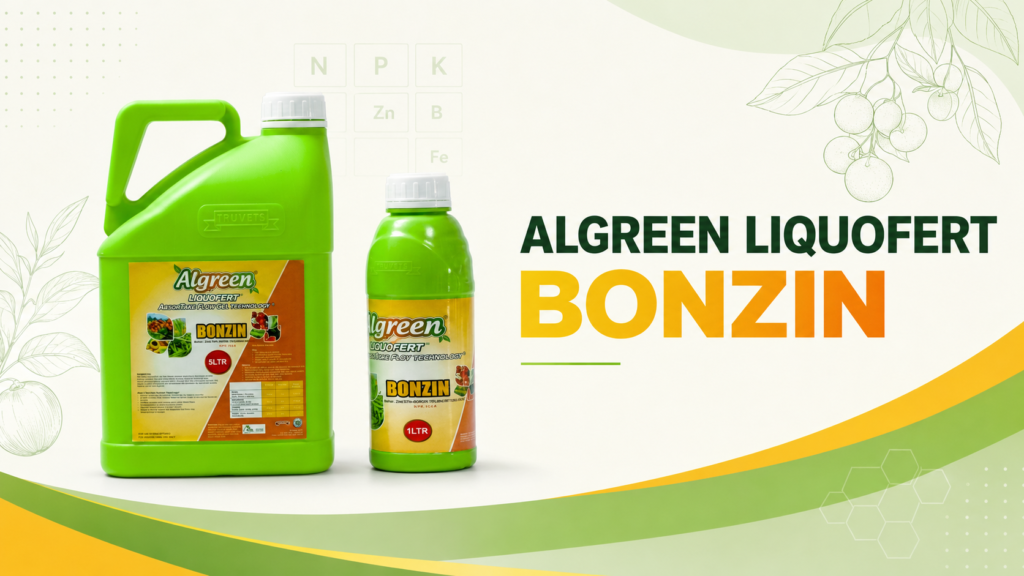
Algreen Bonzin delivers both in a single concentrated foliar feed, supplying 10% zinc and 15% boron with a natural stimulant to boost flower formation and prevent flower abortion and fruit drop. This guide explains what Bonzin is, how zinc and boron drive fruit set, when and how to apply it, and how to convert more of a crop’s flowers into harvestable fruit.
What is Algreen Bonzin?
Algreen Bonzin is a micronutrient foliar feed combining Zinc 10% and Boron 15% with a stimulant. Its stated purpose is to provide a high concentration of boron and zinc with hormones, to increase flower formation, and to prevent flower abortion and fruit drops. It is a flowering-stage product, used to correct the micronutrient deficiencies that quietly limit fruit set. Bonzin is available in 100 ml, 250 ml, 500 ml, 1 L, 5 L and 20 L packs.
Quick facts
| Attribute | Detail |
|---|---|
| Product type | Concentrated liquid micronutrient foliar feed |
| Analysis | Zinc 10% + Boron 15% + Stimulant |
| Primary nutrients | Zinc and Boron |
| Application method | Foliar spray |
| Standard rate | 20–30 ml per 20 litres of water |
| Pack sizes | 100 ml, 250 ml, 500 ml, 1 L, 5 L, 20 L |
| Main use | Flower formation; prevent flower abortion and fruit drop |
| Best stage | From the onset of flowering through fruit set |
Why zinc and boron matter: the science in plain language
Zinc and boron are micronutrients — the plant needs them only in small amounts — but their influence on flowering and fruit set is out of all proportion to the quantities involved. A shortage of either can quietly cap a crop’s yield even when every major nutrient is present.
Boron is essential for reproduction. It is needed for the viability of pollen and for the growth of the pollen tube that fertilises the flower, so a boron shortage means poor pollination and poor fruit set. Boron also plays a role in the movement of sugars into developing fruit and, as noted in the calcium story, in the movement of calcium within the plant. Because boron is poorly mobile, its supply during flowering is critical; the plant cannot easily move it from old tissue to the flowers.
Zinc is central to the production of natural plant hormones, particularly auxin, which governs growth and the development of flowers and fruit. Zinc is also involved in many enzymes and in protein synthesis. A zinc shortage disrupts hormone balance and enzyme activity, leading to poor flowering, small leaves and weak fruit set.
Together, zinc and boron underpin the whole flowering-to-fruit-set transition. Supplying them at the right moment, through a foliar feed like Bonzin, addresses two of the most common hidden limits on yield in one application, and the added stimulant supports overall vigour and uptake.
Recognising zinc and boron deficiency
| Symptom | What it suggests |
|---|---|
| Poor fruit set despite heavy flowering | Boron or zinc shortage |
| Flower drop and fruit drop | Boron or zinc shortage |
| Hollow or corky fruit, cracked fruit | Boron shortage |
| Small, narrow leaves in rosettes | Zinc shortage |
| Short internodes, stunted shoot tips | Zinc shortage |
| Death of growing points | Severe boron shortage |
Key benefits of Algreen Bonzin
More flower formation. Correcting zinc and boron shortages helps the crop set the abundant, healthy flowers that are the starting point of yield.
Prevents flower abortion. Adequate boron and zinc help the crop hold its flowers rather than shedding them before they set.
Prevents fruit drop. Young fruit is more likely to stay on the plant and develop rather than dropping early.
Better fruit set. Improved pollination and hormone balance convert more flowers into fruit — often the single biggest lever on final yield.
Corrects hidden deficiencies. Micronutrient shortages that show no obvious leaf symptoms but still limit yield are addressed directly.
Supports fruit quality. Boron’s role in sugar and calcium movement contributes to sounder, better-quality fruit.
How to use Algreen Bonzin
The standard rate is 20–30 ml of Bonzin per 20 litres of clean water, applied as a foliar spray. Timing is critical: apply at the onset of flowering, and repeat through the flowering and fruit-set period, when the crop’s demand for zinc and boron is at its peak. Some growers also apply a little before flowering to build reserves ahead of the flush. Half-fill the tank, add the measured product, top up while agitating, and spray to cover the foliage and flowers evenly, in the cooler hours of early morning or late afternoon.
Dosage at a glance
| Water volume | Bonzin (low rate) | Bonzin (high rate) |
|---|---|---|
| 20 L (one knapsack) | 20 ml | 30 ml |
| 100 L | 100 ml | 150 ml |
| 200 L | 200 ml | 300 ml |
Boron has a relatively narrow margin between sufficiency and excess, so it is especially important to stay within the recommended rate and not to over-apply.
Crop-by-crop application guide
| Crop | When to apply | What it does |
|---|---|---|
| Tomatoes & capsicum | At flowering, repeated through set | Better fruit set, less flower drop |
| Cucurbits (melon, cucumber) | At flowering | Improved pollination and fruit set |
| Legumes (beans, peas) | At flowering | Better pod set and fill |
| Fruit trees | Before and during flowering | Improved set and reduced drop |
| Coffee | At flowering | Better berry set |
A simple seasonal nutrition calendar
| Stage | Nutrition focus | Suggested Algreen product |
|---|---|---|
| Establishment | Roots and phosphorus | Planta-P |
| Vegetative growth | Nitrogen | Hynitro 42 |
| Flowering / fruit set | Zinc and boron for set | Bonzin, Magical |
| Fruiting / grain filling | Potassium for quality | Supa-K |
Getting spray application right: water quality and technique
A foliar feed only works if it reaches and enters the plant. Use clean water of moderate pH, since very hard or silty water reduces effectiveness and clogs nozzles. Aim for a fine, even film over the foliage and flowers, wetting them without heavy run-off, and reach the underside of leaves where the stomata, the pores that absorb nutrients, are most numerous.
A well-calibrated sprayer producing medium-to-fine droplets, moved at a steady pace, gives the most uniform coverage. Spray in early morning or late afternoon, when stomata are open, and the film lingers long enough for absorption, and avoid midday heat, strong wind, or spraying when rain is expected within a few hours.
Fruit set: the hinge on which yield turns
It is worth appreciating just how decisive fruit set is for the final harvest. A crop produces far more flowers than it can ever carry as fruit, and the proportion of those flowers that successfully set and hold determines a large part of the yield.
A small improvement in the set rate, a few percentage points more flowers holding as fruit, can translate into a substantial increase in the number of fruit harvested, because the crop is working from a large base of flowers. This is why the flowering-to-set window repays close attention, and why correcting a zinc or boron shortage at exactly this point is so valuable: it works on the hinge of the whole yield.
A crop that flowers well but sets poorly is leaving its yield on the ground, and micronutrient nutrition is frequently the missing piece.
The narrow margin of boron
Boron deserves particular respect, because it has a narrower margin between deficiency and toxicity than most nutrients. A crop can be harmed by too little boron, but it can also be harmed by too much, and the gap between the two is smaller than for, say, nitrogen or potassium.
This is why the recommended Bonzin rate should be observed carefully and not exceeded on the assumption that more will help. It is also why boron is best applied as a measured foliar feed at the flowering stage rather than dumped heavily onto the soil, where uneven distribution could create pockets of excess.
Applied correctly at the label rate and timed to flowering, Bonzin supplies the boron the crop needs at the moment it needs it, safely and effectively. Growers who have had boron-deficiency problems should still resist the temptation to over-correct; a consistent, correctly dosed programme is both safer and more effective than a single heavy application.
How foliar micronutrients complement soil nutrition
Zinc and boron are needed in such small amounts that a foliar feed is often the most precise and efficient way to supply them. Applied to the soil, micronutrients can be tied up, distributed unevenly, or, in boron’s case, applied to excess by accident. A foliar spray delivers a measured dose directly to the crop at the stage it is needed, which suits micronutrients particularly well.
This does not replace attention to soil fertility a healthy soil with reasonable micronutrient levels is still the foundation, but for correcting the specific, timing-sensitive demand of the flowering stage, a foliar feed such as Bonzin is usually the better tool. Used together with sound soil management, it ensures that the crop’s flowering is never held back by a hidden zinc or boron shortage.
Tank mixing and compatibility
Bonzin is generally compatible with common foliar products, but do a jar test before combining it with an unfamiliar partner: mix the products in a jar of water in the intended proportions and check for curdling, clumping or separation before loading the tank. Add products one at a time with the agitator running, spray tank mixes promptly, avoid strongly alkaline partners, and keep mixtures simple.
Storage and safe handling
Store the product in its original sealed container in a cool, dry place out of direct sunlight and away from children, animals, food, seed and feed. Wear gloves and eye protection when handling and spraying, and wash hands afterwards. Triple-rinse empty containers into the spray tank and dispose of them responsibly.
Troubleshooting and common mistakes
Applying too late. Bonzin works at flowering and fruit set; a spray applied after set achieves little. Time it to the onset of flowering.
Over-applying boron. Boron has a narrow safe margin; never exceed the recommended rate.
Missing the reserve window. A pre-flowering application can build reserves for the flush; do not rely solely on a single spray at peak bloom.
Poor coverage. Calibrate the sprayer and cover foliage and flowers evenly.
Spraying in the heat. Apply in the cooler hours for better uptake.
Frequently asked questions
What is Algreen Bonzin used for? To boost flower formation and prevent flower abortion and fruit drop through zinc and boron nutrition.
What is the application rate? 20–30 ml per 20 litres of water — stay within this range because boron has a narrow safe margin.
When is the best time to apply? At the onset of flowering and through fruit set, when demand for zinc and boron peaks.
Which crops benefit most? Any flowering and fruiting crop, such as tomatoes, capsicum, cucurbits, legumes, and fruit trees especially where flower drop or poor set is a problem.
Can too much boron harm the crop? Yes — boron has a narrow margin between sufficiency and toxicity, so keep to the recommended rate.
Can I mix it with other products? Generally yes, but do a jar test first with any unfamiliar partner.
Zinc, hormones and the shape of the plant
Zinc’s role in the plant goes beyond flowering, and understanding it helps explain the range of symptoms a shortage produces. Zinc is required for the plant to manufacture auxin, one of its most important natural growth hormones.
Auxin controls the elongation of stems and the development of growing points, so when zinc is short and auxin production falters, the spaces between leaves on a stem shorten and the leaves cluster together in a rosette, giving the stunted, bunched appearance that is a classic sign of zinc deficiency.
Small, narrow leaves are another hallmark. Because auxin also influences flowering and fruit development, a zinc shortage that shows up as odd-looking growth is usually also quietly undermining fruit set.
Correcting zinc, therefore, does two jobs at once: it restores normal growth and shoot development, and it supports the hormone balance the crop needs to flower and set fruit properly. This dual role is part of why a combined zinc-and-boron product is such a practical tool at the flowering stage.
Getting the most from a flowering-stage spray
Because Bonzin works during a specific and relatively short window, a little planning greatly increases its effect. The goal is to have zinc and boron present in the crop as flowering begins and to keep them available through the set period, rather than arriving late.
On crops with a defined flowering flush, this means timing the first application to the very start of flowering, or even just before, so the nutrients are in place when the flowers open. On crops that flower over an extended period, such as tomatoes and peppers that set fruit continuously, it means maintaining a regular programme through the flowering season so that each successive flush is supported.
Coverage matters too: the spray should reach the flowering parts of the crop, not just the lower leaves, so direct the application into the flowering zone of the canopy. And because the flowering stage often coincides with the crop’s need for calcium and, soon after, potassium, planning how Bonzin fits alongside those products in sequence or, where compatible,
in combination makes for a smoother, more effective programme overall. Thinking of the flowering window as a short, high-value period that deserves focused attention is the mindset that gets the best return from a micronutrient feed.
The economic value of better fruit set
Of all the stages at which a grower can intervene, flowering and fruit set offer some of the highest returns, precisely because the crop is working from such a large base of flowers. Almost all of the cost of the crop has been committed by the time it flowers, so protecting and improving fruit set defends that entire investment.
A crop that sheds its flowers or drops its young fruit converts very little of its growth into saleable produce, and no amount of feeding afterward can recreate fruit that never set. By contrast, a modest, well-timed micronutrient application that lifts the set rate works directly on the number of fruit the crop will carry to harvest, multiplying its effect across every flower on the plant.
For high-value fruiting and vegetable crops, where each additional held fruit represents real income, ensuring that zinc and boron are never the limiting factor during flowering is one of the most cost-effective decisions in the whole nutrition programme. This is the practical case for treating the flowering window as a priority and for keeping a micronutrient feed such as Bonzin as a standard part of the crop’s fruiting-stage management rather than an afterthought reached for only when problems appear.
Related Algreen products
Good flowering is the start of good yield. These other Algreen products build on it:
- Algreen Magical — calcium to prevent blossom end rot and firm the fruit
- Algreen Supa-K — potassium for fruit size and sweetness
- Algreen Cytomone — hormones to promote uniform flowering
- Algreen Supasense — balanced NPK nutrition
- Algreen Hynitro 42 — nitrogen for the earlier growth stage
This article is part of our complete guide: Algreen Foliar Fertilizers — The Complete Guide.
Pingback: Algreen Gel Technology: 9 Products, 4 Claims - Solomon Agri