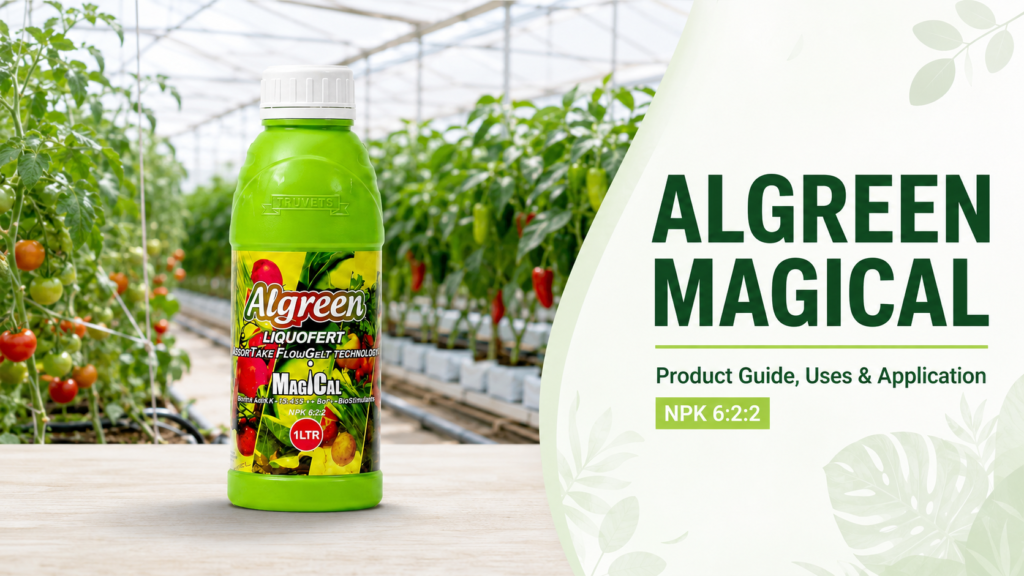
Algreen Magical is a highly concentrated calcium, magnesium, and nitrogen foliar fertilizer with trace boron and hormones. It is used to support calcium nutrition during fruiting and to help reduce blossom end rot in tomatoes and other fruiting crops.
It supplies calcium and magnesium at the stage when the plant’s demand is highest. It works best as part of a programme that also gets the watering right, because blossom end rot is driven as much by how calcium moves through the plant as by how much calcium is available.
This guide explains what blossom end rot really is, why calcium is central to it, and how and when to use Magical. Just as importantly, it covers the watering and management steps that a calcium spray supports but cannot replace. Being straight about that last point is what separates sound agronomy from a sales pitch, and it is the difference between a farmer who solves the problem and one who keeps fighting it.
Written by Solomon Muchori, Agronomist at Solomon Agri. Advisory services for farmers across East Africa. Last updated July 2026.
Quick facts
| Attribute | Detail |
|---|---|
| Product type | Concentrated liquid calcium foliar fertilizer |
| Key nutrients | Calcium 18%, Nitrogen 8%, Magnesium 3%, Boron 1%, plus hormones |
| Main use | Support calcium nutrition, help reduce blossom end rot |
| Application method | Foliar spray |
| Standard rate | 20 to 50 ml per 20 litres of water |
| Best stage | From fruit set through early fruit development |
| Best crops | Tomatoes, capsicum, watermelon, and other cucurbits |
| Works best with | Consistent, even watering |
What is Algreen Magical used for?
Algreen Magical delivers calcium and magnesium to fruiting crops during fruit development, when the plant’s demand for calcium is high and it cannot always move enough of it into the fruit. It also carries nitrogen to support growth, trace boron to aid fruit quality, and hormones to support the plant. Its headline job is calcium nutrition at the fruiting stage, because calcium is the nutrient at the centre of blossom end rot.
One point deserves to be clear from the start, because it is what makes this guide trustworthy. Blossom end rot is not a disease, it is a calcium disorder, which is why spraying a fungicide never fixes it. A calcium feed like Magical addresses the actual nutrient involved.
Research is also honest about the limits. Foliar calcium can reduce blossom end rot only up to a point, because the real issue is usually how calcium moves within the plant rather than how much is available. Magical therefore works best as one part of a programme that also gets the watering right. The added magnesium supports healthy green leaves and photosynthesis, and the trace boron and hormones aid overall fruit quality, so the product does more than supply calcium alone.
What is blossom end rot, and what causes it?
Blossom end rot is a physiological disorder, not an infection. It is caused by a localised calcium shortage in the developing fruit. It shows first as a small, water-soaked spot at the blossom end of the fruit, the end away from the stem. That spot then enlarges, darkens, and becomes sunken and leathery.
The key to understanding it, and the reason a spray alone is not a complete answer, is how calcium behaves inside the plant. Calcium travels upward from the roots with water, and once it settles in a tissue it becomes immobile, so the plant cannot move it again to supply a fast-growing fruit elsewhere. Anything that disrupts the flow of water into the plant therefore also disrupts the delivery of calcium to the fruit. This is why blossom end rot is so often a watering problem in disguise. When the soil dries out, or swings between very dry and very wet, the fruit stops receiving enough calcium even when the soil and the leaves have plenty.
The table below summarises the common triggers, so you can check your own crop against them.
| Trigger | Why it causes blossom end rot |
|---|---|
| Irregular watering | Interrupts the water flow that carries calcium into the fruit |
| Drought and high heat | Dries the soil and stresses water uptake |
| Excess nitrogen | Drives leafy growth that pulls water and calcium to the leaves |
| Root damage | Restricts water and calcium uptake from the soil |
| Wrong soil pH | Below or above pH 6.0 to 6.5, soil calcium becomes less available |
| Very rapid early growth | Fruit grows faster than calcium can be delivered |
| Containers and raised beds | Soil moisture fluctuates more easily than in open ground |
The first fruits of the season are the most commonly affected, and plants often grow out of the problem as the season settles.
How much does a foliar calcium feed like Magical actually help?
This is where honesty matters, and where a farmer is best served by the full picture rather than a marketing line. Foliar applications of calcium have been reported to decrease the incidence of blossom end rot up to a certain point, which is the basis for using a product like Magical during fruiting. Supplying calcium and magnesium at the fruiting stage supports the developing fruit and the plant’s overall nutrition.
The limits are real and worth understanding. Because calcium moves poorly within the plant, and because calcium landing on the leaves does not travel easily down into the fruit, foliar calcium is not the most reliable single fix. Extension specialists are consistent that steady water and nutrient management prevent the disorder more effectively than any spray. Very high spray concentrations can even reduce fruit yields, so more is not better.
The table below sets the two approaches side by side, because seeing them together makes the right strategy obvious.
| Approach | How much it helps | Role in your programme |
|---|---|---|
| Consistent, even watering | The most effective single measure | The foundation, do this first |
| Correct soil pH and calcium | Ensures calcium is available to the roots | Set up before planting |
| Foliar calcium (Magical) | Helps up to a point, supports the fruit | A useful support, not a standalone cure |
| Fungicide spray | Does nothing, it is not a disease | Not applicable |
| Epsom salt | Can make it worse, contains no calcium | Avoid |
The practical conclusion is clear and it is the honest one. Use Magical to supply calcium during fruiting as part of your programme, and at the same time fix the watering, because the spray supports the crop while consistent watering is what actually carries calcium into the fruit. The two together give far better protection than either alone.
When and how to apply Algreen Magical
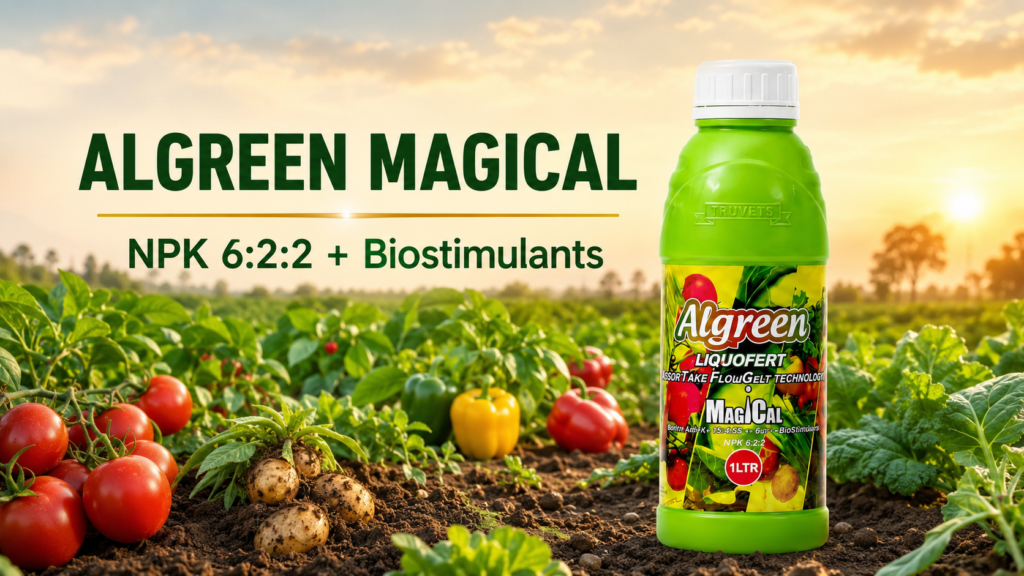
Apply Algreen Magical from fruit set and through early fruit development, which is when the fruit needs calcium most and when blossom end rot takes hold. Spraying early and regularly through this stage is far more useful than trying to treat rot after it appears, because fruit already affected will not recover. Timing matters for another reason too: young fruit can absorb calcium far better than older fruit, which becomes unable to take up more once it has grown past roughly one to two centimetres.
Follow these steps for a clean, effective application.
- Start at fruit set. Begin when the first fruits are setting, not after you see damage.
- Measure the dose. Use around 20 to 50 ml or grams per 20-litre knapsack, and confirm the exact rate on your pack. Do not over-concentrate, since excess calcium can reduce yield.
- Mix with clean water in a knapsack sprayer and agitate until uniform.
- Cover the fruit trusses and foliage to just before run-off, wetting the crop well but not to dripping.
- Spray in the cool of the day, early morning or late afternoon, which also reduces the risk of leaf injury, and avoid spraying before rain.
- Repeat through fruit development at the label’s interval, typically weekly.
The watering and management steps that matter just as much
Because blossom end rot is mostly about calcium movement, these steps do the heavy lifting, and Magical supports them rather than replacing them. The table gives you a checklist to work through.
| Step | What to do | Why it works |
|---|---|---|
| Water evenly | Deep, regular watering, ideally drip on a schedule | Keeps the steady water flow that carries calcium into the fruit |
| Mulch | Apply a mulch layer around the plants | Reduces evaporation and steadies soil moisture in the heat |
| Correct pH | Test soil, lime to pH 6.0 to 6.5 before planting | Keeps soil calcium available to the roots |
| Balance nitrogen | Avoid heavy nitrogen during fruiting | Stops leafy growth stealing water and calcium from fruit |
| Protect roots | Avoid deep cultivation near plants after fruit set | Prevents root damage that restricts uptake |
| Remove affected fruit | Pick off fruit already showing rot | Lets the next healthy fruit set develop cleanly |
Do these alongside Magical, and you address both the supply of calcium and, more importantly, its delivery to the fruit.
Which crops benefit from Magical?
Magical is best known for tomatoes, where blossom end rot is a common and costly problem. The same disorder and the same management apply to several other fruiting crops, as the table shows.
| Crop | Susceptibility | Notes |
|---|---|---|
| Tomatoes | High | Large and elongated varieties are especially prone |
| Capsicum and peppers | Moderate to high | Same calcium and watering management applies |
| Watermelon | Moderate | Affected during rapid fruit swelling |
| Pumpkin and squash | Moderate | Watch during fruit development |
| Cucumber | Lower | Can occur under moisture stress |
| Eggplant | Moderate | Same prevention as tomatoes |
Container-grown and raised-bed crops of any of these types are more susceptible, because their soil moisture fluctuates more easily.
Common mistakes to avoid
Being aware of these keeps a good product from being wasted.
- Waiting until rot appears before acting. Prevention from fruit set is the only thing that works.
- Relying on the spray alone while ignoring irregular watering, which is usually the real driver.
- Over-concentrating the spray, which can reduce yield and injure leaves.
- Using Epsom salt to fix it. Epsom salt is magnesium sulphate with no calcium, and the extra magnesium can compete with calcium uptake and make things worse.
- Over-applying nitrogen during fruiting, which diverts water and calcium to the leaves.
- Ignoring soil pH, which can leave soil calcium unavailable even when it is present.
- Spraying in midday heat or before rain, which wastes the application and risks leaf injury.
Frequently asked questions
What causes blossom end rot in tomatoes? It is caused by a localised calcium shortage in the developing fruit, not by a disease. It is usually triggered by irregular watering, because calcium moves into the fruit with water and cannot get there when the water supply swings between dry and wet.
Can I spray Magical to cure rot that has already appeared? No. Fruit already showing rot will not recover. Magical is used to help prevent the disorder by applying it early, from fruit set onward, which protects the fruit still developing.
Is a calcium spray enough on its own to stop blossom end rot? Usually not. Because calcium moves poorly within the plant, steady watering and good soil management are the most effective prevention, and a foliar feed supports that rather than replacing it.
Does Magical also supply magnesium? Yes. It carries calcium, magnesium, and nitrogen with trace boron and hormones, so it supports leaf health and photosynthesis as well as fruit quality.
Will Epsom salt fix blossom end rot? No. Epsom salt is magnesium sulphate and contains no calcium, so it does not address the cause, and the extra magnesium can compete with calcium uptake and make things worse.
What soil pH is best for preventing blossom end rot? A soil pH of about 6.0 to 6.5 helps keep calcium available to the plant. A soil test and, if needed, liming before planting are worthwhile steps.
Which crops get blossom end rot? Tomatoes most famously, but also peppers, eggplant, watermelon, pumpkin, squash, and cucumbers. The same calcium and watering management works for all of them.
Get a fruiting and nutrition programme for your farm
Preventing blossom end rot is about getting both the calcium and the watering right, matched to your crop and soil. Solomon Agri provides soil testing, crop nutrition planning, and farm advisory services for farmers across East Africa. Book a consultation or reach an agronomist for a programme tailored to your farm.
Note: always confirm product-specific rates, timing, and directions on the actual Algreen Magical label before use, and remember that consistent watering is central to preventing this disorder.
Related Algreen products
Healthy soil makes every other input work better. These Algreen products feed the crop that healthy soil supports:
- Algreen Planta-P — phosphate starter feed with humic acid
- Algreen Supasense — balanced NPK crop nutrition
- Algreen Supa-K — potassium for fruit quality
- Algreen Hynitro 42 — nitrogen for vegetative growth
- Algreen Cytomone — hormones for rooting and vigour
This article is part of our complete guide: Algreen Foliar Fertilizers — The Complete Guide.
Pingback: Algreen Gel Technology: 9 Products, 4 Claims - Solomon Agri