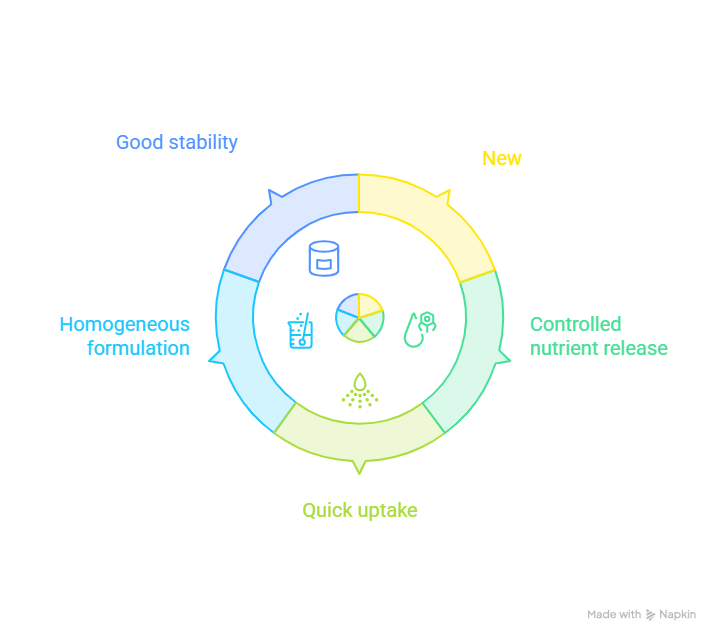
Algreen Gel Technology is a formulation technology used across several Algreen foliar fertilizer products sold in Kenya. Algreen describes the technology in terms of controlled nutrient release, quick uptake and absorption, formulation stability, and storability.
But what does “Gel Technology” actually mean?
Does a gel-based foliar fertilizer really help nutrients get into a leaf? How does foliar fertilizer enter a plant? Is the newer Algreen Liquofert packaging the same as the older Gel Technology bottles? And what can farmers in Kenya reasonably expect from the technology?
This guide separates the manufacturer’s claims from established plant science and explains what is known, what is plausible, and what has not been publicly verified.
Quick answer: What is Algreen Gel Technology?
Algreen Gel Technology is the manufacturer’s term for the formulation used in its foliar fertilizer products.
Algreen product information describes the technology as providing:
- Controlled nutrient release
- Quick uptake and absorption
- A homogeneous formulation
- Good stability and storability
The newer Algreen packaging refers to Liquofert and Flow Gel Technology, while older bottles commonly display Gel Technology directly beneath the Algreen logo.
Importantly, publicly available Algreen material does not explain the precise chemical composition or manufacturing mechanism of the gel. Therefore, it would be inaccurate to claim that Algreen uses a particular polymer, microgel structure, or controlled-release mechanism unless the company provides technical documentation confirming it.
That distinction matters.
How does gel foliar fertilizer work?
To understand why formulation could matter, first understand what happens when foliar fertilizer is sprayed onto a plant.
The process is broadly:
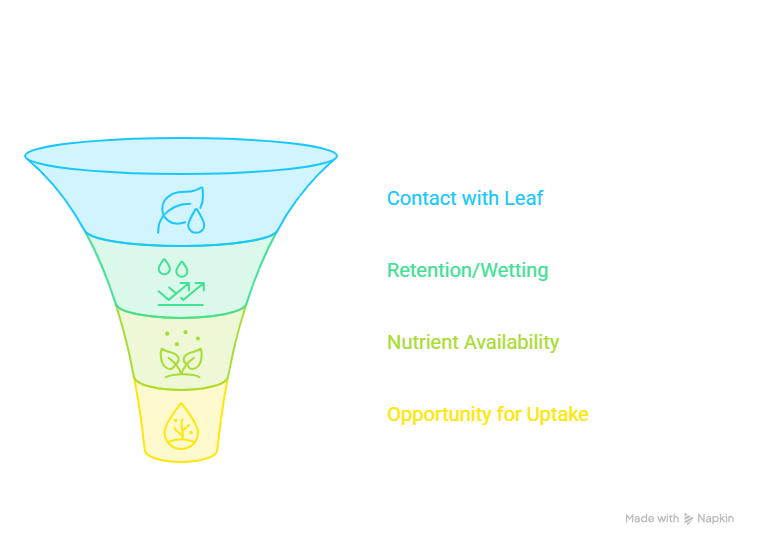
Spray droplet → leaf surface → wetting and spreading → penetration → internal tissues → nutrient use and transport
A foliar fertilizer does not simply disappear into the plant when it lands on a leaf.
The leaf has protective structures designed to control the movement of water and dissolved substances. Its outer cuticle is particularly important.
For a foliar nutrient to become useful to the plant, it needs an opportunity to move from the spray deposit into the leaf.
That means several factors can influence performance:
- Droplet size
- Leaf surface
- Wetting and spreading
- Nutrient concentration
- Formulation
- Temperature
- Humidity
- Rainfall after spraying
- Plant growth stage
- Leaf age
- Application timing
This is why two foliar fertilizers containing similar nutrients can behave differently when sprayed on a crop.
Why the formulation matters
Think of foliar application this way:
The nutrient is the payload. The formulation determines how that payload behaves.
A spray droplet needs to make useful contact with the leaf rather than simply bouncing off, running down the leaf, or drying immediately in an unfavourable way.
Formulation can influence properties such as:
- How the spray wets the leaf
- How well the deposit remains on the surface
- How nutrients remain available
- How quickly nutrients are released
- How the product behaves during storage
This does not mean that every gel fertilizer automatically performs better than every conventional liquid fertilizer.
The actual performance depends on the specific formulation and the conditions under which it is applied.
How does foliar fertilizer enter a plant?
A common misconception is that leaves are simply open surfaces through which nutrients can freely pass.
They are not.
The leaf has barriers that regulate movement into and out of plant tissues.
Foliar-applied nutrients may enter through several routes, including the leaf cuticle and structures such as stomata and other surface features.
The general sequence is:
1. The droplet lands on the leaf
The spray needs to reach the plant’s foliage and form a useful deposit.
2. The droplet wets the surface
The formulation determines how the liquid behaves when it contacts the leaf.
3. The nutrient remains available
The nutrients need to remain in a form that can potentially move across the leaf surface barriers.
4. Nutrients penetrate the leaf
Depending on the nutrient, formulation and plant conditions, nutrients can cross the leaf’s external barriers.
5. Nutrients reach internal tissues
Once inside, nutrients can participate in the plant’s metabolic and physiological processes.
This explains why foliar fertilizer absorption is not simply a matter of spraying more product.
More fertilizer does not automatically mean more nutrient uptake.
What makes Algreen Gel Technology different?
Algreen’s own product descriptions repeatedly associate Gel Technology with four characteristics:
Controlled nutrient release
Algreen describes the technology as allowing controlled nutrient release.
In practical terms, the claim suggests that nutrients are not simply presented to the leaf in an uncontrolled manner.
However, the publicly available material does not provide enough technical information to state exactly how Algreen achieves this control.
Quick uptake and absorption
Algreen also associates the technology with quick uptake and absorption.
This is commercially important for foliar fertilizer because the objective is to make nutrients available to the crop through the foliage.
However, “quick absorption” should not be interpreted as meaning that every nutrient is instantly absorbed or that 100% of the sprayed fertilizer enters the plant.
Homogeneous formulation
A homogeneous formulation means the product is intended to remain uniformly mixed.
This matters because a foliar fertilizer should deliver a consistent concentration of its ingredients throughout the spray solution.
Stability and storability
Algreen also describes good stability and storability.
For farmers and agrovets in Kenya, this is practical rather than merely technical.
A fertilizer may pass through transport, storage and temperature fluctuations before it reaches the farm. Formulation stability can therefore be important for maintaining product quality.
Algreen Gel Technology vs conventional foliar fertilizer
It is tempting to make a simple claim:
“Gel fertilizer is better than ordinary foliar fertilizer.”
That is too simplistic.
A better comparison is to look at the formulation objective.
| Factor | Conventional liquid foliar fertilizer | Gel-based formulation |
|---|---|---|
| Nutrient delivery | Nutrients delivered in liquid spray | Nutrients delivered through a gel-based formulation |
| Leaf interaction | Depends on formulation and spray conditions | Formulation may be designed to influence droplet behaviour and nutrient availability |
| Nutrient uptake | Depends on nutrient, leaf and environment | Depends on nutrient, formulation, leaf and environment |
| Retention | Depends on formulation and conditions | May be influenced by formulation characteristics |
| Storage | Product dependent | Product dependent |
| Performance | Depends on the complete formulation and application | Depends on the complete formulation and application |
The important point is this:
“Gel” by itself does not prove superior crop performance.
The entire formulation and how it behaves under real agricultural conditions matter.
Is gel-based foliar fertilizer scientifically possible?
Yes.
Independent scientific research has investigated gel and microgel-based systems for foliar nutrient delivery.
Research into microgel-based fertilizers has explored ways of improving interaction with the leaf surface and controlling nutrient delivery.
That supports the broader scientific principle that formulation can influence foliar nutrient delivery.
But there is an important limitation.
Research demonstrating that a particular microgel delivery system can work does not automatically prove that Algreen’s commercial formulation uses the same technology or achieves the same results.
Therefore, the strongest evidence-based conclusion is:
Algreen markets its products as using Gel Technology with controlled-release, uptake and stability characteristics. Independent plant science supports the broader principle that formulation, leaf-surface interaction and nutrient availability can influence foliar uptake. However, publicly available information does not establish the exact mechanism or independently measured performance of Algreen’s proprietary formulation.
That is the distinction farmers should understand.
Algreen Gel Technology products available in Kenya
Several products in the Algreen range are associated with the technology.
Algreen Hynitro 42
Hynitro 42 is a nitrogen-focused foliar fertilizer.
Published product information describes:
- Nitrogen: 42%
- Humic acid: 3%
- Stimulants and trace elements
The published application information gives different rates depending on crop type, so farmers should follow the label on the product they have rather than copying a rate from another Algreen fertilizer.
Algreen Supasense
Supasense is an NPK foliar fertilizer containing:
NPK 24:24:18, together with zinc, magnesium, manganese and stimulants according to published Kenyan product information.
It is marketed for crops requiring balanced nutritional support and is one of the Algreen products associated with Gel Technology.
Algreen Supa-K
Supa-K is a potassium-focused formulation.
Published information gives:
NPK 6:0:42
along with trace elements and a biostimulant.
Potassium becomes particularly important when crop development moves toward processes such as fruit development and quality.
Algreen Planta-P
Planta-P is a phosphorus-led Algreen formulation containing trace elements and stimulants.
The appropriate application rate should be taken from the label on the specific pack.
Algreen Bonzin
Bonzin provides:
- Zinc: 10%
- Boron: 15%
- Stimulants
Zinc and boron are micronutrients with important roles in plant development, but their application should be based on the crop’s nutritional requirements rather than assuming that more is always better.
Algreen Magical
Magical contains:
- Nitrogen: 8%
- Calcium: 18%
- Magnesium: 3%
- Boron: 1%
It is positioned as a nutritional product supplying calcium, magnesium and boron alongside nitrogen.
Algreen Copagel 50
Copagel 50 is a copper-containing formulation.
Published product information describes:
- Copper: 50 g/L
- Biostimulants
- Stated NPK: 8:2:2
Always verify the current label before application because product formulations, rates and recommendations can change.
Algreen Gel Technology and the new Liquofert packaging
Farmers visiting Kenyan agrovets may currently encounter two different Algreen packaging designs.
The older packaging commonly appears in white or orange bottles with GEL TECHNOLOGY beneath the Algreen branding.
The newer packaging is commonly green and carries the LIQUOFERT branding together with wording referring to Flow Gel Technology.
This has naturally created a question:
Has Algreen changed its formulation?
Based on the available labels and product information, there is no statement declaring that the formulation itself has changed.
The visible change is primarily the packaging and branding terminology.
The newer packaging retains the reference to Flow Gel Technology.
Therefore, seeing an older Algreen bottle in a Kenyan agrovet does not by itself mean the product is counterfeit or expired.
Check:
- Batch number
- Manufacturing information
- Expiry date
- Registration information
- Product label
- Physical condition of the container
rather than judging authenticity solely from the bottle colour.
What is Algreen Liquofert?
Liquofert appears to be the newer Algreen product-line branding used on several foliar fertilizer products.
The newer packaging places LIQUOFERT above the product name and retains wording referring to Flow Gel Technology.
This means the appearance of Liquofert does not, based on the available evidence, establish that Gel Technology has been abandoned.
Instead, the technology appears to have been incorporated into the newer product-line presentation.
Which Algreen products use the newer packaging?
Based on the packaging information available at the time of writing, the transition includes:
Liquofert packaging:
- Hynitro 42
- Supasense
- Supa-K
- Planta-P
- Bonzin
- Magical
- Copagel 50
Older Gel Technology packaging still encountered:
- Supa-K-Extra
- Majani Combi
- OrganoHumos
The range is therefore best understood as being in a packaging transition rather than assuming that every Algreen product should already have identical packaging.
Who makes Algreen fertilizer?
This is one area where caution is necessary.
Public Kenyan product information identifies Truvets Techno-Systems Ltd in Nairobi as a distributor of the Algreen range.
The newer green containers also have TRUVETS moulded into the plastic.
However, the publicly available information reviewed for this article does not establish the identity of the actual manufacturer or formulator of the proprietary Gel Technology.
Therefore, it would be misleading to state categorically that Truvets manufactures the formulation unless an authoritative technical or regulatory document confirms it.
Can Gel Technology guarantee higher yields?
No—not based on the publicly available evidence reviewed here.
This is an important distinction.
A formulation may be designed to improve nutrient delivery, but crop yield depends on much more than foliar fertilizer.
Yield can be affected by:
- Soil fertility
- Water availability
- Variety
- Pest pressure
- Disease
- Temperature
- Plant population
- Crop stage
- Nutrient deficiencies
- Spray timing
- Application accuracy
- Overall farm management
Therefore, claims such as “Gel Technology increases yield by X%” should only be accepted when supported by controlled trials using the specific commercial formulation.
How should farmers apply Algreen foliar fertilizer?
The correct rate depends on the specific Algreen product and crop.
This is critical because Algreen products do not share one universal application rate.
For example, published information gives Supasense at around 20 ml per 20 litres in its recommendations, while Hynitro 42 has different published rates depending on the crop.
That means:
Do not calculate the rate of one Algreen product by copying the rate of another.
Before spraying:
- Read the label on your specific product.
- Confirm the recommended crop and growth stage.
- Measure the correct quantity.
- Use clean spray water where appropriate.
- Ensure good leaf coverage.
- Avoid spraying under unsuitable weather conditions.
- Observe the label’s safety and mixing instructions.
- If tank-mixing, perform a jar test first where appropriate.
The label on the product in your hands should take priority over an old blog post, social-media recommendation or retailer listing.
Why spray timing matters
Even a well-formulated foliar fertilizer can perform poorly when applied under poor conditions.
A farmer spraying during intense heat, immediately before rainfall, or with inadequate leaf coverage is changing the environment in which the formulation has to work.
The same product can therefore produce different practical outcomes under different field conditions.
For Kenyan farmers, application timing should take into account:
- Crop growth stage
- Weather
- Rainfall
- Temperature
- Crop canopy
- Irrigation
- The specific nutrient requirement
The goal is not simply to spray.
The goal is to create conditions in which the crop can make effective use of the nutrients supplied.
Algreen Gel Technology: what we know and what remains unknown
This is perhaps the most important section of the entire article.
What we can establish
Algreen product information associates Gel Technology with:
- Controlled nutrient release
- Quick uptake and absorption
- Homogeneous formulation
- Stability and storability
Newer Algreen packaging refers to Liquofert and Flow Gel Technology.
Gel and microgel approaches to foliar nutrient delivery are also scientifically plausible and have been investigated independently.
What we cannot currently establish
Publicly available information reviewed for this article does not clearly establish:
- The exact chemical composition of Algreen’s gel
- The precise manufacturing process
- The specific mechanism responsible for controlled release
- Independent laboratory measurements of Algreen nutrient uptake
- Independent field trials proving a specific yield increase
- Whether the formulation itself changed during the packaging transition
Those are not minor details.
They are the information needed to move from “the manufacturer says this technology has these characteristics” to “independent evidence demonstrates exactly how this formulation performs.”
Frequently Asked Questions About Algreen Gel Technology
What is Algreen Gel Technology?
Algreen Gel Technology is the manufacturer’s terminology for the formulation used in its foliar fertilizer range. Algreen associates the technology with controlled nutrient release, quick uptake and absorption, formulation uniformity, and stability.
Does Algreen Gel Technology really work?
The broader concept of using formulation technology to influence foliar nutrient delivery is scientifically plausible and has been researched. However, publicly available independent trial data specifically measuring the performance of Algreen’s proprietary Gel Technology is limited.
What is Algreen Liquofert?
Liquofert is the newer product-line branding appearing on several Algreen foliar fertilizer packages. The newer labels continue to reference Flow Gel Technology.
Has Algreen Gel Technology been replaced by Liquofert?
There is no evidence in the reviewed labels that Gel Technology has been discontinued. Instead, the newer Liquofert packaging continues to reference Flow Gel Technology.
Why are there different Algreen bottles in Kenyan agrovets?
The Algreen range is undergoing a packaging transition. Older Gel Technology bottles can appear alongside newer Liquofert packaging. Farmers should check batch and expiry information rather than judging a product solely by its packaging.
Which Algreen fertilizer is best?
There is no single “best” Algreen fertilizer for every crop.
The appropriate product depends on the crop, growth stage and nutritional requirement.
For example, Hynitro 42 is nitrogen-focused, Supasense provides an NPK formulation, Supa-K is potassium-focused, while Bonzin supplies zinc and boron.
Can I mix Algreen foliar fertilizers?
Do not assume that every Algreen product can be mixed safely with every other fertilizer or pesticide.
Check the product label and compatibility guidance. Where appropriate, conduct a small jar test before preparing a full spray tank.
Does gel fertilizer replace soil fertilizer?
Not necessarily.
Foliar feeding and soil fertilization serve different purposes. Foliar application can provide nutrients through the leaves, while soil-applied fertilizers supply nutrients through the root zone.
The appropriate strategy depends on the crop and nutritional situation.
The bottom line
Algreen Gel Technology is more than a label phrase, but we should also be careful about what we claim it proves.
Algreen describes the technology as providing controlled nutrient release, quick uptake and absorption, homogeneous formulation and good stability.
Independent plant science supports the broader idea that formulation and leaf-surface interaction can influence foliar nutrient delivery.
What remains unknown from publicly available information is the exact mechanism behind Algreen’s proprietary formulation and its independently measured performance in the field.
For farmers in Kenya, the practical lesson is straightforward:
Choose the Algreen product according to the crop’s nutritional requirement, follow the label rate for that specific product, apply under suitable conditions, and don’t assume that a technology name alone guarantees a yield increase.
And if you are seeing an older Gel Technology bottle alongside a newer green Liquofert bottle at your local agrovet, the packaging difference alone does not prove that one is fake or that the formulation has changed. Check the label, batch and expiry information.
Related Algreen guides
- Algreen Foliar Fertilizers in Kenya: Complete product range, compositions, rates and uses
- Algreen Supasense: Composition, application rate and uses
- Algreen Hynitro 42: Nitrogen foliar fertilizer guide
- Algreen Supa-K: Potassium foliar fertilizer guide
- Algreen Bonzin: Zinc and boron foliar fertilizer guide
- Algreen Magical: Calcium, magnesium and boron fertilizer guide
- Algreen Planta-P: Phosphorus foliar fertilizer guide
- Algreen Cytomone: Plant growth regulator guide
Editorial note
This article distinguishes manufacturer/product claims from independent plant-science evidence. Product rates and formulations can change, so farmers should always verify the current label on the product they are using.