A soil fertility test result sitting in your pocket is worth more than a full bag of fertiliser applied blindly. I’ve said this to farmers across Meru, Embu, and Nakuru counties, and I’ll say it here: most fertiliser waste on Kenyan small farms comes not from using too little but from applying the wrong product at the wrong rate on soil whose chemistry is working against you. This guide shows you how to read a soil test, correct the problems it reveals, and build a crop nutrition plan that your crops can actually use.
This article is part of the Agronomy Fundamentals for Kenya Farms guide — the root system for everything I cover on soil, nutrition, water, and pest management.
Why Most Kenyan Small Farm Soils Are Underperforming
Two generations of continuous cultivation, residue burning, and blanket fertiliser use have left most smallholder soils in Kenya in a compromised state. The specific problems vary by region, but the pattern is consistent:
- Soil pH is too low (acidic) — phosphorus is locked, aluminium becomes toxic
- Organic matter is below 2% — poor water retention, low microbial activity
- Potassium is depleted — crops are physically weak and disease-prone
- Micronutrients (especially boron and zinc) are deficient — yields are capped regardless of NPK applications
The good news: all of these are correctable. The bad news: you can’t correct what you haven’t measured.
How to Get a Soil Test in Kenya
Getting a soil test is straightforward and relatively affordable. Here’s how to do it correctly:
Step 1 — Collect Soil Samples Properly
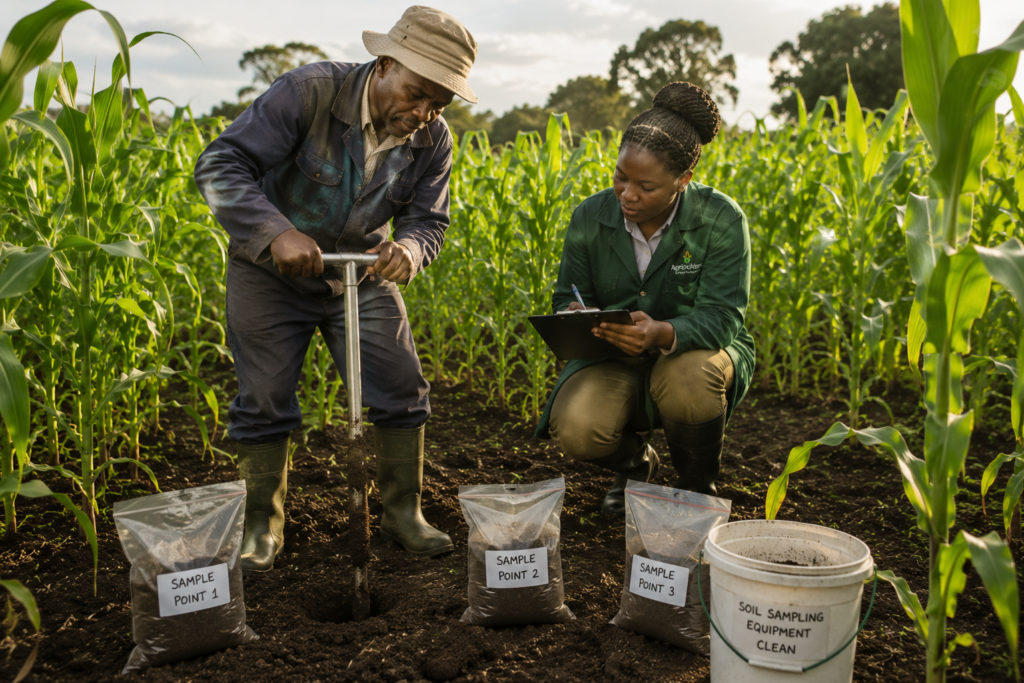
A soil test is only as good as the sample you collect. Poor sampling gives misleading results and leads to wrong corrections. Follow this method:
- Divide your farm into zones of similar soil appearance and crop history — don’t mix sandy and clay areas in one sample
- Use a clean trowel, auger, or stick — avoid galvanised or rusty tools that contaminate with zinc or iron
- Collect 10–15 sub-samples per zone from a depth of 0–20cm (topsoil) in a zigzag pattern across the zone
- Mix all sub-samples for that zone in a clean plastic bucket, spread to dry in shade, then take 500g as your final sample
- Label each sample clearly with your name, farm name, zone, date, and crop you intend to grow
Step 2 — Where to Send Soil Samples in Kenya
- KALRO Kabete, Nairobi — national reference lab, comprehensive analysis
- University of Nairobi, Department of Land Resource Management
- Crop Nutrition Laboratory Services (CNLS), Nairobi — private lab, faster turnaround
- County Agriculture offices — many counties now offer subsidised testing
- Select agrochemical companies — some offer free or subsidised testing tied to recommendations (be aware of potential product bias)
Typical cost: KES 1,500–3,500 for a standard NPK + pH analysis. A full micronutrient panel runs KES 4,000–6,000. For most small farms, start with the standard panel.
Reading Your Soil Test Results
When your results come back, here’s what each parameter means for your farm:
Soil pH
pH is the master variable. It controls nutrient availability, microbial activity, and the performance of every input you apply.
| pH Range | Classification | What It Means |
|---|---|---|
| Below 5.0 | Strongly acidic | Aluminium toxicity risk; phosphorus severely locked; lime essential before planting |
| 5.0 – 5.5 | Moderately acidic | Common in Kenyan highlands; phosphorus partially locked; lime application recommended |
| 5.5 – 6.5 | Slightly acidic | Acceptable for most crops; phosphorus becoming available; minor correction if needed |
| 6.5 – 7.0 | Near neutral | Optimal for most Kenyan crops; no correction needed |
| Above 7.5 | Alkaline | Iron, manganese, zinc availability reduced; common in semi-arid regions |
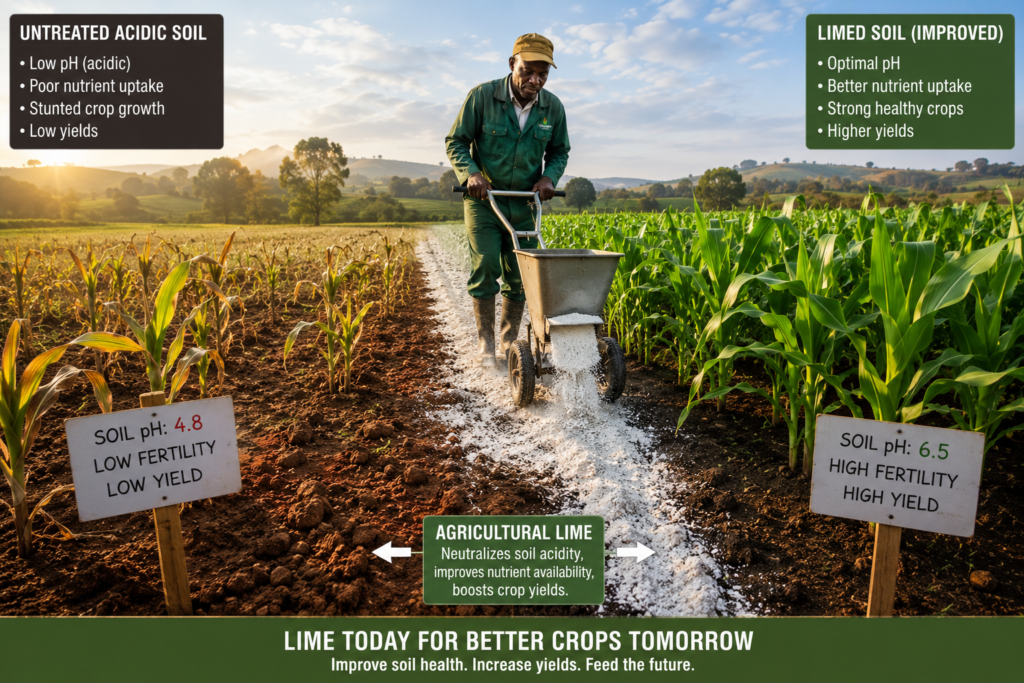
How to Correct Soil pH with Lime
Agricultural lime (calcium carbonate) is the standard correction for acidic soils. The amount required depends on both the current pH and your soil texture:
- Sandy soils — respond faster to lime; lower rates required (1–2 tonnes/acre)
- Clay/loam soils — require higher lime rates (2–4 tonnes/acre) for same pH change
- Target pH — for most Kenyan crops, aim for 6.0–6.5
Apply lime at least 4–6 weeks before planting and incorporate it into the topsoil. Lime takes time to react — you won’t see the full effect in the first season, but it’s cumulative. Liming every 2–3 seasons maintains optimal pH. At roughly KES 1,200–1,800 per 50kg bag, lime is the most cost-effective single input on acidic soils.
Organic Matter Content
Results are expressed as a percentage. Target levels:
- Below 1% — severely depleted; heavy organic input needed before productivity can improve
- 1–2% — low; priority to add compost or manure every season
- 2–4% — adequate for productive farming; maintain with annual organic inputs
- Above 4% — excellent; common in well-managed coffee or tea farms
Nitrogen (N), Phosphorus (P), and Potassium (K)
Results are typically reported as Low / Medium / High or as actual ppm values. Here’s how to act on them:
| Nutrient | Low Result — Action | Medium Result — Action | High Result — Action |
|---|---|---|---|
| Nitrogen | Apply CAN or urea at 50–75kg/acre at key growth stages | Reduce rate to 25–50kg/acre; supplement with legume rotation | Reduce mineral N; let organic matter supply it |
| Phosphorus | Apply DAP or TSP at planting; 50kg DAP/acre minimum | Apply at reduced rate; avoid over-application (locks zinc) | Skip P application for 1–2 seasons; monitor crop response |
| Potassium | Apply MOP (KCl) at 25–50kg/acre; especially for fruiting crops | Apply NPK blends that include K; no need for standalone MOP | No potassium supplementation needed |
Building a Practical Crop Nutrition Plan
Once you have your soil test results, the next step is building a fertiliser programme that matches crop demand to soil supply. Here’s how I structure this for clients:
Step 1 — Identify the Nutrient Gaps
List which nutrients are Low in your results. These are your priority corrections. Nutrients testing Medium or High are secondary considerations.
Step 2 — Select Products That Address Multiple Gaps
Rather than buying separate products for each nutrient, choose fertilisers that address several gaps at once:
- DAP (18:46:0) — excellent starter fertiliser; addresses P and some N at planting
- NPK 17:17:17 — balanced blend; good where multiple nutrients are Low
- CAN (26% N) — best nitrogen top-dress on acidic soils (less acidifying than urea)
- Urea (46% N) — highest N content per bag; best value on soils where pH is already corrected
Step 3 — Time Applications to Crop Growth Stages
A split application programme consistently outperforms a single large application:
- At planting (basal): Phosphorus-rich product (DAP) placed in the planting hole or furrow. Also apply lime if pH correction is needed.
- Early vegetative stage (top-dress 1): Nitrogen application to drive leaf area and early growth. For maize: V4–V6 stage. For vegetables: 2–3 weeks after transplanting.
- Pre-flowering (top-dress 2): Potassium and nitrogen to support flowering, fruit set, and grain fill. Often an NPK blend or CAN + MOP combination.
Organic Inputs and Their Role in Fertility Management
Mineral fertilisers address immediate nutrient deficits. Organic inputs rebuild the soil system over time. For sustainable small farm productivity, you need both.
Farmyard Manure
Well-composted cattle manure applied at 5 tonnes per acre supplies approximately:
- N: 40–60 kg/acre (released slowly over the season)
- P: 20–30 kg/acre
- K: 50–70 kg/acre
- Significant improvements to soil structure and water retention
Important: Fresh manure can burn seedlings and introduces weed seeds. Always compost for at least 2–3 months before application.
Compost
A well-managed compost pile from crop residues, kitchen waste, and dry material can produce 3–5 tonnes of finished compost per season at almost zero cost. The nutrient content varies, but the soil structure benefits are consistent and significant.
Green Manures and Cover Crops
Leguminous cover crops — mucuna (velvet bean), crotalaria, dolichos lab lab — fix atmospheric nitrogen and add significant organic matter when incorporated. On degraded soils, a season of mucuna before a food crop can supply 50–100 kg N/acre at no input cost.
Micronutrient Management
Three micronutrient deficiencies are widespread enough on Kenyan farms to warrant regular attention:
Boron Deficiency
Common in high-rainfall leached soils. Symptoms: hollow stems in brassicas, poor seed set in sunflower and canola, tip burn in celery and vegetables. Correction: Borax at 1–2 kg/acre incorporated into soil, or foliar Solubor at 0.2% spray solution during vegetative stage.
Zinc Deficiency
Common where high P applications have been made. Symptoms in maize: white striping on young leaves, shortened internodes. Correction: zinc sulphate at 5–10 kg/acre incorporated at planting, or foliar application of ZnSO₄ at 0.5%.
Sulphur Deficiency
Increasingly common as compound fertilisers replace sulphur-containing single superphosphate. Symptoms: yellowing of young leaves (unlike nitrogen deficiency which yellows older leaves first). Correction: use SSP instead of TSP where sulphur is deficient, or apply gypsum at 100–200 kg/acre.
Soil Fertility Maintenance — The Long Game
Building soil fertility is a multi-year process. Here’s the maintenance programme I recommend for Kenyan smallholders:
| Action | Frequency | Estimated Cost per Acre |
|---|---|---|
| Soil test | Every 2–3 years | KES 1,500–3,500 |
| Lime application | Every 2–3 years (on acidic soils) | KES 3,000–6,000 |
| Compost/manure | Every season | KES 0–2,000 (mostly labour) |
| Mineral fertiliser | Every season (adjusted to soil test) | KES 4,000–12,000 |
| Cover crop (off-season) | Annually | KES 500–1,500 (seed cost) |
Summary: Soil Fertility Management for Kenyan Small Farms
| Parameter | Target | Main Correction |
|---|---|---|
| Soil pH | 6.0 – 6.5 | Agricultural lime, 2–4 t/acre on acid soils |
| Organic matter | Above 2% | Compost, manure, cover crops |
| Phosphorus | Medium–High | DAP at planting, reduced on high-P soils |
| Nitrogen | Adequate at each growth stage | CAN top-dress split applications |
| Potassium | Medium | MOP or NPK blends from flowering |
| Boron / Zinc | Sufficient | Borax, ZnSO₄ foliar or soil application |
Next step: Apply this knowledge to how you manage water on your farm. Read Irrigation Scheduling for Kenyan Farms: Water Efficiency Guide for the full picture on managing moisture to match your fertilised crop’s demand.
And if you’re growing vegetables specifically, the nutrient management principles here work hand in hand with the pest management system in Integrated Pest Management for Vegetables in Kenya.
Diagnosing Nutrient Deficiencies in the Field
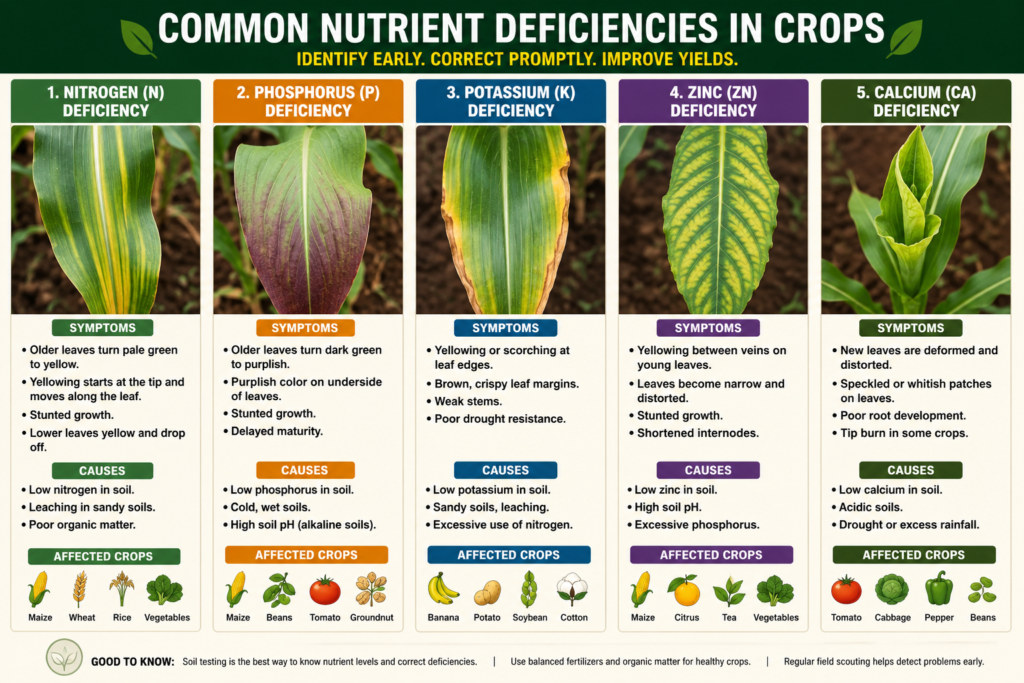
While a lab test is always the most accurate approach, being able to read visible deficiency symptoms in your crop saves you the wait and helps you act faster between testing cycles. Here’s a practical field diagnosis guide for the most common deficiencies on Kenyan farms:
Nitrogen Deficiency
Starts on older (lower) leaves first — yellowing beginning at the leaf tip and progressing toward the base. Whole plant appears pale green. Stunted growth. Commonly seen in fast-growing crops when top-dress applications are delayed or skipped, or when heavy rains have leached nitrogen below the root zone. Correction: top-dress CAN at 25–50kg/acre immediately; water in if no rain.
Phosphorus Deficiency
Purpling or reddening of leaves, particularly on the underside and at the leaf margins. Occurs in seedlings and young plants on cold or very acidic soils where P is locked. Can also appear even on high-P soils when root systems are damaged (soil compaction, waterlogging, nematodes) and can’t access available P. Correction: foliar application of MAP (monoammonium phosphate) as a short-term bridge; long-term correction is soil pH management.
Potassium Deficiency
Scorching and browning at leaf margins and tips, starting on older leaves. Plants look drought-stressed even with adequate moisture. Fruit is small, poorly developed. Common on sandy soils and on farms where only DAP + CAN has been applied for many seasons without any potassium replacement. Correction: MOP (60% K₂O) at 25–50kg/acre; foliar K as a fast-acting supplement.
Calcium Deficiency
Affects young growth — tip burn on young leaves; blossom end rot in tomatoes and peppers (black, sunken lesion at the blossom end of the fruit, not a disease). Calcium doesn’t move within the plant from old tissues to new, so deficiency always shows in the newest growth. Often occurs not from low soil Ca but from irregular irrigation that restricts Ca uptake — another reason consistent soil moisture management matters. Correction: foliar calcium nitrate or calcium chloride spray; consistent irrigation.
Iron and Manganese Deficiency
Both cause interveinal chlorosis (yellowing between leaf veins while veins remain green) on young leaves. More common on alkaline soils (pH above 7.0) in semi-arid regions. Correction: foliar chelated iron (EDTA-Fe) or manganese sulphate spray; long-term correction is pH management toward 6.0–6.5.
Building a Soil Health Improvement Plan Over 3 Years
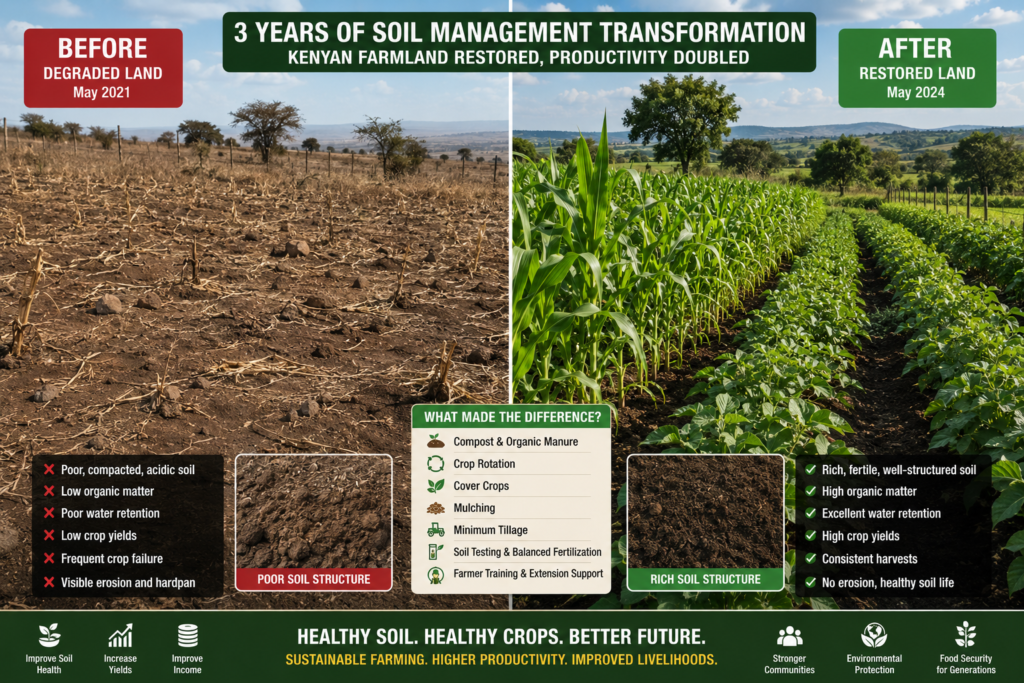
Soil degradation took decades to build up. Meaningful recovery takes 2–4 seasons of consistent management. Here’s how I structure a 3-year soil improvement plan for clients starting from a degraded state (pH 5.0, organic matter below 1%, low P and K):
| Season | Priority Actions | Expected Change |
|---|---|---|
| Season 1 | Soil test; apply lime at full corrective rate; apply 5t/acre compost; plant cover crop in off-season | pH moves from 5.0 toward 5.8; organic matter begins rising; crop response to fertiliser improves |
| Season 2 | Reduced lime (maintenance rate); continue compost; optimise NPK based on updated soil test; introduce rotation | pH stabilises at 6.0–6.3; crop yields improve 20–30% on same fertiliser rates; reduced aluminium toxicity |
| Season 3 | Maintenance lime (if needed); compost + mineral fertiliser; micronutrient correction where identified | Organic matter above 2%; nutrient efficiency improving; lower fertiliser rates needed for same yield |
The investment in Seasons 1–2 pays compounding returns. A soil at pH 6.2 with 2.5% organic matter grows the same crop on 15–20% less mineral fertiliser than a soil at pH 5.0 with 0.8% organic matter. The lime and compost you apply in Season 1 reduce your fertiliser bill for the next 5–7 years.
Pingback: Algreen Supasense NPK Application Guide - Solomon Agri
Pingback: Best Maize Seed Varieties in Kenya 2026: Which Variety Works in Your Region? - Solomon Agri
Pingback: 10 Soil Testing for Farmers: Complete Guide to Better Yields and Fertilizer Management - Solomon Agri