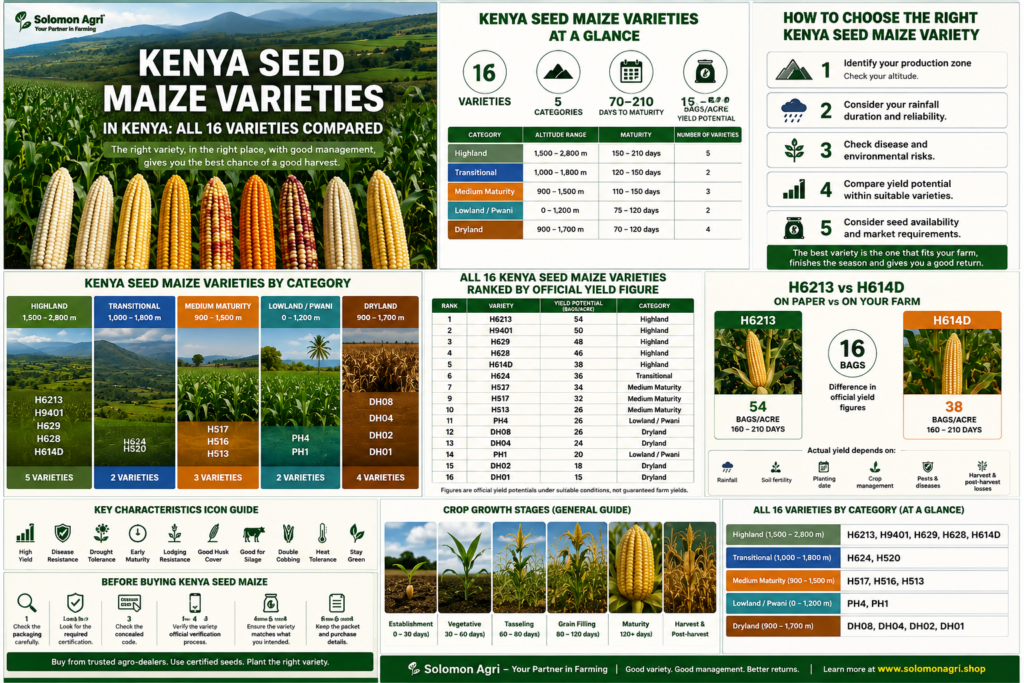
Kenya Seed Company maize varieties number sixteen, spread across five zone categories. Most farmers can name three or four.
That gap is where the yield is. The variety almost everyone plants — H614D — has the lowest official yield ceiling of the five highland varieties. Four others in the same altitude band, sold by the same company, at broadly the same price, officially out-yield it. They are simply less famous.
This guide covers all sixteen: what each one is for, what it yields per acre, and — the part nobody writes — how to choose between two varieties that look identical on paper.
Quick answer
| Your farm | Category | Start with |
|---|---|---|
| 1,500–2,800m, long reliable rains | Highland | H6213 (54 bags/acre) |
| 1,000–1,800m, between zones | Transitional | H624 (36 bags) |
| 900–1,500m, reliable rains | Medium maturity | H517 (32 bags) |
| 0–1,200m, coastal | Lowland / Pwani | PH4 (26 bags) |
| 900–1,700m, arid or semi-arid | Dryland | DH08 (26 bags) |
The four everyone plants are not the best four
Rank the highland Kenya Seed Company maize varieties by the company’s own published yield ceiling and the familiar name comes last:
| Variety | Yield per acre | Maturity |
|---|---|---|
| H6213 | 54 bags | 160–210 days |
| H9401 | 50 bags | 160–190 days |
| H629 | 48 bags | 160–210 days |
| H628 | 46 bags | 150–210 days |
| H614D | 38 bags | 160–210 days |
H614D sits last. It is not a bad variety — it has a long track record, millers like its large white grain, and it is available in every agrovet in the country. But its advantage is familiarity and distribution, not yield. A farmer in Trans Nzoia planting H614D out of habit, on ground that would carry H6213, is leaving roughly 16 bags an acre on the table before the season starts.
The same altitude. The same season length. The same fertilizer programme. A different bag.
How Kenya Seed Company maize varieties are classified
Kenya Seed Company groups its range into five categories, defined by altitude and season length rather than by brand tier. Getting the category right matters more than getting the variety right — a well-chosen variety in the wrong category fails, while a mediocre one in the right category still harvests.
| Category | Altitude | Maturity | Varieties |
|---|---|---|---|
| Highland | 1,500–2,800m | 150–210 days | 5 |
| Transitional | 1,000–1,800m | 120–150 days | 2 |
| Medium maturity | 900–1,500m | 110–150 days | 3 |
| Lowland / Pwani | 0–1,200m | 75–120 days | 2 |
| Dryland | 900–1,700m | 70–120 days | 4 |
Note the overlap between Transitional (1,000–1,800m) and Medium maturity (900–1,500m). A farm at 1,200m sits legitimately in both, and the choice comes down to how reliable the rains are rather than altitude alone. More on that below.
Highland varieties — 1,500–2,800m, 150–210 days
The long-season, high-yield tier. All five need reliable rainfall across five to seven months. Plant any of them below 1,500m and the rains typically end before grain fill completes.
| Variety | Maturity | Yield per acre | Standout trait |
|---|---|---|---|
| H6213 | 160–210 days | 54 bags | Highest ceiling in the entire range; excellent milling quality |
| H9401 | 160–190 days | 50 bags | Broadest disease package; also good for silage |
| H629 | 160–210 days | 48 bags | Lodging resistant, good husk cover, best storage quality |
| H628 | 150–210 days | 46 bags | Heavy white flint grain; blight and GLS resistant |
| H614D | 160–210 days | 38 bags | Most widely available; large white grain millers prefer |
Choosing between them
All five occupy the same altitude band and the same season. This is the decision most guides skip, so here it is plainly:
- You want maximum yield and can feed it → H6213. The 54-bag ceiling is real but conditional; a crop fed like a 30-bag variety yields like one.
- Your farm’s disease risk is mixed or you can’t predict it → H9401. Lodging, ear rot, rust, GLS, stem and leaf blight all covered in one variety. Also the only highland option explicitly suited to silage.
- Exposed, windy site, or you store grain for months → H629. Lodging resistance protects a standing crop; husk cover and storage quality protect it afterwards.
- You sell to posho millers, or blight and GLS are your known problems → H628. Heavy flint grain has a milling premium, and the disease focus is specific.
- The others aren’t stocked near you → H614D. Availability is a genuine reason. Planting the second-best variety you can actually buy beats planning around one you can’t.
Transitional zone — 1,000–1,800m, 120–150 days
| Variety | Yield per acre | Standout trait |
|---|---|---|
| H624 | 36 bags | Higher ceiling of the pair |
| H520 | 34 bags | Explicit GLS and MSV tolerance |
Both are double-cobbing. That trait is a yield lever and a trap in equal measure: a plant carrying two cobs needs sustained nutrition through the whole fill period, and an underfed one aborts the second cob rather than filling both. You end up with a single-cob yield having paid for double-cob genetics.
Choose H520 if your farm has a history of grey leaf spot or maize streak virus. Otherwise H624 for the extra two bags.
Medium maturity — 900–1,500m, 110–150 days
| Variety | Maturity | Yield per acre | Standout trait |
|---|---|---|---|
| H517 | 120–150 days | 32 bags | Officially noted as ideal for irrigation |
| H516 | 120–150 days | 30 bags | Blight, rust and lodging resistant |
| H513 | 110–130 days | 26 bags | Shortest season in the category |
H517 is the one to know about. Kenya Seed marks it explicitly as ideal for irrigation, and it carries the highest ceiling of the three. If you farm at Mwea, Ahero, Bunyala or any lowland irrigation scheme, this is the officially recommended variety — not a highland variety like H614D or DK777, which fail at those altitudes regardless of how much water you can supply.
Between the other two: H516 if disease pressure is your concern, H513 if your rainfall window is genuinely short. H513 gives up six bags against H517, but it finishes in 110–130 days, and a 26-bag crop that matures beats a 32-bag crop that runs out of moisture at grain fill.
Lowland / Pwani hybrids — 0–1,200m
| Variety | Maturity | Yield per acre |
|---|---|---|
| PH4 | 100–120 days | 26 bags |
| PH1 | 75–100 days | 20 bags |
Bred for the coastal strip, where heat and humidity rule out every highland variety. PH4 yields more but needs a longer rains window; PH1 is the faster, safer option where rainfall is short or unreliable. On the coast, finishing is usually worth more than the extra six bags.
Dryland varieties — 900–1,700m
| Variety | Maturity | Yield per acre | Standout trait |
|---|---|---|---|
| DH08 | 100–120 days | 26 bags | Newest release; ear rot tolerant |
| DH04 | 75–100 days | 24 bags | Widest altitude range, up to 1,700m |
| DH02 | 70–100 days | 18 bags | MSV tolerant |
| DH01 | 70 days | 15 bags | Fastest maturing; stay-green trait |
The whole category trades yield ceiling for certainty of finishing. Read it as a ladder: the drier and less predictable your rainfall, the further down you go.
DH01 at 70 days and 15 bags an acre looks unimpressive next to H6213’s 54. But in Garissa, Kitui or Tharaka Nithi, 15 bags harvested is infinitely better than 54 bags that died in the field — and H6213 in those counties dies in the field every time.
DH01’s stay-green trait matters more here than the headline number: it holds leaf area under stress, which keeps the plant filling grain when a conventional variety would have shut down.
Which category is your farm in?
| Your situation | Category | Best entry point |
|---|---|---|
| 1,500–2,800m, reliable long rains | Highland | H6213, or H614D if supply is the constraint |
| 1,000–1,800m, between highland and medium | Transitional | H624, or H520 with GLS/MSV history |
| 900–1,500m, reliable rains, no irrigation | Medium maturity | H516 |
| Any altitude, under irrigation | Medium maturity | H517 |
| 0–1,200m, coastal | Lowland / Pwani | PH1 or PH4 |
| 900–1,700m, arid or semi-arid | Dryland | DH08, or DH01 in the most marginal rainfall |
If you sit near 1,200–1,500m, you are legitimately in two categories at once. The tiebreaker is not altitude, it is how confident you are in the rains lasting. Confident: go transitional and take the higher ceiling. Not confident: go medium maturity and take the shorter season.
Every variety ranked by yield per acre
| Variety | Yield per acre | Category |
|---|---|---|
| H6213 | 54 bags | Highland |
| H9401 | 50 bags | Highland |
| H629 | 48 bags | Highland |
| H628 | 46 bags | Highland |
| H614D | 38 bags | Highland |
| H624 | 36 bags | Transitional |
| H520 | 34 bags | Transitional |
| H517 | 32 bags | Medium |
| H516 | 30 bags | Medium |
| H513 | 26 bags | Medium |
| PH4 | 26 bags | Lowland |
| DH08 | 26 bags | Dryland |
| DH04 | 24 bags | Dryland |
| PH1 | 20 bags | Lowland |
| DH02 | 18 bags | Dryland |
| DH01 | 15 bags | Dryland |
This is the most misused table in Kenyan maize farming. Ranking Kenya Seed Company maize varieties against each other invites exactly the wrong conclusion. Read down it and the temptation is to plant whatever sits highest. But every figure is a ceiling in the correct zone under good management. H6213’s 54 bags and DH01’s 15 bags are not competing offers — they describe completely different farms. Choose your category first, then rank within it.
Feeding them
Yield ceilings assume nutrition scaled to match. Two adjustments by category are worth making:
| Category | Programme |
|---|---|
| Highland (H6213, H9401, H629, H628, H614D) | Full season: Planta-P at planting → split nitrogen with Hynitro 42 → Supa-K through grain fill. These are heavy feeders across 150–210 days |
| Double-cobbing (H624, H520) | Sustained balanced feeding with Supasense through the whole fill period — underfeeding means the second cob aborts |
| Medium maturity (H517, H516, H513) | Timing over volume. A short season leaves no room to correct a slow start |
| Dryland and coastal (DH01–DH08, PH1, PH4) | Cytomone at establishment for root depth, plus Organohumos on sandy or low-organic-matter soils — both reinforce the drought tolerance these varieties are bred for |
Before you buy
All sixteen Kenya Seed Company maize varieties are hybrids. Two consequences follow:
Never replant saved seed. Second-generation hybrid seed segregates and loses vigour — yield drops 30–50%. This is genetics, not storage.
Verify the packet at the counter. Scratch the KEPHIS sticker, text the concealed code to 1393, and check the reply names the variety on the bag. It is free and takes half a minute. Full detail: how to identify fake seeds in Kenya.
Frequently asked questions
How many maize varieties does Kenya Seed Company sell? There are sixteen Kenya Seed Company maize varieties, across five zone categories: Highland (5), Transitional (2), Medium Maturity (3), Lowland/Pwani (2) and Dryland (4).
Which Kenya Seed Company maize variety has the highest yield per acre? H6213, at 54 bags per acre under good management in the 1,500–2,800m highland band — the highest official ceiling in the range.
Is H614D still Kenya Seed’s best variety? Not by yield. H6213 (54 bags), H9401 (50), H629 (48) and H628 (46) all officially out-yield H614D (38) in the same altitude band. H614D’s advantage is availability and a long track record.
Which Kenya Seed variety is best for irrigation? H517, which Kenya Seed explicitly marks as ideal for irrigation and which carries the highest ceiling of the three medium-maturity varieties at 32 bags per acre.
What is the difference between the Transitional and Medium Maturity categories? Transitional (H624, H520) covers 1,000–1,800m with double-cobbing genetics. Medium Maturity (H517, H516, H513) covers 900–1,500m without it. If your farm sits around 1,200–1,500m, check both — the tiebreaker is rainfall reliability rather than altitude.
Which Kenya Seed variety works in dry areas like Kitui, Garissa or Tharaka Nithi? The dryland DH series. DH08 is the newest and highest-yielding at 26 bags per acre; DH01 matures fastest at 70 days and carries a stay-green trait for the most marginal rainfall.
Can I plant a highland variety at medium altitude if I add more fertilizer? No. The limit is season length, not nutrition. A 160–210 day variety planted into a 90–120 day rainfall window runs out of moisture during grain fill, and no fertilizer programme compensates for that.
How much does Kenya Seed maize seed cost? Roughly KES 2,600–3,800 for a 10kg bag depending on variety, season and county — one bag plants about an acre. Confirm locally, as prices move between seasons.
Read the full guide for each variety
Highland: H6213 · H9401 · H629 · H628 · H614D
Medium maturity: H513
Guides for H624, H520, H517, H516, PH4, PH1, DH08, DH04, DH02 and DH01 are in progress. The tables above carry their official figures in the meantime.
Related reading: Best Maize Seed Varieties in Kenya 2026 — the parent guide, covering Bayer DEKALB, Seed Co and Pioneer alongside Kenya Seed
Pingback: H513 Maize Variety Kenya: Short Rains Yield Per Acre - Solomon Agri
Pingback: Best Maize Seed Varieties in Kenya 2026: Which Variety Works in Your Region? - Solomon Agri
Pingback: Guide to Farming Maize in Kenya: Choosing the Right Seed Varieties - Solomon Agri