Last updated: October 7, 2026
In 2026, planting the wrong maize seed costs the average East African farmer up to 60% of their potential harvest before the first shoot even breaks the soil. Farming maize in kenya requires matching your specific seed variety directly to your agro-ecological zone, soil health, and rainfall patterns. High-altitude areas demand late-maturing hybrids for maximum yield, while arid regions require early-maturing, drought-tolerant seeds to secure a harvest. By selecting the right certified seeds and applying expert soil fertility management, you can drastically increase your bags per acre.
Key Takeaways
- Match your seed to your altitude. High-altitude zones (1,500-2,100m) thrive on the H600 series, yielding up to 50 bags per acre.
- Arid and semi-arid lands (ASALs) require early-maturing varieties like Katumani Composite B or DroughtTEGO hybrids that need minimal rainfall.
- The 2022 lifting of the GMO ban allows Kenyan farmers to plant Bt maize, which inherently resists fall armyworm and stem borers.
- Never buy uncertified seeds. Always look for the KEPHIS certification to guarantee genetic purity and germination rates.
- Seed selection is only half the battle. Proper soil testing and crop nutrition are mandatory for reaching full yield potential.
- Adopt the Solomon Agri mindset: Grow More. Lose Less. Farm Smarter.
High-Altitude Varieties for Farming Maize in Kenya
For regions situated 1,500 to 2,100 meters above sea level, the late-maturing H600 series offers the absolute highest yield potential for farming maize in kenya. These varieties require reliable, heavy rainfall and a longer growing season, but they reward patient farmers with massive harvests.
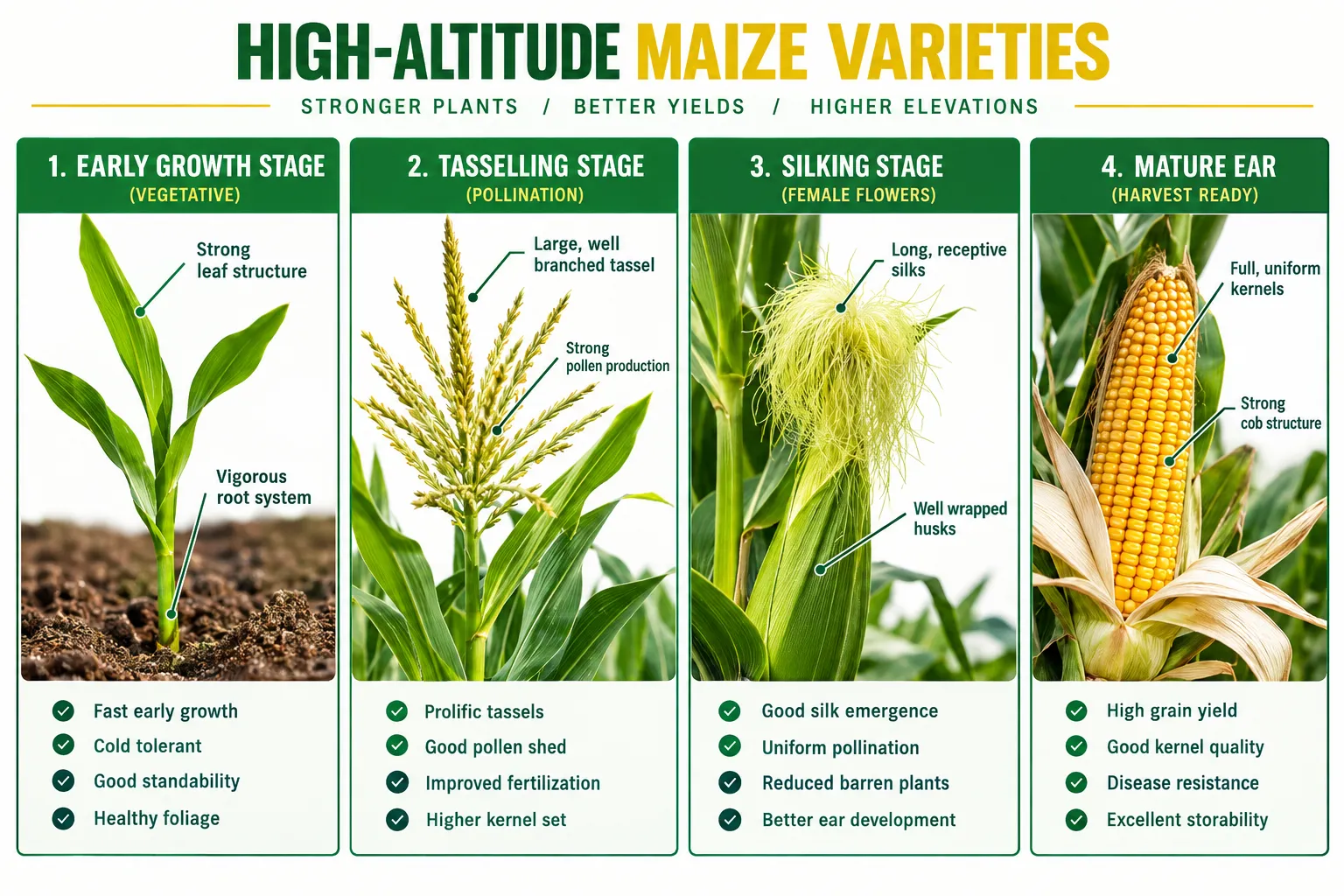
The Kenya Agricultural and Livestock Research Organization (KALRO) officially recommends specific H600 series hybrids, such as H614D, H6213, and H629, for high-altitude, high-rainfall areas [1]. When supported by proper agronomy advice and farm plans, these seeds possess a proven yield potential of 40 to 50 bags per acre [1]. Because they take longer to mature, they draw more nutrients from the soil, making baseline soil testing critical before planting.
Choose the H600 series if you farm in the Rift Valley or Central highlands and experience consistent, heavy rains over a long season. Do not plant these varieties in lower altitudes; the heat and shorter rain cycles will cause the crop to fail before the cobs fully develop.
At Solomon Agri, we constantly see farmers miss their yield targets because they skip basic crop nutrition. High-yielding seeds demand high-performing soil. Let’s chat about getting your soil tested before you buy your high-altitude seeds.
Drought-Tolerant Seeds for Arid and Semi-Arid Lands
Farmers in arid and semi-arid lands (ASALs) must plant early-maturing, drought-tolerant varieties to secure a harvest during short and unpredictable rain seasons. Relying on traditional late-maturing seeds in these zones is a guaranteed path to crop failure.
KALRO maintains and recommends open-pollinated varieties (OPVs) like Katumani Composite B (KCB) and Makueni (DLC) specifically for these dry regions [1]. These varieties are bred for early maturity, reaching harvest in just 90 to 120 days, and require only 250mm to 400mm of rainfall per season [1].
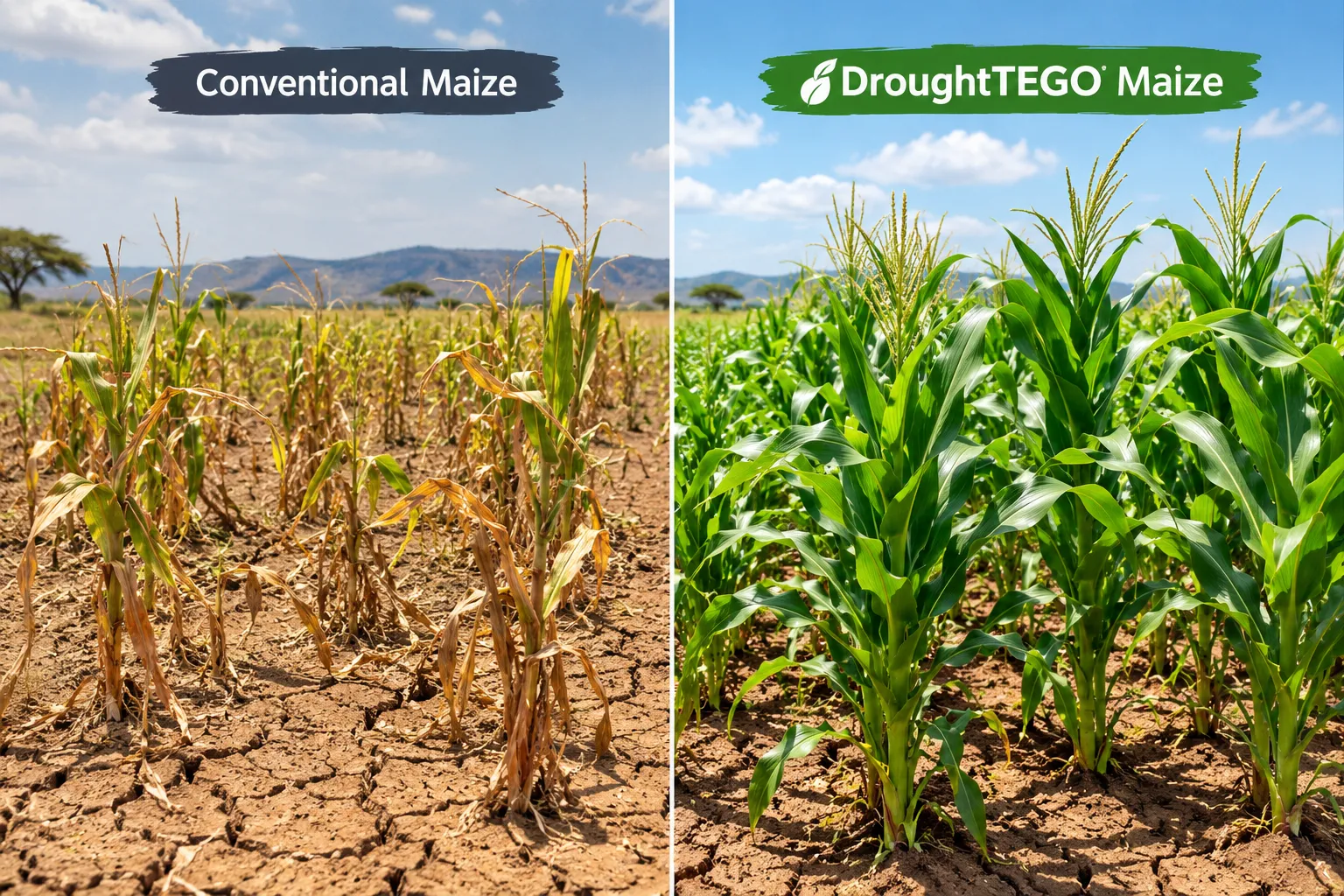
Beyond open-pollinated options, conventional hybrids now offer incredible resilience. Through the Water Efficient Maize for Africa (WEMA) partnership, the African Agricultural Technology Foundation (AATF) deployed DroughtTEGO hybrids (such as WE1101 and WE4127) in Kenya [3]. These conventionally bred varieties provide a 20% to 35% yield advantage under moderate drought conditions compared to traditional commercial hybrids [3]. Additionally, private sector firms like Seed Co Kenya have introduced climate-smart proprietary hybrids, including the ultra-early maturing “Sungura” (SC 419) and the drought-tolerant “Punda” (SC 513) series, targeted at lower mid-altitude zones facing erratic rainfall [7].
If you farm in Eastern Kenya or other ASAL regions, prioritize early maturity over maximum potential yield. A guaranteed 15 bags per acre from a drought-tolerant seed is always better than zero bags from a failed high-altitude hybrid. Pair these seeds with smart irrigation planning to buffer against extended dry spells.
Defending Against Pests and Diseases in Maize
Protecting your maize from destructive pests like stem borers and fall armyworm, as well as viral complexes like Maize Lethal Necrosis (MLN), requires planting resistant seed varieties and utilizing smart field management tactics.
In October 2022, the Kenyan government officially lifted its 10-year ban on genetically modified crops [2]. This allowed the National Biosafety Authority to authorize the environmental release and cultivation of Bt maize (utilizing the MON810 event), which is genetically engineered to provide inherent resistance against the spotted stem borer and fall armyworm [2]. For farmers facing heavy pest pressure, Bt maize reduces the need for expensive and toxic chemical sprays.
For viral threats, the International Maize and Wheat Improvement Center (CIMMYT) partnered directly with KALRO to breed and release MLN-resistant and tolerant maize hybrids [4]. This ensures farmers in the Rift Valley have access to seeds that can withstand this devastating viral complex [4].
If you prefer non-chemical, non-GMO pest control, the International Centre of Insect Physiology and Ecology (ICIPE) integrates specific local and hybrid maize varieties with its “Push-Pull” technology [6]. By intercropping maize with Desmodium (which repels pests) and planting Napier grass borders (which attracts them away from the crop), farmers in Western Kenya simultaneously control fall armyworm, stem borers, and the parasitic Striga weed [6].
The Seed Certification Process in Kenya
Always buy certified seeds that have passed official regulatory trials to guarantee genetic purity, high germination rates, and verified disease resistance. Buying cheap, uncertified grain from local markets to use as seed is the most expensive mistake a farmer can make.
The Kenya Plant Health Inspectorate Service (KEPHIS) serves as the official regulatory body for seed certification [5]. KEPHIS legally requires all new maize varieties to undergo rigorous National Performance Trials (NPT) for a minimum of two planting seasons before commercial release [5]. This testing ensures that the seed you buy actually performs as advertised in your specific ecological zone.
When buying seeds for farming maize in kenya, always check the packaging for the official KEPHIS tag and verification code. Scratch the panel and SMS the code to confirm the seed is genuine. Fake seeds are common in the market, and planting them results in poor germination and massive yield losses.
Essential Soil Fertility Management for Maize
Even the highest-quality certified seed will fail in depleted, acidic soil. Proper soil fertility management and precise crop nutrition are non-negotiable requirements for optimizing your maize yields.
Maize is a heavy feeder. It requires significant amounts of Nitrogen (N), Phosphorus (P), and Potassium (K) to develop strong roots and large cobs. However, applying fertilizer blindly wastes money and can actually harm your soil. If your soil pH is too acidic, the maize roots cannot absorb the fertilizer you apply, meaning your expensive inputs are literally washed away.
This is where expert farm advisory services change the game. At Solomon Agri, we start every successful farm plan with comprehensive soil testing. We tell you exactly what your soil lacks and provide a precise crop care schedule. We help East African farmers stop guessing and start measuring.
Want to stop wasting money on the wrong fertilizers? WhatsApp Expert today and let’s get your soil tested. Grow More. Lose Less. Farm Smarter.
Interactive Maize Yield Estimator
Use this calculator to estimate your potential harvest based on your land size and target bags per acre. This helps in basic farm planning and revenue forecasting.
Maize Yield Estimator
Farm Size (Acres)Expected Bags per Acre (90kg)Calculate Estimate
Conclusion
Farming maize in kenya successfully requires a strategic approach to seed selection, soil health, and pest management. You cannot control the weather, but you can control what you plant and how you feed your soil. Whether you need the high-yielding H600 series for the highlands or the resilient DroughtTEGO hybrids for the ASALs, choosing the right certified seed is your foundation for success.
Remember, a seed is only as good as the soil it grows in. Partner with Solomon Agri for professional soil testing, tailored crop nutrition, and expert irrigation planning. We are dedicated to helping East African farmers optimize their yields and build profitable agricultural businesses. Reach out to our team, get your farm plans in order, and let’s secure your best harvest yet. Grow More. Lose Less. Farm Smarter.
FAQ
What is the best maize seed for high-altitude areas in Kenya?
The KALRO H600 series, specifically varieties like H614D, H6213, and H629, are the best choices for areas 1,500 to 2,100 meters above sea level, offering yields of 40 to 50 bags per acre.
Which maize varieties are best for dry areas in Kenya?
For arid and semi-arid lands, early-maturing and drought-tolerant varieties like Katumani Composite B (KCB), Makueni (DLC), DroughtTEGO hybrids, and Seed Co’s Sungura (SC 419) are highly recommended.
Is GMO maize legally allowed to be planted in Kenya?
Yes. In October 2022, the Kenyan government lifted its ban on genetically modified crops, allowing the cultivation of Bt maize to combat pests like the fall armyworm and stem borer.
How do I know if my maize seeds are genuine?
Always buy seeds certified by the Kenya Plant Health Inspectorate Service (KEPHIS). Check the packaging for the official KEPHIS scratch tag and SMS the code to verify authenticity.
What is Push-Pull technology in maize farming?
Push-Pull is a pest management system developed by ICIPE. It involves intercropping maize with Desmodium to repel pests (push) and planting Napier grass around the field borders to attract them away from the maize (pull).
Why is soil testing important before planting maize?
Soil testing reveals the exact nutrient deficiencies and pH levels of your land. This allows you to apply the correct type and amount of fertilizer, preventing wasted money and ensuring